
Views: 0 Author: Site Editor Publish Time: 2025-06-05 Origin: Site
In today’s global economy, sustainability has become more than just a buzzword — it’s a fundamental priority reshaping how manufacturers operate. Consumers are increasingly aware of environmental issues and actively seek products with a lower ecological footprint. This shift in market demand drives companies to adopt greener packaging solutions to stay competitive and meet evolving customer expectations.
Alongside consumer pressure, regulatory frameworks worldwide are tightening. Governments are imposing stricter guidelines on waste reduction, carbon emissions, and resource management. Companies face increasing scrutiny through Environmental, Social, and Governance (ESG) reporting, where transparent sustainability performance directly impacts investor relations and brand reputation.
Manufacturers that proactively integrate sustainability into their processes benefit from cost savings, enhanced brand loyalty, and reduced compliance risks. Thermoforming technology, especially with advanced equipment like the Model-500, plays a key role in enabling this eco-conscious transformation.
One of the biggest sustainability challenges in packaging is material waste. Thermoforming helps address this through its inherent precision and flexibility in using raw materials.
Thermoforming can create thin-walled products that maintain structural integrity while using significantly less plastic compared to traditional molding methods. This precision reduces raw material consumption, resulting in less plastic entering the supply chain and, eventually, less waste.
For example, the Model-500 thermoforming machine employs advanced control systems that precisely manage sheet thickness during forming, ensuring uniformity and minimizing excess material. Manufacturers can optimize product designs for minimal thickness without sacrificing strength or functionality.
Thermoforming offers highly accurate forming capabilities, which means cut lines and trims can be tightly controlled. This reduces offcuts and scrap materials during production. Unlike bulk molding, where excess plastic is often trimmed away, thermoforming’s efficient material layout improves yield per sheet.
Moreover, scraps from thermoforming processes tend to be clean and consistent, making them easier to recycle back into production streams, thus supporting a circular economy approach.
Thermoforming primarily uses thermoplastics such as PET, PP, and PS, which are widely recyclable. These materials can be reprocessed multiple times without significant degradation of properties, unlike thermoset plastics. By selecting recyclable polymers and using machines like the Model-500 that handle these materials efficiently, manufacturers can produce packaging that fits into established recycling programs.
Energy usage is a significant factor in manufacturing sustainability. Thermoforming machines have evolved to incorporate energy-saving design features that cut power consumption without compromising performance.
Advanced thermoforming machines like the Model-500 include intelligent temperature control systems. Instead of constantly heating the entire forming area, these systems use sensors and software algorithms to apply heat precisely where and when it’s needed. This targeted heating lowers energy waste and shortens cycle times.
Modern heating elements are designed for rapid warm-up and cool-down cycles, improving energy efficiency. Infrared heaters or ceramic-based elements provide consistent heat with minimal power draw. The Model-500’s heating panels are arranged to maximize energy transfer, reducing overall consumption during production runs.
Energy-efficient thermoforming machines implement power-saving modes during idle periods. When the line pauses or demand slows, the system automatically reduces heating and motor power to conserve energy. These features cumulatively reduce the carbon footprint of packaging operations, particularly in facilities with variable production schedules.
The rise of biodegradable and bio-based plastics challenges traditional thermoforming processes, as these materials often have different thermal and mechanical properties.
The Model-500 and similar advanced thermoforming machines are engineered with adjustable heat zones and forming pressures to accommodate sensitive eco-friendly materials like PLA (polylactic acid) and PHA (polyhydroxyalkanoates). This flexibility prevents material degradation and ensures consistent product quality.
Bio-based polymers derived from renewable resources such as corn starch or sugarcane require careful thermal management. Thermoforming machines that offer customizable temperature profiles and adjustable dwell times enable manufacturers to process these materials efficiently, expanding their sustainable packaging options.
Because biodegradable plastics can be more temperature-sensitive, the ability to finely tune heating times and forming cycles is critical. Automated systems in the Model-500 allow operators to program precise parameters for each material type, minimizing waste and avoiding production defects.
Sustainability extends beyond manufacturing; the entire lifecycle of packaging — from production to disposal — matters.
Thermoformed packaging tends to be lightweight, which reduces shipping costs and associated fuel consumption. By optimizing product design with thin-walled thermoforming, companies can cut carbon emissions throughout the supply chain, not just during production.
Thermoformed products provide excellent durability, which can enable multiple uses or repurposing before disposal. Sturdy packaging reduces the need for frequent replacements, lowering overall material usage.
Because thermoforming uses recyclable thermoplastics, packaging produced on machines like the Model-500 integrates easily into recycling streams. This compatibility ensures materials can be recovered and reused rather than sent to landfills or incineration, supporting circular economy goals.
Sustainability starts at the machine level, and manufacturers designing thermoforming equipment have a significant responsibility.
Leading manufacturers focus on creating machines with energy-efficient motors, optimized heating systems, and minimal waste generation. The Model-500 embodies these principles through cutting-edge engineering and eco-conscious design choices.
Sustainable manufacturing requires ongoing support to maintain equipment performance and extend machine lifespan. Comprehensive maintenance programs and timely spare parts availability ensure thermoforming machines remain efficient over many years, reducing the need for premature replacement.
Manufacturers also provide training programs that educate operators on best practices for energy conservation, machine optimization, and sustainable material handling. Well-informed operators can maximize the environmental benefits of thermoforming technology.
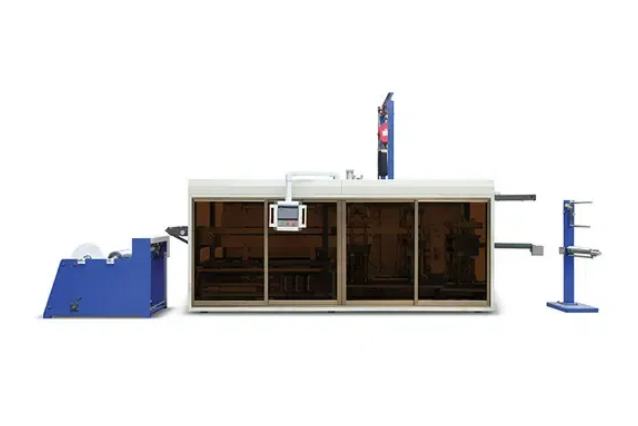
Thermoforming stands out as a powerful manufacturing technology that aligns perfectly with the growing demand for sustainable packaging. By enabling material efficiency, energy savings, and compatibility with eco-friendly polymers, thermoforming machines like the Model-500 help manufacturers reduce environmental impacts while maintaining productivity and product quality.
For businesses committed to green manufacturing, investing in advanced thermoforming equipment is a strategic step toward meeting regulatory requirements, satisfying eco-conscious consumers, and achieving long-term operational savings.
If you want to learn how the Model-500 sustainable thermoforming machine can transform your packaging operations, reduce waste, and boost your green credentials, contact us today to explore tailored solutions that fit your business needs.


