
Views: 0 Author: Site Editor Publish Time: 2025-07-09 Origin: Site
In the modern world of manufacturing, custom trays are used in various industries, ranging from food packaging to medical devices, electronics, automotive parts, and more. Custom trays help organize, store, protect, and display products, ensuring that they are safely transported and conveniently arranged. However, the question remains: how are these trays made with such precision, efficiency, and affordability?
In this post, we will dive deep into how vacuum forming machines are revolutionizing custom tray production. These machines allow manufacturers to produce custom trays quickly, affordably, and with the utmost precision. We'll examine the key benefits of vacuum forming machines, the process behind them, and how they align with modern manufacturing needs. By the end of this post, you’ll have a clear understanding of why vacuum forming machines are indispensable for custom tray production.
Vacuum forming is a highly effective thermoforming process used to shape plastic sheets into three-dimensional products by applying heat and vacuum pressure. In essence, it transforms a flat plastic sheet into a custom-designed tray. This process is both efficient and versatile, making it a popular choice for industries requiring customized, cost-effective packaging and organizing solutions.
Let’s break down the vacuum forming process step by step:
The first and most important step in vacuum forming is the creation of the mold. The mold determines the final shape and design of the custom tray. It is usually made from materials such as aluminum, wood, or 3D-printed plastics, depending on the volume and complexity of the tray design.
The mold’s quality directly impacts the tray’s precision and durability. When creating molds, manufacturers need to consider several factors, such as draft angles (to help with easy removal of the formed part), surface finish, and the addition of venting holes to avoid air entrapment during the forming process.
Once the mold is ready, the plastic sheet is heated to the optimal forming temperature. During this phase, the plastic is placed in a specialized oven that utilizes radiant or infrared heating systems to evenly heat the sheet. ABS, HIPS, PVC, and PETG are some of the commonly used plastics in vacuum forming. Each material requires specific heating conditions to achieve the best results.
Heating must be done uniformly to avoid issues like warping or uneven thickness in the final product. The plastic must become soft and flexible enough to conform to the mold without losing its structural integrity.
Once the plastic sheet reaches the optimal temperature, it is moved over the mold. A vacuum system is then activated, applying suction to pull the plastic sheet tightly over the mold. This ensures that the plastic takes on the exact shape of the mold, with all its intricate details.
The vacuum pressure ensures that there are no air pockets between the mold and the plastic, which is crucial for the tray’s structural integrity and the smoothness of the surface. The vacuum pressure used in this phase usually ranges between 70 and 85 kPa (20-25 inHg), depending on the plastic’s thickness and the complexity of the mold.
Once the plastic is fully conformed to the mold, it must cool and solidify. Cooling ensures that the plastic retains its new shape after the vacuum is released. Cooling can be expedited using forced air or water cooling systems, especially for thicker materials.
Proper cooling is critical because it prevents distortion or warping of the tray after it has been removed from the mold. The cooling phase must be carefully controlled to achieve a uniform solidification process.
Once the plastic has cooled and hardened, the custom tray is removed from the mold. At this point, the tray will have excess material (known as "flash") around the edges. This excess material is trimmed away using precision tools such as CNC routers, laser cutters, or manual trimming.
Additional finishing processes, such as edge smoothing, hole drilling, or surface texturing, may also be applied to meet specific requirements. These steps help ensure that the final tray meets all the desired functional and aesthetic properties.
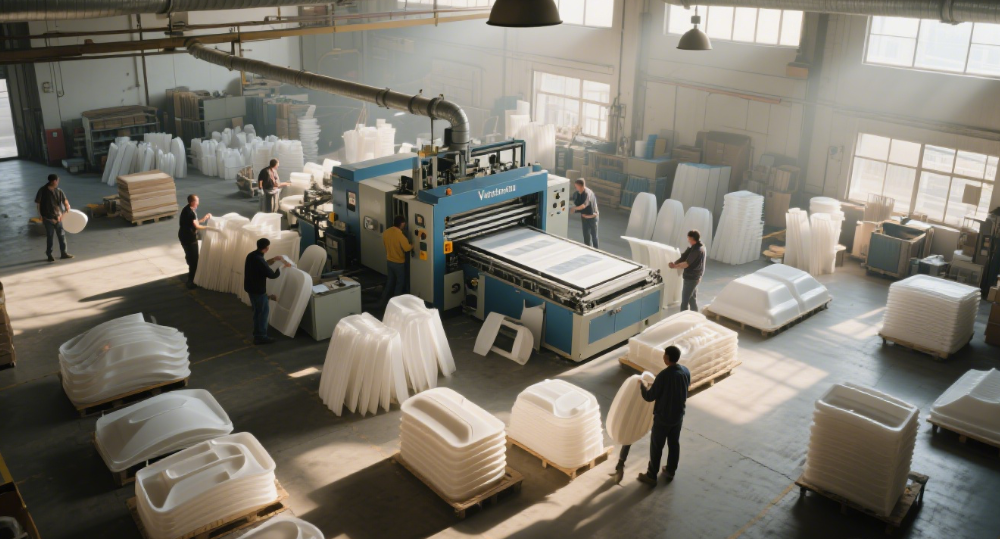
One of the primary reasons manufacturers choose vacuum forming is its cost-effectiveness. Compared to other molding methods like injection molding, vacuum forming requires significantly less investment in tooling. The mold creation process is also faster and more affordable, especially for small to medium production runs.
Moreover, vacuum forming machines are relatively simple to operate and maintain. This reduces both initial investment costs and ongoing maintenance expenses, making vacuum forming a highly attractive solution for businesses of all sizes. The ability to reuse molds also helps reduce production costs, making it a sustainable choice for custom tray production.
In today’s fast-paced manufacturing environment, speed is of the essence. Vacuum forming allows for rapid production cycles. Once the mold is created, manufacturers can produce custom trays quickly and efficiently. The molding process itself can take just a few minutes, and the overall turnaround time is much shorter than other methods like injection molding.
This quick turnaround is especially useful for businesses that require fast prototyping or need to respond rapidly to customer demands. With vacuum forming machines, manufacturers can fulfill custom orders in a fraction of the time it would take using other methods.
Vacuum forming machines are compatible with a wide variety of thermoplastics, such as ABS, HIPS, PETG, PVC, and polycarbonate. The versatility in material selection makes vacuum forming an excellent choice for different industries with unique needs.
ABS is known for its strength, durability, and impact resistance, making it ideal for automotive and consumer goods.
HIPS is commonly used for food packaging trays due to its excellent forming properties and relatively low cost.
PETG is highly favored in food packaging because of its clarity, food-safe nature, and resistance to moisture.
PVC is used in industries that require chemical resistance, such as the medical and industrial sectors.
This range of materials allows manufacturers to choose the best material for their specific needs, ensuring that custom trays meet the necessary functional and aesthetic standards.
One of the standout advantages of vacuum forming is the flexibility it offers in design. Manufacturers can create custom trays with complex shapes, intricate details, and varying thicknesses. Whether the tray is simple or has a complex compartmentalized design, vacuum forming can accommodate almost any requirement.
This level of flexibility is essential for industries that need customized solutions. For example, the ability to create multi-compartment trays for food packaging or trays with precision cutouts for automotive parts is one of the reasons vacuum forming is so popular in these fields.
Moreover, molds can be easily modified or adjusted to accommodate changes in design, making vacuum forming an adaptable solution for ever-changing production needs.
Vacuum forming machines are designed to produce custom trays with high precision and consistency. The vacuum pressure ensures that the plastic sheet evenly conforms to the mold, reducing defects such as warping, thinning, or uneven material distribution.
This level of precision is crucial for industries that require consistent results, such as medical packaging, where precision is critical for ensuring the safety and functionality of medical devices. Vacuum forming offers high repeatability, ensuring that each tray produced meets the same specifications and quality standards.
In the food industry, vacuum forming is commonly used for packaging products such as fruits, vegetables, meats, snacks, and prepared meals. PETG is often used for food trays due to its transparency, durability, and food-safe properties. Vacuum-formed trays not only help protect the food during transportation but also provide an attractive display for consumers. Additionally, vacuum forming can be used to create trays that perfectly fit inside outer packaging, reducing waste and improving storage efficiency.
Custom trays are vital in the medical sector for organizing medical devices, pharmaceutical products, and other essential items. Vacuum-formed trays ensure that these items are securely held in place during storage or transportation. The high precision and consistency of vacuum forming are particularly beneficial in the medical field, where product safety is of the utmost importance.
Materials like ABS and PETG are commonly used in medical trays because they are resistant to high temperatures, sterilization processes, and chemicals. Vacuum forming allows manufacturers to create trays that comply with healthcare regulations while providing optimal protection and easy access to medical tools.
Vacuum-formed trays are widely used in the automotive and electronics industries to transport and store components. Custom trays ensure that each part stays securely in place, preventing damage during shipping or storage. Vacuum forming allows manufacturers to create trays that are both lightweight and durable, making them ideal for protecting sensitive automotive or electronic components.
The ability to design trays that perfectly fit the shape and size of each component ensures that products remain organized and well-protected throughout the entire supply chain.
In the retail sector, vacuum-formed trays are commonly used for packaging consumer products such as electronics, cosmetics, toys, and tools. These trays help secure products in place, preventing damage during handling or transport. They also offer an attractive presentation for retail display, ensuring that products stand out on the shelves.
The flexibility of vacuum forming allows for creative designs, such as decorative compartments or clear trays that showcase the products inside. This versatility is essential for businesses that want to create appealing and functional packaging solutions.
Wenzhou Mingdu Machinery is a leader in the vacuum forming machine industry, offering high-quality machines that are reliable, durable, and customizable. Here’s why Mingdu is the best choice for your custom tray production:
Mingdu’s vacuum forming machines are engineered for high reliability and performance. Whether you are producing a small batch or large-scale production runs, Mingdu’s machines will help you achieve consistent, high-quality results. These machines are built to last, reducing the need for frequent repairs or replacements.
Mingdu understands that each business has unique needs. Their vacuum forming machines are highly customizable, ensuring that you can tailor the machine to your production requirements. Whether you need a machine for prototyping or high-volume production, Mingdu can provide the right solution.
Mingdu’s vacuum forming machines are equipped with the latest technology to ensure precision and consistency in production. From temperature control to vacuum pressure regulation, these machines ensure high-quality results every time.
Mingdu provides expert support throughout the entire process, from installation to ongoing maintenance. Their team of professionals is always ready to assist with troubleshooting, helping you optimize machine performance and minimize downtime.
Custom tray production is made efficient and cost-effective with vacuum forming machines. Whether you're in the food, medical, automotive, or retail industry, vacuum forming provides a reliable, fast, and flexible solution for creating high-quality trays. With the advanced technology and expert support provided by Wenzhou Mingdu Machinery, businesses can meet the growing demands of modern markets while maintaining superior product quality and operational efficiency.
A: A vacuum forming machine heats a plastic sheet until it becomes pliable, then uses vacuum suction to pull the material tightly over a mold, shaping it into a custom tray.
A: Materials like ABS, HIPS, PETG, PVC, and polycarbonate are commonly used for vacuum-formed trays, depending on the specific requirements of strength, flexibility, and clarity.
A: Vacuum forming is known for its rapid production cycle, and custom trays can often be created in just minutes, depending on the complexity of the design.
A: Food packaging, medical equipment, automotive, electronics, and retail packaging industries benefit from vacuum-formed custom trays due to the cost-effectiveness, speed, and flexibility of the process.


