
Views: 0 Author: Site Editor Publish Time: 2026-08-04 Origin: Site
Large part thermoforming is an efficient manufacturing process for producing large plastic covers, housings, trays, panels and structural components from heated thermoplastic sheets. Compared with processes designed mainly for small packaging products, industrial thermoforming must address larger forming areas, deeper shapes, material distribution, mold stability, cooling and trimming. This guide explains the thermoforming manufacturing process, suitable materials, thermoforming draw ratio, mold design considerations and how to select equipment for industrial thermoforming plastic parts.
Key Takeaways
What Is Large Part Thermoforming?
How Does Industrial Thermoforming Work?
Thermoforming Manufacturing Process Step by Step
Materials Used for Industrial Thermoforming
Thermoforming Draw Ratio and Wall Thickness
Thermoforming Mold Design for Large Plastic Parts
Vacuum Forming, Pressure Forming or Both?
How to Choose a Machine for Large Plastic Part Thermoforming
Common Applications
Large Part Thermoforming vs. Other Plastic Processes
Production Quality and Waste Control
Questions to Ask a Thermoforming Machine Supplier
Frequently Asked Questions
Conclusion
Large part thermoforming is suitable for oversized plastic components, covers, housings, panels and shells.
The main process variables are sheet temperature, material thickness, forming depth, draw ratio, vacuum or air pressure, mold temperature and cooling time.
ABS, PP, PET, PS, PVC and PC can be considered for different industrial applications, but the final selection depends on strength, temperature, chemical resistance, appearance and end use.
Good thermoforming mold design requires suitable draft angles, radii, vents, cooling provisions and trimming references.
Vacuum forming is effective for many large and relatively simple shapes, while pressure forming is more suitable for sharp details, textures and tighter dimensional requirements.
Machine selection should be based on the actual sheet size, product dimensions, material, thickness, forming depth, mold type, required output and level of automation.
A complete industrial thermoforming solution should be evaluated through product drawings, material samples, mold trials and finished-part inspection.
Large part thermoforming is a plastic manufacturing method in which a thermoplastic sheet is heated until it becomes flexible and then formed over or inside a mold. Vacuum, compressed air, mechanical pre-stretching or a combination of these methods is used to bring the sheet into contact with the mold surface.
The process is called “large part” thermoforming when the finished component or forming area is significantly larger than the packaging products typically produced on compact machines. There is no single universal size that defines a large thermoformed part. In practice, the classification depends on the product dimensions, sheet size, forming depth, material thickness, mold weight and production requirements.
Large plastic part thermoforming is often selected when a manufacturer needs:
Large surface coverage
Lightweight construction
Faster tooling development
Lower tooling investment than some alternative processes
Good appearance on the visible surface
Low or medium production volumes
The ability to produce different product designs with replaceable molds
Typical industrial thermoforming plastic parts include machine covers, automotive interior components, equipment housings, agricultural panels, transport components, protective guards, appliance liners, large trays and custom enclosures.
The key difference between general thermoforming and industrial large-part production is the level of process control required. A small tray may be formed with relatively simple geometry and short material flow paths. A large housing or panel may require more careful control of heating zones, sheet sag, air evacuation, material stretching, mold temperature, cooling and trimming.
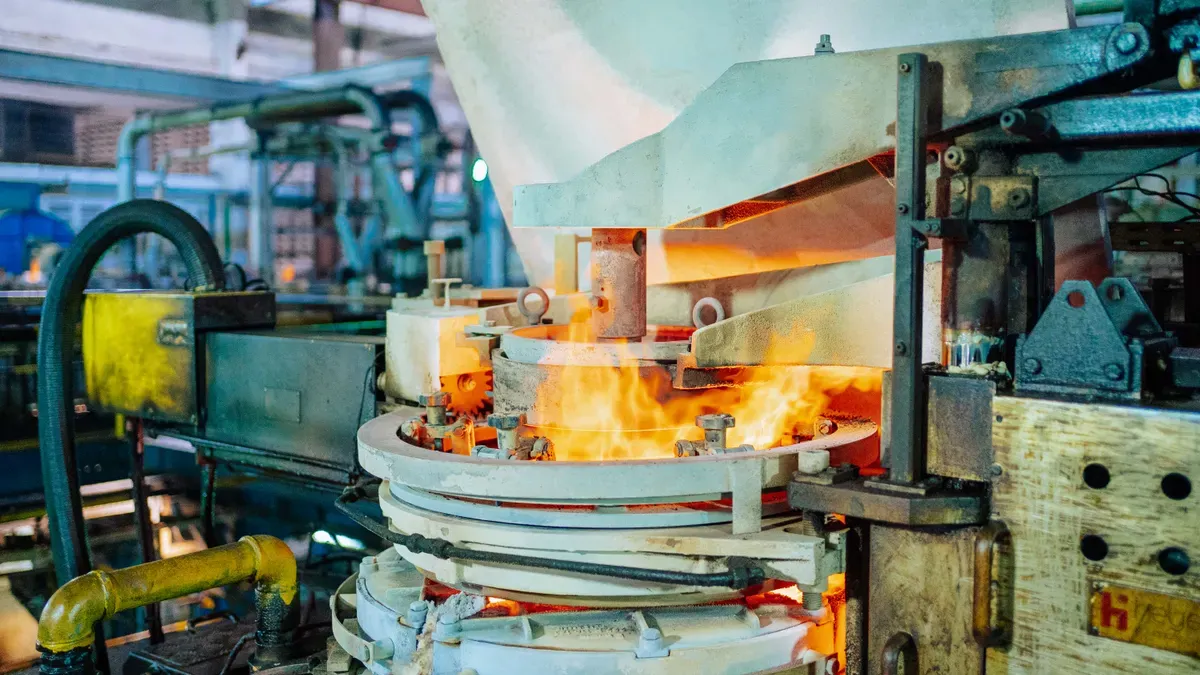
The sheet is first clamped securely so that it does not move during heating or forming. The heating system then raises the sheet temperature to a suitable forming range. The correct temperature depends on the material, sheet thickness, color, additives and product geometry.
After heating, the softened sheet is positioned over or around the mold. A vacuum removes air between the sheet and mold surface. In pressure forming, compressed air is also applied to push the sheet against the mold with greater force. Mechanical tools such as plug assists may be used to improve material distribution in deep or demanding shapes.
Once the sheet has contacted the mold, cooling begins. The part must become rigid enough to retain its shape before it is released. After demolding, excess material is removed by routing, sawing, trimming, punching or another secondary operation. Some production lines integrate forming and cutting into a coordinated sequence.
For manufacturers comparing equipment options, MINGDU provides different forming configurations, including Pressure And Vacuum Forming Machines for applications that require both general forming and improved surface detail.
The process begins with the product drawing and application requirements. Engineers should review the overall length, width and height, forming depth, corner radius, wall thickness, visible surfaces, holes, mounting points and trimming line.
The intended use is equally important. A component used inside a vehicle may require impact resistance and temperature stability. A machine guard may require stiffness and chemical resistance. A protective cover may prioritize appearance and dimensional consistency.
At this stage, the manufacturer should also identify whether the part will be produced from an extruded sheet, a co-extruded sheet, a printed sheet or a sheet with a special surface finish.
The sheet is held around its perimeter by a clamping frame. Stable clamping is essential for large parts because uneven movement can produce wrinkles, webbing or non-uniform wall thickness.
The clamping system should match the sheet dimensions and thickness. It should provide sufficient holding force while avoiding unnecessary marks on the sheet. For repeat production, the clamping reference must remain consistent from cycle to cycle.
Heating is one of the most important stages in the thermoforming production process. The sheet must be soft enough to form but not so hot that it becomes unstable, excessively thin or difficult to control.
Large sheets often require multiple heating zones. Different areas of the sheet may need different heat levels because the product geometry does not stretch uniformly. Corners, deep sections and areas near the mold perimeter may require special attention.
Manufacturers should monitor:
Heater zone temperature
Heating time
Sheet surface temperature
Temperature difference across the sheet
Sheet sag during heating
Material behavior after heating
Infrared heating systems are commonly used because they can be divided into controllable zones. The actual settings should be established through material testing and production trials rather than copied from another project.
Deep or large parts may benefit from pre-stretching before the sheet reaches the final mold surface. Pre-stretching can be achieved through air pressure, a plug assist, a controlled bubble or a combination of methods.
The purpose is to distribute the softened material more evenly. Without sufficient pre-stretching, the material may become too thin at the deepest area while remaining unnecessarily thick near the original sheet perimeter.
Pre-stretching is particularly important when the product has:
Deep cavities
Narrow openings
Long vertical walls
Uneven height
Multiple recesses
Large differences between the highest and lowest points
During forming, vacuum removes air between the sheet and mold. Pressure forming adds compressed air to improve contact between the sheet and mold surface.
The forming stage must be synchronized with the sheet temperature and mold position. If the sheet is too cold, it may not reproduce the mold details. If it is too hot, it may stretch excessively or lose dimensional stability.
For industrial parts, forming quality is affected by:
Vacuum flow
Air pressure
Mold venting
Forming speed
Plug-assist position
Mold temperature
Sheet temperature
Part geometry
Cooling allows the formed part to retain its final shape. Large plastic components may require more controlled cooling because their surfaces and wall sections do not cool at the same rate.
If the outer surface cools too quickly while the inner area remains hot, shrinkage can create distortion or residual stress. Mold cooling channels, air cooling and controlled dwell time may be used depending on the mold structure and material.
Cooling should be evaluated together with productivity. Reducing cooling time may increase output, but it can also cause warping, poor dimensional stability or difficulty during demolding.
The part is removed from the mold after it reaches sufficient rigidity. Draft angles, release design and surface condition all influence demolding.
A large component with insufficient draft may stick to the mold, especially when the material shrinks during cooling. Excessive force during release can damage the part or the mold.
Most thermoformed parts require trimming after forming. The trimming operation removes the flange and creates the final edge.
Depending on the product, secondary operations may include:
Hole punching
Drilling
Routing
Edge finishing
Welding
Bonding
Installation of inserts
Surface decoration
Assembly with other components
The trimming reference should be considered during mold and product design. A poorly defined trim line can lead to inconsistent dimensions and additional manual work.

Material selection directly affects forming behavior, part performance and machine configuration. The same mold may not perform identically with different polymers because each material has its own heating range, shrinkage behavior, stiffness and cooling characteristics.
ABS is frequently considered for housings, equipment covers, vehicle interior components and consumer products. It offers a useful balance of impact resistance, appearance and processability.
An ABS thermoforming guide should address:
Sheet thickness
Surface finish
Heating uniformity
Impact requirements
Color and gloss
Post-forming shrinkage
Trimming method
ABS may be suitable when the part needs a relatively attractive appearance and good practical durability. The final grade should be selected according to the application and operating environment.
PP is lightweight and offers good chemical resistance. It is used in containers, trays, automotive parts and industrial products. However, PP can require careful temperature control because its forming behavior and shrinkage may differ from materials such as ABS or PET.
When using PP, the production team should pay close attention to:
Sheet temperature
Cooling rate
Mold temperature
Part release
Dimensional stability
Required stiffness
PET is widely used in packaging and transparent or semi-transparent products. Depending on the grade and application, it may also be considered for selected formed components.
PET projects should be evaluated for clarity, stiffness, thickness, recycling requirements and compatibility with the heating and forming process.
PS is often used for packaging and disposable products where cost and ease of forming are important. It is more commonly associated with thin-gauge production, although the suitable material range depends on the product and sheet specification.
PVC can provide useful chemical resistance and barrier properties. It may be used for certain packaging and industrial applications. The specific formulation, additives and processing requirements must be reviewed before production.
PC is chosen for applications that require a combination of impact resistance, transparency or higher performance than standard packaging materials. It may require more demanding temperature control and mold design.
When comparing materials, do not select a polymer only because it forms easily. The final decision should also consider:
Impact resistance
Stiffness
Temperature exposure
Chemical contact
Outdoor weathering
Flammability requirements
Surface appearance
Recyclability
Product service life
Total material cost
Thermoforming draw ratio describes how much the sheet must stretch to cover the mold geometry. It is an important design concept for deep-draw and large-part applications.
A simple part with shallow walls usually places less demand on material distribution. A deep part with narrow openings, sharp transitions or multiple cavities may create a much higher stretching requirement.
There is no single draw-ratio value that works for every material and product. The practical result depends on:
The shape of the mold
The opening size
The forming depth
The original sheet thickness
The material’s forming range
The heating profile
Pre-stretching method
Vacuum or pressure level
Corner radius
Cooling conditions
A high thermoforming draw ratio can result in excessive thinning if the process is not carefully designed. The deepest area may become too weak, while other areas retain more material than necessary.
To improve wall-thickness distribution, engineers may use:
A thicker starting sheet
A different sheet size
Zoned heating
Plug assist
Pre-blowing or pre-stretching
Modified mold geometry
Larger corner radii
Adjusted forming speed
Improved venting
A different material grade
Wall thickness should be evaluated at critical locations, not only at the nominal sheet thickness. For industrial thermoforming plastic parts, samples should be measured at corners, deep sections, mounting areas and trimmed edges.
Thermoforming mold design has a direct influence on part quality, cycle time and tooling life. A mold that looks acceptable on a drawing may still create forming or demolding problems if air evacuation, material flow and cooling are not considered.
Draft allows the formed part to release from the mold. The correct angle depends on the material, surface texture, depth, shrinkage and mold type.
Textured surfaces generally require more release consideration than smooth surfaces. Deep vertical walls should be reviewed carefully before the mold is manufactured.
Sharp corners force the plastic to stretch quickly and can cause thin spots, webbing or incomplete forming. Suitable radii help the material flow more evenly and improve the strength of the finished part.
Corner design also affects the appearance of the part. A radius that is too small may produce visible stress or inconsistent surface quality.
Small vent holes or channels allow trapped air to escape from the mold surface. Without adequate venting, the plastic may not fully contact the mold, resulting in soft details, incomplete corners or surface defects.
Venting is especially important in deep pockets, narrow recesses, textured surfaces and areas far from the main vacuum path.
The mold surface determines the appearance of the formed plastic. The design should account for gloss, texture, grain direction, visible flow marks and release behavior.
For cosmetic components, surface consistency is often as important as dimensional accuracy.
Large molds may need integrated cooling channels or another controlled cooling method. Uneven mold temperature can lead to inconsistent shrinkage and warping.
Cooling design should focus on the areas that retain heat longest, such as thick corners, deep sections and reinforced regions.
The mold should include clear references for trimming and downstream operations. The trim line must be compatible with the final installation dimensions.
Early coordination between the thermoforming supplier, mold maker and trimming-equipment provider can reduce rework.
Vacuum forming and pressure forming are both thermoforming methods, but they serve different design and production needs.
Vacuum forming uses vacuum to draw the heated sheet against the mold. It is often suitable for large, relatively simple parts, protective covers, trays, panels and housings.
Pressure forming uses vacuum together with compressed air. The additional pressure can improve contact with the mold and reproduce finer details, sharper edges and surface textures.
A combined pressure and vacuum process may be considered when the part requires both broad forming capability and more detailed surface reproduction. The correct choice depends on the product rather than on the machine name alone.
Application requirement | Preferred forming direction | Main reason |
|---|---|---|
Large shell with relatively simple geometry | Vacuum forming | Efficient forming for broad surfaces |
Part with sharp edges or fine surface details | Pressure forming | Improved contact with the mold |
Deep shape with challenging material distribution | Pressure and vacuum forming with pre-stretching | Better process control for demanding geometry |
High-volume thin packaging | Thin-gauge or multistation production | Coordinated forming and downstream operations |
Custom industrial housing or cover | Application-specific configuration | Product size, material and output determine the machine |
For a more detailed comparison, link this section to the existing vacuum forming process guide. If the product requires sharper details or more controlled surface replication, review the Pressure Forming Machine category.
Machine selection should begin with the product and process requirements. A machine that performs well for thin packaging may not be suitable for a large industrial housing, even if both products are made from thermoplastic sheets.
The usable forming area must accommodate the product, clamping margin, trimming allowance and mold structure. The supplier should evaluate the actual sheet layout instead of relying only on the finished-part dimensions.
The machine should be compatible with the selected material and the full range of sheet thicknesses required for production. Thermoforming material thickness affects heating time, forming behavior, cooling time and finished-part stiffness.
The maximum forming depth, undercuts, ribs, corners, holes and textured areas affect the forming method and mold design. A deep product may require pre-stretching, plug assist or pressure forming.
Large sheets benefit from controllable heating zones. The heating system should provide stable and repeatable temperature distribution across the forming area.
Vacuum capacity, vacuum response and air-pressure requirements should be matched to the mold and material. The supplier should confirm whether the proposed configuration can reach the required forming detail without damaging the sheet.
The machine must support the mold’s size, weight, connection method and cooling requirements. Mold changeover should also be considered if multiple products will be produced on the same equipment.
Cycle time is not determined only by forming speed. Heating, forming, cooling, demolding, trimming and part handling all contribute to the final production rate.
Manufacturers should request a realistic cycle-time estimate based on the actual product, material and mold rather than a general machine specification.
If the part requires repeatable edges or high output, an integrated trimming or automated handling solution may reduce manual work. The right level of automation depends on production volume, product design and labor costs.
For packaging and coordinated forming operations, MINGDU’s Multistation Thermoforming Machine category may be relevant. For thinner sheet applications, review the Thin-Gauge Thermoforming Machine category.
Large part thermoforming is used across industries where manufacturers need lightweight, shaped plastic components.
Applications may include interior panels, door components, wheel covers, console parts, luggage-area components and protective covers. Automotive parts often require consistent appearance, impact performance and repeatable dimensions.
Thermoformed housings can protect pumps, control systems, electrical equipment and production machinery. The design may include ventilation openings, mounting points, access doors and removable panels.
Thermoformed guards can provide lightweight protection around moving equipment. Material selection and design must reflect the required impact, visibility and operating conditions.
Panels, covers, water-management components and equipment enclosures may benefit from corrosion resistance and lightweight construction.
Large liners, covers, panels and internal components can be produced using suitable thermoplastic sheets and molds.
Thermoformed plastic components may be used in transport systems, storage equipment, custom cases and specialty enclosures where low weight and design flexibility are valuable.
Thermoforming is not the best solution for every plastic component. It should be compared with injection molding, blow molding, rotational molding, composite manufacturing and CNC-machined plastic.
Thermoforming can be attractive for large parts, lower production volumes or projects requiring relatively fast tooling changes. Injection molding may be more appropriate for small, detailed parts produced in very high quantities.
Blow molding is designed mainly for hollow products with suitable closed-form geometries. Thermoforming offers more flexibility for open shells, panels, trays and parts that require post-forming trimming.
Rotational molding can produce large hollow products, but its cycle time and tooling approach differ from thermoforming. Thermoforming may offer advantages when the part starts from a sheet and requires a controlled visible surface.
CNC machining is useful for prototypes and low-volume parts, but it may create more material waste when a large component can be formed from a sheet. Thermoforming can reduce machining requirements for shaped shells and covers.
The final choice should consider tooling, production volume, part size, material usage, tolerance, surface finish, assembly and total production cost.
A stable thermoforming production process depends on repeatability. Manufacturers should define quality checkpoints for every major stage.
Important control points include:
Incoming sheet thickness and surface quality
Sheet moisture or storage condition where relevant
Heating-zone performance
Forming temperature
Vacuum and pressure response
Mold temperature
Cooling time
Part dimensions
Wall-thickness distribution
Trim-line accuracy
Surface appearance
Warpage and shrinkage
Packaging and handling
Waste can be reduced through better nesting, correct sheet dimensions, optimized trim lines, stable heating and reduced trial-and-error during production.
However, reducing sheet usage too aggressively may create weak areas or unstable forming. Material efficiency should always be balanced with product performance and acceptable quality.
For a new project, the recommended sequence is:
Confirm the part drawing and application.
Select candidate materials and sheet thicknesses.
Review forming depth and material distribution.
Develop or modify the mold.
Run a forming trial.
Measure the sample part.
Adjust heating, forming, cooling or trimming.
Approve the final process.
Establish production inspection standards.
Before requesting a quotation, prepare as much technical information as possible. This helps the supplier recommend a more suitable machine configuration.
Ask the supplier to confirm:
What is the maximum usable forming area?
What sheet materials can the machine process?
What is the recommended sheet-thickness range?
Can the machine handle the required forming depth?
Is pressure forming, vacuum forming or a combined method recommended?
Is plug assist or pre-stretching required?
How is the heating zone controlled?
How is the mold cooled?
What mold dimensions and weight are supported?
How are parts trimmed after forming?
What level of automation is included?
What production output is realistic for the actual part?
How are samples tested and approved?
What installation, training and after-sales support are available?
Provide the supplier with:
Product drawings
3D files if available
Product dimensions
Material and thickness
Estimated annual or monthly output
Required surface finish
Tolerance expectations
Photos of similar parts
Existing mold information
Factory power and space limitations
A machine recommendation should be based on the complete production requirement rather than on a single keyword such as “large” or “high speed.”
Large part thermoforming is the process of forming large plastic components from heated thermoplastic sheets. It is used for housings, covers, panels, trays, guards and other industrial products.
ABS, PP, PET, PS, PVC and PC may be suitable for different applications. The best choice depends on impact resistance, stiffness, temperature, chemical exposure, appearance, cost and service life.
Draw ratio describes the forming demand created by the relationship between the part depth, opening and available sheet material. A higher forming demand can increase the risk of wall-thickness variation, so pre-stretching, heating control and mold design become more important.
Vacuum forming is often suitable for large parts with relatively simple geometry, broad surfaces and moderate detail requirements. The final suitability depends on the material, product depth, mold design and required dimensional accuracy.
Pressure forming should be considered when the product requires sharper edges, finer surface details, textures or tighter contact with the mold. The machine and mold must be designed for the required pressure and product geometry.
Wall-thickness distribution can be improved through correct sheet sizing, zoned heating, pre-stretching, plug assist, suitable radii, controlled forming speed and proper mold design. Sample parts should be measured at critical locations.
Not necessarily. Some large products use relatively thin sheets, while others require thicker material for stiffness or impact resistance. The appropriate configuration depends on the product function, size, depth, material and required strength.
Output depends on cycle time, number of parts per cycle, sheet layout, trimming, cooling, loading, unloading and machine availability. A realistic estimate should be based on the actual mold and product rather than a theoretical machine speed.
A machine may produce different products when the forming area, material range, mold support, heating system and process requirements are compatible. The supplier should review each mold and product before confirming compatibility.
Large part thermoforming provides a flexible way to manufacture lightweight industrial plastic components with a controlled surface appearance and adaptable tooling. The most important factors are not simply machine size or forming speed. Product geometry, material selection, thermoforming draw ratio, sheet thickness, mold design, heating uniformity, cooling and trimming must work together.
Vacuum forming may be appropriate for many large and straightforward parts. Pressure forming can provide improved detail and surface reproduction. A combined pressure and vacuum configuration may be useful for more demanding geometries. Thin-gauge and multistation equipment may be more suitable for high-volume packaging applications, while custom industrial parts require a solution based on their specific dimensions and production conditions.
MINGDU can evaluate thermoforming projects according to product size, material, thickness, mold and target output. Contact MINGDU and provide your product drawings, sheet material, thickness, forming depth and expected production volume to receive a suitable machine recommendation.


