
Views: 0 Author: Site Editor Publish Time: 2026-09-22 Origin: Site
A shallow food tray, a deep takeaway container and a detailed cup lid may require different forming, cooling, mold and cutting conditions. The right equipment is the one that matches your actual packaging design and production target.
What product will you form?
Which sheet material and thickness will you use?
What production output is actually required?
How will forming, cutting and stacking connect?
A thermoforming machine for food packaging heats a plastic sheet until it becomes flexible, forms the sheet against or inside a mold, cools the formed shape and separates the finished products through cutting or punching.
Typical products include food trays, takeaway containers, lunch boxes, cup lids, bakery packaging, produce trays, meat trays, ready-meal trays and plastic food containers. MINGDU’s food packaging applications also cover cup lids, takeaway packaging and food packaging for fresh produce, bakery, dairy and meat products.
Heated plastic sheet is shaped with a mold, making the process suitable for many thin-wall packaging formats.
Interchangeable molds can support different trays, lids, containers and packaging inserts where the machine configuration allows.
Automatic systems may combine forming, punching, cutting and stacking to reduce manual handling.
Unlike injection molding, thermoforming starts with a plastic sheet rather than molten plastic pellets. It is commonly considered for open trays, lids, containers and packaging inserts. Blow molding is generally associated with enclosed hollow products such as bottles, while thermoforming is often selected for open or shallow packaging products.
The product geometry should determine the machine configuration. Different packaging formats place different demands on forming depth, wall-thickness distribution, cooling, cutting and stacking.
Meat, fruit, bakery, sushi, ready-meal and compartment trays require consistent dimensions, flat flanges and reliable stacking.
Deep containers and lunch boxes require careful control of corners, compartments, material stretching and lid compatibility.
Flat lids, dome lids and straw-slot lids require repeatable forming and clean edges for a stable fit with the cup.
Food trays may be used for meat, fruit, bakery products, sushi, ready meals and other fresh or prepared foods. Buyers should evaluate tray length and width, forming depth, cavity count, corner radius, flange width, nesting, sealing surface quality and wall-thickness distribution.
A food tray must not only have the correct shape. It should also maintain sufficient rigidity, stack consistently and provide a stable surface for sealing, labeling or further packaging operations. The Plastic Food Tray Container Thermoforming Making Machine is one relevant example of an automatic system integrating forming, punching and cutting.
For manufacturers producing food trays, takeaway containers and other open plastic packaging, an automatic thermoforming machine can integrate forming, punching and cutting in one production process.

This machine is designed for automatic food tray and container production, with integrated forming, punching and cutting functions.
View Product DetailsTakeaway containers and lunch boxes often require deeper forming, accurate wall distribution and reliable matching between the container and its lid. Important considerations include product depth, compartment design, lid compatibility, stackability, material stiffness, heat resistance and denesting.
Thermoforming machines can produce flat lids, dome lids, coffee cup lids, transparent beverage lids and lids with straw openings. Other possible formats include bakery packaging, fruit packaging, dairy packaging, meat packaging, transparent inserts and custom food containers.
A typical production line connects several stages. A weakness in one stage can affect forming quality, output, scrap rate and the performance of the finished package.
The sheet is transferred into the forming area with controlled positioning and clamping.
Heating zones soften the sheet to a stable forming range without overheating or uneven stretching.
Vacuum, positive air pressure or a combination of both shapes the sheet against the mold.
The formed packaging is cooled sufficiently to reduce deformation and dimensional changes.
Punching, mold cutting, mechanical cutting or laser cutting separates the products from the web.
Finished products are collected and stacked for inspection, packing or downstream processing.
A machine should be selected from the product drawing and production target, not from a model name or maximum speed alone.
Review the overall product length and width, forming depth, number of cavities, corner radius, draft angle, compartments, sealing edges and nesting requirements. A machine that produces a shallow tray may not be suitable for a deep takeaway container.
The machine must be compatible with the intended sheet material and thickness range. Material selection affects heating temperature, forming pressure, cooling time, transparency, rigidity, sealing performance, product cost and recyclability.
The usable forming area must accommodate the product, mold, clamping margin and trimming allowance. Check the largest forming area, maximum sheet width, maximum forming depth, mold dimensions, cavity count and sheet thickness range.
Compare cycle time, cavities per mold, dies per minute, output per hour, heating time, cooling time, cutting time, stacking time, mold changeover and scrap rate. Actual output should be calculated using the real product and mold rather than a dry-cycle figure.
Vacuum forming may suit simple packaging shapes and shallow trays. Pressure forming can provide sharper detail, stronger definition and improved dimensional control for more demanding geometries. A combined pressure and vacuum system may provide more flexibility across different packaging formats.
Mechanical or mold cutting may suit stable, high-volume products with established tooling. Laser cutting may be considered when a manufacturer needs greater flexibility for customized packaging, rapid changes or reduced dependence on dedicated cutting dies.
If the factory produces several product sizes, check mold replacement time, mold positioning, recipe storage, parameter adjustment and whether the machine can support different packaging formats.
Evaluate how the machine connects with sheet feeding, forming, punching, cutting, stacking, scrap collection, sealing, filling, labeling and case packing. The production line should be considered as one system.
Food packaging buyers should assess dimensional consistency, wall-thickness distribution, flange flatness, sealing surface quality, cleanliness, material traceability and rejection rate. The machine supplier should clarify which requirements are supported by the equipment and which depend on material, mold or plant controls.
Ask about sample testing, mold design support, installation, commissioning, operator training, spare parts, warranty terms, troubleshooting and downstream integration.
The suitable equipment direction depends on the packaging geometry, production volume, material range and level of automation required.
| Production Requirement | Suitable Equipment Direction | What to Verify |
|---|---|---|
| Shallow trays and simple packaging | Vacuum or pressure and vacuum forming | Forming depth, material distribution and product release |
| Detailed packaging with sharper features | Pressure forming machine | Pressure control, mold detail and dimensional repeatability |
| High-volume trays, lids and containers | Thin-gauge or multistation thermoforming machine | Sheet range, cavity count, output and changeover |
| Forming, punching, cutting and stacking in one line | Automatic multistation machine | Station synchronization and downstream handling |
| Several product sizes | Machine with interchangeable molds | Mold replacement time and recipe management |
| Flexible cutting requirements | Laser cutting or integrated cutting system | Material compatibility, edge quality and operating cost |
For high-volume thin packaging, review MINGDU’s Thin-Gauge Thermoforming Machine category. For integrated high-output production, the Multistation Thermoforming Machine category provides a more relevant equipment direction.
Material selection should be completed together with machine selection because each sheet material behaves differently during heating, forming and cooling.
| PET | Often considered when clarity, stiffness and product visibility are important. |
| rPET | May be considered when recycled content is part of the packaging strategy. Sheet quality and process stability should be validated. |
| PP | May be selected for certain containers and applications requiring higher heat resistance. |
| PS | Can be considered where formability, rigidity and cost are important factors. |
| PLA | May suit selected packaging applications with specific sustainability objectives and processing requirements. |
| Other | PVC, BOPS and HIPS may be suitable for particular product designs and machine configurations. Confirm actual suitability through testing. |
Before comparing quotations, prepare a specification sheet that connects the machine parameters with the actual packaging product.
For example, one MINGDU customizable pressure sheet thermoforming machine lists a 500 × 400 mm forming area, a maximum depth of 90 mm, a sheet thickness range of 0.10–1.50 mm and a stated production rate of 10–30 dies per minute. These figures belong to that particular model and should be compared with the buyer’s own packaging drawings and production target.
Review the customizable pressure sheet thermoforming machine for food packaging page for a concrete example of the type of specifications that should be checked.
When food packaging requires controlled forming depth, detailed geometry and flexible production settings, a pressure sheet thermoforming machine may be a suitable option.
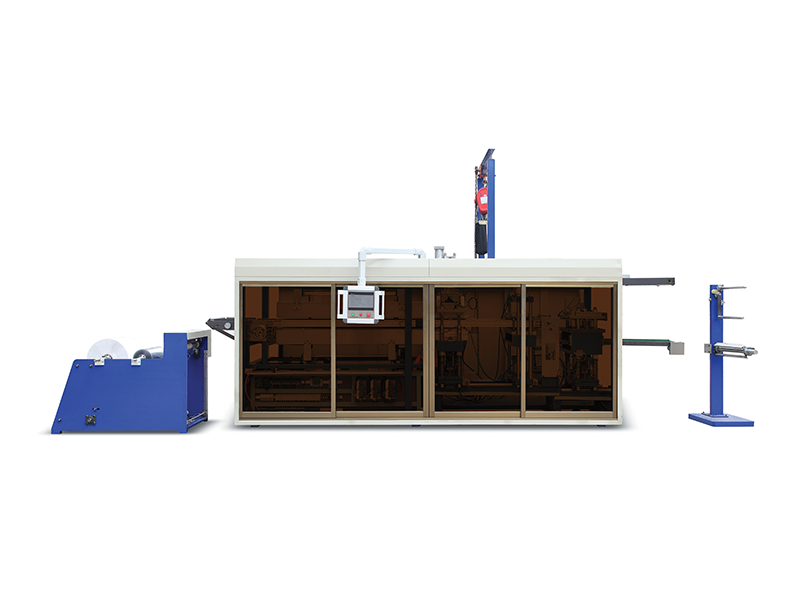
The machine provides a 500 × 400 mm forming area, a maximum forming depth of 90 mm, a sheet thickness range of 0.10–1.50 mm and a stated production rate of 10–30 dies per minute.
View Product DetailsThe total cost of a thermoforming machine includes more than the initial purchase price.
Compare actual output per hour, cavity count, cycle time and planned operating efficiency.
Review sheet utilization, trim layout, scrap rate and the possibility of controlled trim recovery.
Include mold changeover, maintenance, troubleshooting, cleaning and product change time.
Other costs may include mold investment, cutting tools, energy, labor, spare parts, product rejection, installation and training. A lower-cost machine can become more expensive to operate if it creates excessive scrap, requires long manual handling or experiences frequent downtime.
For high-volume food packaging, the best commercial result may come from a machine that provides stable heating, consistent forming, reliable cutting, fast mold changeover and low rejection rather than the highest theoretical speed.
A detailed supplier discussion should be based on your actual product and production requirements.
Prepare the following information before requesting a quotation:
Product drawings and dimensions
Material type and sheet thickness
Required output
Number of product cavities
Forming depth and cutting requirements
Stacking and downstream production requirements
Expected future products
Then ask the supplier:
Can the machine process the required material and sheet thickness?
What is the expected output for the actual product and mold?
Can forming, punching and cutting be completed in one production cycle?
How long does mold replacement take?
Can the supplier provide a sample test before ordering?
Which components and services are included in the quotation?
Is installation and operator training available?
What spare parts should be purchased?
Can the machine integrate with downstream equipment?
What production data will be reviewed during acceptance testing?
The best machine depends on the product, material, sheet thickness, forming depth, production volume and cutting requirements. A thin-gauge multistation machine may suit high-volume trays and lids, while a pressure forming machine may be better for packaging requiring detailed shapes or tighter dimensional control.
In some cases, a machine with interchangeable molds can produce different trays, lids and containers. The product dimensions, material range, mold size, forming depth and cutting method must be compatible with the machine.
Common materials may include PET, rPET, PP, PS, PLA, PVC, BOPS and HIPS, depending on the machine and product requirements. The material must also be evaluated for the intended food-contact application and applicable regulations.
Vacuum forming uses vacuum force to draw the heated sheet against the mold. Pressure forming adds positive air pressure to improve detail and dimensional definition. The appropriate method depends on product geometry, surface requirements and production targets.
Scrap can be reduced through suitable sheet dimensions, efficient cavity layout, stable heating, accurate forming, optimized cutting, proper mold design and controlled trim recovery. Actual scrap performance should be verified during sample testing.
Some thermoforming machines are designed to process recycled materials such as rPET, but actual performance depends on the material grade, sheet quality, thickness, heating profile and product requirements. Trial production is recommended before final confirmation.
Share your packaging drawing, material, sheet thickness and target output with MINGDU. The machine configuration can then be evaluated against your actual product and production requirements.
Contact MINGDU


