
Views: 0 Author: Site Editor Publish Time: 2026-08-04 Origin: Site
You use thermoforming products daily.
The thermoforming process shapes plastic sheets. It uses heat and mold pressure. Then, workers trim the edges.
Ancient workers started this forming idea. They heated natural tortoise shells.
Later, mid-20th-century makers added vacuum systems. This made production much faster.
Today, vacuum forming is top. It holds 70% to 75% of global market uses.
Market Metric | Value |
|---|---|
2024 Market Size | USD 1,197 Million |
2032 Projected Size | USD 1,635.6 Million |
Forecast Period Growth (CAGR) | 3.98% (2024–2032) |
Note: Quick heat and vacuum pressure changed an old craft. It became a modern industrial power.
This dependable process makes strong items. It quickly builds sturdy containers. It also crafts tough car panels.
Early workers heated shells to make simple tools.
They made items like spoons and hair combs.
Chemists made plastic sheets in the nineteenth century.
These synthetic sheets replaced rare natural goods.
World War II sped up plastic creation.
Workers heated acrylic sheets for strong plane windows.
Today, thermoforming uses heat to shape soft plastic.
Vacuum suction and air pressure push sheets onto molds.
One-sided molds cut start costs by ninety percent.
They cost less than old injection molds.
Fast machines and smart tools speed up factory output.
Infrared heaters and robots help trim products quickly.
Engineers pick plastics like ABS for clear product needs.
They also use Polycarbonate and recycled PET.
Thermoforming makes strong boxes, car parts, and farm tools.
This process helps support green plastic recycling efforts.
You can trace thermoforming back thousands of years. Early workers learned how heat changes natural items. They set rules that modern factories use today.
You may ask how ancient people shaped hard items. Crafters gathered animal horns and shells from nature. These natural materials have keratin. Heat softens keratin fast. Crafters placed items in hot water. They also held items near fire. High heat softened hard stuff. Soft material became easy to bend.
Soft horn let makers bend sheets into new forms. Makers pushed warm sheets into wood molds. They used simple tools. Clamps held the cooling sheet tight. The cold locked the shape. You see old thermoforming in historic combs. Lantern windows used it too. Spoon handles also used it. Early workers proved a big idea. Heat and pressure reshape flat items into 3D goods.
Inventors made better items in the 1800s. Charles Goodyear made rubber strong in 1839. Workers got gutta-percha from trees. Hot water softened it. Cold water hardened it. Makers used heat to shape resin. They made cable covers and cool decor. These new items reacted well to heat. The thermoforming industry grew very fast.
Engineers made fast press machines during industrial times. Metal tools stamped warm sheets into matching shapes. This step replaced slow hand methods.
Chemists changed natural items into semi-synthetic options. Check key 19th-century material steps in this table:
Inventor / Chemist | Material Breakthrough / Process | Resulting Semi-Synthetic Polymer |
|---|---|---|
John Wesley Hyatt & Isaiah Hyatt | Chemical modification of cellulose mixed with camphor under heat and pressure | Celluloid (1869/1870) |
Count Hilaire de Chardonnet | Transforming cellulose into cellulose nitrate and spinning into fiber | Chardonnet silk (1890) |
Early Chemists (Braconnot, Parkes, Hayward, etc.) | Broad chemical manipulation and modification of natural polymers (e.g., cellulose, natural rubber) | Vulcanized rubber, Parkesine, Galalith, Rayon |
These strong materials replaced costly natural horn. Factories stamped plastic sheets fast. They made daily items quickly. Modern thermoforming uses these early ideas every day. You can see modern bases in old heat methods.
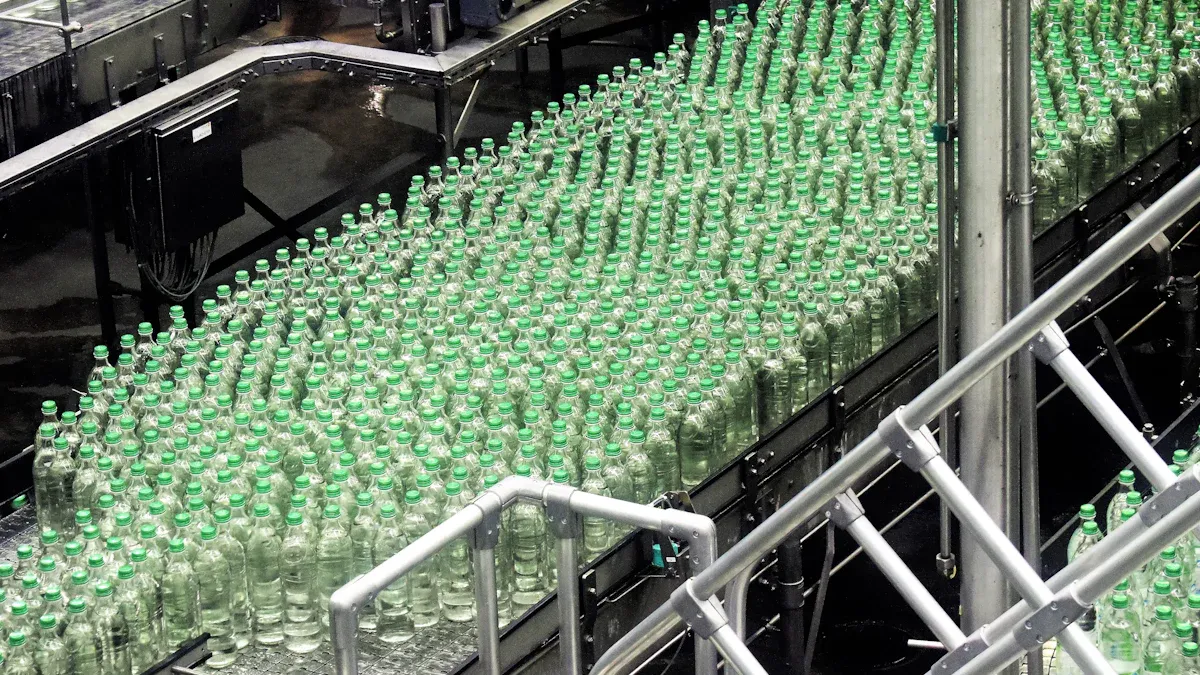
You see thermoforming in daily items.
The thermoforming process shapes plastic sheets.
First, heat makes a flat sheet soft.
Next, stretch the warm sheet over molds.
Then, cool it down.
Last, cut away extra edge parts.
This process builds light food boxes.
It crafts car interior panels.
It makes protective equipment cases.
Factories love this fast method.
It works with great speed.
You can build new sample parts fast.
You can test new designs quickly.
Full production starts without long delays.
Modern machines help businesses of all sizes.
You choose vacuum or pressure methods.
Vacuum tools pull soft sheets down.
Air suction holds sheets on molds.
Pressure methods add air from above.
Air pushes soft sheets tight.
Every mold detail gets filled nicely.
Thermoforming saves money for your shop.
It gives high design freedom.
You get sharp details for less cash.
Note: Pressure methods make clean, sharp surfaces. They keep tooling budgets very low.
Here are major pressure system perks:
Single-Sided Tooling: Systems use simple single-sided molds. You avoid double-sided metal dies. This cuts starting tool costs fast.
Cosmetic Quality: You can make big, complex parts easily. Items keep great visual appeal. Tooling costs stay low.
Check key performance facts below:
Aspect | Mechanism / Feature | Performance Comparison |
|---|---|---|
Sharp Aesthetic Detail | Combines vacuum drawing with positive back air pressure (up to ~9.8–12.25 psi) to push plastic into mold contours. | Picks up precise grain textures, tight styling radii, and smooth finishes that rival injection molding quality. |
Tooling Cost Reduction | Utilizes simpler, single-sided tooling designs rather than complex dual-sided closed molds. | Tooling costs can be up to 90% less expensive than traditional injection molding tooling. |
Automated systems boost modern factory output.
Continuous sheet feeds move plastic along.
Heaters warm raw sheets constantly.
Sensors check temperatures across sheets.
Smart tools stop material waste.
They protect total item quality.
Today, thermoforming builds great plastic items cheaply.

Horn and rubber helped early makers. Natural items lacked steady quality. Makers wanted synthetic items. Modern plants started with man-made plastic.
Synthetic items began in 1862. Alexander Parkes made Parkesine. He mixed cellulose with acid and liquids. Parkes heated the soft mix. He pressed it into molds.
Parkesine hardened as it cooled. It kept its shape well. The item shrunk over time. Parkes failed to sell it. Still, he proved a big idea. Man-made plastic replaces natural horn.
John Wesley Hyatt fixed this in 1869. Hyatt added camphor to cellulose nitrate. Heat and pressure made Celluloid. It became the first useful plastic sheet.
Tip: Celluloid changed plant work forever. Workers heated and bent flat sheets safely.
Celluloid offered great bend choices. Makers built combs and film rolls. It burned fast near fire. Still, it opened thermoforming doors.
Workers shaped Celluloid by hand. Imagine their daily work. First, workers warmed sheets in hot water. Steam tables softened items too. Heat made plastic soft.
Next, workers set soft sheets on wood. Hand clamps pushed sheets down. Plastic took the wood shape. Cold water chilled the sheet. The material hardened fast.
[Warm Sheet] ---> [Manual Mold Press] ---> [Cold Water Lock] ---> [Finished Shape]
Engineers built metal tools for speed. They created cavity mold methods. Metal halves squeezed soft sheets. The lower mold held the shape. The top piece pushed plastic down.
This process built hollow toys easily. Air pressure helped form items. Workers blew air between warm sheets. Air expanded plastic in closed molds.
Early steps set plastic rules. Pioneers built plastic roots long ago. Modern fast tools use these rules. Heating sheets led to modern plastic work.
Pioneer | Key Material Invention | Primary Processing Method |
|---|---|---|
Alexander Parkes | Parkesine (1862) | Heat softening and hand pressing |
John Wesley Hyatt | Celluloid (1869) | Heat stamping and blow-cavity molding |
World War II changed plastic making forever.
War needs forced fast new sheet steps.
Factories needed quick ways to build parts.
World War II made advanced steps urgent.
Military needs created fast technical leaps.
Thermoforming joined many big industries.
It helped make new plane parts.
It improved acrylic processing.
It brought new vacuum pressure methods.
It also refined mold tools.
Wartime speed turned hand steps modern.
Military leaders needed combat planes fast.
Old metal methods were too slow.
Factory workers used warm plastic sheets.
They heated sheets over basic shapes.
Workers built deep parts in minutes.
This work built modern thermoforming molds.
It also created fast production lines.
Pilots needed clear sky views.
Heavy glass windows blocked pilot vision.
Glass also added bad weight.
Engineers shaped clear sheets into bubbles.
Planes adopted these clear thermoformed covers:
Supermarine Spitfire: Used acrylic glass for sleek canopy covers.
Avro Lancaster: Added acrylic turrets for defense guns.
Boeing B-17 Flying Fortress: Used tough acrylic for gun covers.
These clear shapes helped gunners see.
Engineers made large thermoforming molds.
Molds held large plastic bubbles tight.
Check this structural change table below:
Military Operational Need | Technical Advantage of Acrylic (PMMA) | Structural Design Impact |
|---|---|---|
Unobstructed 360° Visibility | Very clear material without color. Better than standard glass. | Removes dark support frames. Mounts right into light aluminum tracks. |
Protection from Elements & Altitude | Great weather hold, heat resistance, and chemical safety. | Allows smooth, sealed crew covers. Fits cockpits, noses, and blisters. |
Combat Vulnerability & Weight Constraints | Weighs under half of glass. Handles impacts much better. | Helps build big, complex 3D thermoformed parts within plane weight limits. |
PMMA, or acrylic, became the top choice.
Standard glass failed in harsh combat.
Bullets broke glass into sharp pieces.
Acrylic beat old glass in tests:
Feature / Criterion | PMMA (Acrylic) | Traditional Glass |
|---|---|---|
Impact Resistance | About 10 to 17 times higher than regular glass. | Much lower strength. Shatters very easily. |
Fracture Behavior | Breaks into dull-edged pieces under high stress. | Shatters into sharp, dangerous shards. |
Medical Outcome for Pilots | Secondary injuries led to much better recovery. | Sharp shard cuts caused severe flight crew danger. |
Wartime Adoption | Standard for WWII plane canopies, windows, and turrets. | Replaced in combat plane covers due to safety rules. |
Acrylic sheets softened nicely under heat.
Workers pulled warm acrylic over wood.
The material stayed clear after cooling.
This proved plastic met strict standards.
Factory workers upgraded tools after war.
New markets wanted cheap plastic goods.
Makers built automated tools to replace levers.
They added vacuum pumps and air pressure.
Inventors built specialized thermoforming tools in 1950.
Companies introduced machines with built-in heaters.
Track the early machinery pioneers here:
Inventor / Key Figure | Company / Entity | 1950s Commercialization & Machinery Role |
|---|---|---|
E. Bowman (Bow) Stratton | Industrial Radiant Heat Corp. / Auto-Vac Corp. | Showed early vacuum forming tools at the 1952 National Plastics Exhibition; later started Auto-Vac Corp. to build tools. |
J.E. Kostur | Comet Corp. | Created engineered vacuum forming tools right after 1952 shows. |
David Zelnick | Atlas Corp. (now Zed Corp.) | Made commercial vacuum formers in Rochester, NY. |
Gaylord Brown | Brown Machine Co. (in partnership with Dow Chemical & Maryland Cup) | Built automated continuous sheet thermoforming and trim tools for mass cups in late 1950s. |
These new tools boosted plant speed.
Operators loaded plastic on auto tracks.
Electric heaters softened plastic fast.
Automated clamps held sheet edges flat.
Early shops used simple drape forming.
Workers stretched warm sheet over molds.
Gravity pulled soft sheets down.
This early method made thin corners.
[Warm Plastic Sheet] ---> [Air Vacuum Drape] ---> [Pneumatic Air Blast] ---> [Sharp Finished Part]
Engineers fixed thin walls with air.
They made vacuum forming for hollow molds.
Air pumps removed air under sheets.
Suction pulled plastic tight on metal.
Later, engineers added pressure forming methods.
They pushed compressed air on top.
Air blasts hit 100 psi.
This air drove plastic into corners.
Pneumatic valves worked fast.
Workers increased speed and quality.
Air methods enabled mass package production.
They built fridge liners and signs.
Wartime needs made simple heat modern.
Modern vacuum forming uses these foundations.
They deliver top speed and quality.
Today, plants use precise plastic shaping daily.
You see big tech gains in thermoforming steps.
You follow four main thermoforming steps to build parts.
First, clean dust off flat plastic sheets.
Next, electric heat panels warm the sheet up.
Radiant heaters warm sheets evenly without thin spots.
Good heat yields an ideal soft sheet.
Next, tools press soft plastic against cold molds.
Use vacuum tools to pull sheets down.
Add pressure forming to push top details.
Plugins push thick plastic into deep mold holes.
These forces build precise, exact part shapes.
Plastic cools down fast inside mold tools.
Water lines chill tools to freeze shapes fast.
Pneumatic clamps release cold parts.
Next, workers move parts to trim edges.
Computer tools trim extra plastic edge waste.
Note: CNC tools perform key heavy-gauge trims for major shops:
Precision Trimming & Material Removal: Cuts waste, shapes edges, and drills holes.
Quality & Repeatability: Keeps tight limits, sharp edges, and high quality.
Automated & Flexible: Uses robots to handle custom parts easily.
Automated lines replaced slow old hand steps.
See how factory tools changed over time:
Stage of Evolution | Workflow & Technical Characteristics | Key Innovations / Capabilities |
|---|---|---|
Manual Methods | Rely heavily on manual labor; operators manually heat sheets, stretch them over molds, and apply vacuum/pressure and trimming. | Basic heating elements; low precision, labor-intensive, and inconsistent output. |
Semi-Automated Systems | Introduces mechanical assistance to diminish heavy manual dependency and enhance production uniformity. | Automatic clamping frames, mechanical presses, and rudimentary control setups. |
Fully Automated Lines | Manages the complete production cycle (heating, shaping, cooling, trimming, stacking) with minimal operator involvement. | Computerized controls, ceramic/infrared precision heating, robotic material handling, real-time sensor feedback loops, and rapid tool adjustments. |
New thermoforming tools use ceramic and infrared heaters.
These items offer cool plant perks:
Energy Efficiency: Infrared tools boost energy use by 20% to 30%.
Thermal Control: They keep heat steady within ±2°C.
Cycle Time Reduction: Fast heat softens plastic to save time.
Fast inline tools raised factory output speeds fast.
Continuous tools drive fast mass making:
Continuous Automated Flow: Roll sheets move through stations without stopping.
Elimination of Manual Handling: Smart tools remove hands between steps.
Optimized Throughput: Inline setups cut cycle times up to 70%.
Shops choose special thermoforming materials for tough jobs.
High Impact Polystyrene (HIPS) offers cheap, easy shapes.
Acrylonitrile Butadiene Styrene (ABS) gives high strength for car panels.
Factories use polyolefin items in plant work.
High-Density Polyethylene (HDPE) gives high chemical resistance for packing.
Polypropylene (PP) adds top heat safety for food boxes.
These items boost plant reuse choices.
High-grade plastics handle hard plant duties.
Check key facts for these two polymers:
Material | Key Performance Characteristics & Advantages |
|---|---|
Polycarbonate (PC) | • Exceptional impact resistance and toughness (virtually unbreakable) |
PETG | • High impact strength combined with excellent optical transparency |
Engineers pick these options to build strong gear.
Modern thermoforming methods help build great parts fast.
Today, these methods offer cheap choices everywhere.
You can change your ideas into real plastic items.
Modern plants use early heat ideas.
They solve hard plant problems today.
Early makers shaped natural items by hand.
Now, a custom thermoforming manufacturer builds tough goods.
They work with great precision.
Farmers need strong tools for daily work.
Outdoor jobs need tough material choices.
The thermoforming process makes heavy parts.
They resist bad weather and sun.
They stop chemical leaks too.
Farmers use many thermoforming uses daily.
This keeps daily farm tasks running well:
Heavy-Duty Watering Troughs: Big plastic troughs take hard animal hits. They hold clean water without leaks.
Nursery Flats: Light trays support young plants. Workers move plants across farms easily.
Seed Trays: Thin trays hold seeds well. They save greenhouse space fast.
Custom thermoforming molds make tools fast.
Growers get tools for many seasons.
Note: Thermoforming uses give high outdoor strength. They protect farm cash and cut costs.
Early workers used basic vacuum tools in war.
Today, top plant methods serve global markets.
Old thin and thick methods drive packing.
They help car makers today too.
Industry | Gauge Type | Historical Origin | Modern Product Application |
|---|---|---|---|
Food & Medical | Thin-Gauge Sheet | Manual Celluloid Stamping | Disposable Clamshell Containers |
Automotive & Transport | Heavy-Gauge Sheet | WWII PMMA Canopies | Interior Dashboard Panels |
Modern plants use fast thermoforming tools.
These machines stretch soft sheets over dies.
Smart tools check every heat step.
This setup boosts plant work speed.
It cuts raw material costs nicely.
You see clear plastic boxes in stores.
Fast lines build safe food covers.
We deliver smart packaging for daily goods.
This keeps items safe during moves.
Shops want green packing to save earth.
Plants recycle scrap plastic to save items.
Medical packaging keeps tools very clean.
It cuts total material use fast.
Car makers need strong parts that fit.
Modern thick methods shape tough plastic panels.
The process builds engine covers and doors.
It makes car dash parts with care.
Engineers choose thermoforming tools to cut costs.
These methods lower tool costs fast.
You get big perks from thermoforming today.
You get fast work and design choices.
Our team builds custom plastic parts daily.
We offer custom plant answers for shops.
These smart methods save big time.
You get cheap plastic parts that work.
Call our experts to start now!
You trace thermoforming from old crafts to modern systems.
20th-century pioneers turned basic heat into smart workflows.
Today, fast machines heat sheets, shape parts, and trim.
This quick process boosts eco-friendly factory work everywhere.
Plants use green resins to raise product recycling.
Thermoplastic Material | Industrial Application & Impact | Mechanical Sustainability |
|---|---|---|
rPET | Cuts demand for virgin resins in packaging applications. | Retains structural integrity across reprocessing cycles. |
PP & HDPE | Enables repeated mechanical reprocessing for manufacturing. | High recyclability for long-term material durability. |
Old heat methods drive modern thermoforming success now.
Heat a flat sheet. Soften the plastic. Stretch it over molds. Use vacuum air suction. Air pressure also works. Cool the warm plastic down. It takes a new shape. Trim extra edge parts fast. Automated tools cut waste.
Ancient workers heated animal horn. They boiled natural tortoiseshell too. Hot water softened items fast. Fire heat worked well. Keratin inside became soft. People pressed soft stuff. They used simple wood tools. Workers made old combs. They crafted early spoons. They built clear lantern windows.
War needs forced fast steps. Factories needed plane covers quickly. Clear plastic covers saved weight. Workers warmed hard acrylic sheets. They built clear cockpit windows. They shaped defense gun turrets. War created modern vacuum tools. It set better mold rules.
Vacuum tools pull sheets down. Air suction holds soft plastic. Pressure tools add top air. Compressed air pushes plastic hard. Soft sheets fill tight corners. This method builds sharp details. You get clean part surfaces.
Factories use strong plastic types:
HIPS: Saves cash and shapes easily.
ABS: Fights hard hits on cars.
HDPE & PP: Blocks safe heat and chemicals.
PC & PETG: Stays very clear and strong.
Thermoforming saves starting budget money. Single-sided tools cut setup costs. You avoid costly metal dies. Tool costs drop fast. Save up to 90 percent. You test sample designs quickly. You get high shape freedom.
