
Views: 0 Author: Site Editor Publish Time: 2025-06-20 Origin: Site
In today’s fast-evolving industrial landscape, manufacturers constantly face the challenge of adapting to shifting market trends, new regulations, diverse product requirements, and the ever-growing demand for efficiency and sustainability. To stay competitive, production equipment must not only deliver high quality and throughput but also possess the flexibility to accommodate these dynamic changes.
Automatic thermoforming machines have become an indispensable tool for manufacturers who seek to future-proof their production lines. With their advanced automation, modular design, and upgrade paths, these machines enable businesses to swiftly respond to changing industry demands while maintaining optimal performance.
At Wenzhou Mingdu Machinery, we have focused on perfecting thermoforming technology for over 15 years, providing highly adaptable and reliable equipment tailored to diverse industrial needs. In this article, we will explore why automatic thermoforming machines are key to meeting today’s and tomorrow’s manufacturing challenges.
Before delving into adaptability, it’s important to understand the key features that define an automatic thermoforming machine.
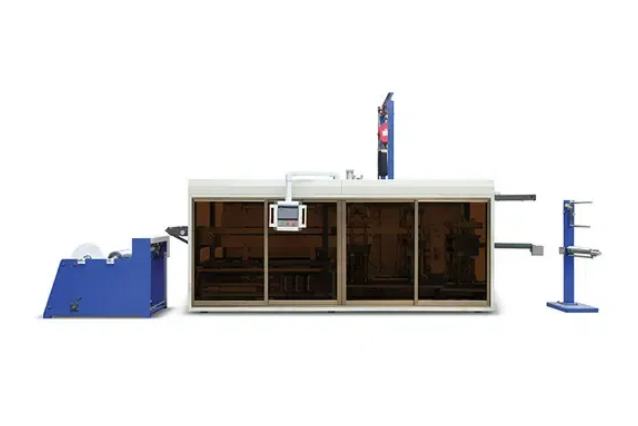
Unlike manual or semi-automatic thermoforming equipment, automatic thermoforming machines incorporate multiple intelligent components working in harmony to maximize efficiency and reduce human error.
Automatic Feeders: Continuously feed plastic sheets or films with high precision, ensuring smooth material supply. This minimizes downtime and maximizes production speeds.
Stacking Systems: Automatically collect and organize finished products post-forming and trimming. Automated stacking reduces handling time and prevents damage, which is crucial for fragile or high-value items.
Integrated Sensors: Equipped with sensors to monitor temperature, pressure, sheet positioning, and cutting accuracy in real-time. This data ensures consistent product quality by detecting and correcting deviations immediately.
Modern automatic thermoforming machines come with user-friendly touchscreens and control panels. These interfaces offer:
Intuitive navigation for machine setup, monitoring, and troubleshooting.
Real-time production data display and error alerts.
Remote access capabilities for off-site monitoring and software updates.
Such HMIs simplify operation, allowing even less experienced operators to maintain stable production and reduce training costs.
Industries such as packaging, automotive, medical, and electronics are under constant pressure to innovate. New product designs, stricter regulations, and sustainability demands require equipment that can keep pace.
One of the most critical innovations in automatic thermoforming machines is their modular design. This means the machine is composed of interchangeable functional units, such as:
Heating modules
Forming stations
Cutting units
Stacking and packaging sections
This modularity allows manufacturers to:
Upgrade or replace specific parts without purchasing an entirely new machine.
Integrate the latest technologies (e.g., laser cutting) seamlessly.
Adjust machine size and functionality according to production needs.
This approach significantly reduces capital expenditure over the machine’s lifecycle and enables businesses to adapt quickly to market changes.
Automatic thermoforming machines today are equipped with embedded controllers and support remote firmware and software upgrades. This means manufacturers can:
Implement new features and process improvements without hardware replacement.
Enable connectivity with Industry 4.0 systems for real-time data analytics, predictive maintenance, and process optimization.
Improve energy efficiency and reduce downtime through smart diagnostics.
With software-driven adaptability, your thermoforming machine evolves alongside your business, ensuring long-term relevance.
Manufacturers often face unique challenges based on their product portfolio and production scale. Automatic thermoforming machines cater to this with extensive customization options.
Fast mold changes are essential for businesses producing multiple product types or running short batches. Advanced machines offer:
Quick mold-change systems that minimize downtime, sometimes reducing changeover from hours to under 30 minutes.
Adjustable mold holders to fine-tune part dimensions, thickness, and geometry during production runs.
Support for various mold types, including vacuum forming, pressure forming, and plug assist.
With growing interest in sustainable materials and specialized applications, machines must handle diverse substrates:
Rigid plastics such as PET, PP, HIPS, and ABS.
Flexible films and bio-based, compostable materials.
Variable thickness sheets in a single production batch, enabling broader product ranges without changing equipment.
This flexibility supports rapid product development and eco-friendly initiatives.
Automation goes beyond faster machines; it fundamentally transforms labor dynamics and operational cost structures.
Automated feeding, forming, trimming, and stacking drastically reduce errors caused by manual intervention:
Enhanced consistency in product quality.
Reduced scrap rates due to misfeeds or misalignments.
Lower material waste, supporting sustainability goals.
Though automatic thermoforming machines represent upfront capital expenditure, they generate long-term savings by:
Reducing the number of required operators.
Shortening training time with easy-to-use interfaces.
Increasing uptime and throughput, leading to higher per-shift output.
The capital investment translates into better labor efficiency and improved profitability over the machine’s lifecycle.
Automatic thermoforming technology is widely adopted across sectors demanding agility, precision, and quality.
Packaging needs are ever-changing, influenced by marketing trends, regulatory compliance, and sustainability. Flexible thermoforming machines enable:
Rapid switches between package types and sizes.
Use of recyclable or biodegradable plastics.
Production of high volumes with consistent quality to meet demand surges.
In medical device manufacturing, precision and hygiene are paramount. Automation provides:
Accurate, sterile trays and housings.
Reliable compliance with strict regulatory standards.
Quick adaptation to new product lines driven by healthcare innovations.
Consumer products such as electronics and home appliances benefit from:
Ability to produce complex shapes and high-quality finishes.
Efficient small batch production alongside mass manufacturing.
Integration with assembly or finishing lines for streamlined workflows.
Automatic thermoforming machines offer unmatched flexibility, efficiency, and scalability, enabling manufacturers to stay competitive amid rapid market changes. Their modular design and advanced automation reduce downtime, support diverse materials and products, and lower labor costs, making them a smart long-term investment. To maximize your production’s adaptability and ROI, upgrading to a reliable, customizable automatic thermoforming machine is essential—contact us today to explore how our solutions can meet your evolving industry demands.


