
Views: 0 Author: Site Editor Publish Time: 2026-09-12 Origin: Site
Transitioning from contract packaging to in-house production marks a major operational shift. Upgrading legacy equipment is often necessary to handle increasing SKU variability in modern retail environments. We understand the pressure to scale production efficiently without disrupting current shop-floor workflows.
Capital expenditure on packaging machinery always carries distinct integration risks and hidden technical challenges. You might face extended downtime if the newly acquired equipment fails to match your required production scale. These integration setbacks inevitably disrupt supply chains and compromise product launch schedules.
This article provides an objective, engineering-focused evaluation framework. We will help you assess vital equipment specifications accurately. You will learn how to verify plastic blister production line for retail packaging performance and shortlist a reliable partner without relying on exaggerated vendor claims.
Evaluating the base frame design dictates future scalability. Modular lines offer distinct operational advantages. They provide dedicated physical space between stations. Operators gain easier access for deep cleaning and mechanical troubleshooting. You can add custom inspection stations or secondary feeders later. Monoblock systems take a different approach. Engineers integrate all stations into a single continuous chassis. They occupy a significantly smaller physical footprint. The internal mechanics maintain tighter synchronization between forming and cutting phases. Maintenance crews often find monoblock systems harder to service due to dense internal cabling.
Modern equipment relies heavily on drive architecture. Selecting a plastic blister forming line requires analyzing motion control. Servo-driven precision represents the industry gold standard. Servo motors monitor position feedback continuously. They maintain exact film tension across the entire web. This prevents micro-tearing in thinner plastics. They require minimal physical maintenance. Pneumatic systems offer a cheaper initial alternative. They actuate moving parts using compressed air cylinders. Pneumatics consume massive volumes of plant air. Seals wear out rapidly under high-cycle conditions. Stroke consistency degrades as air pressure fluctuates.
The heating method directly impacts pocket clarity. Creating a perfect thermoformed blister pack requires precise thermal management. Multi-zone contact heating pushes heated plates directly against the film. It guarantees rapid energy transfer. It works exceptionally well for flat, consistent material runs. Radiant heating uses infrared elements positioned above and below the web. Radiant systems do not touch the film physically. They allow gradual, uniform heat penetration. This matters when thermoforming thicker plastics. It prevents surface scorching while keeping the core pliable.
The sealing station fuses the protective layer to the formed base. Roller sealing utilizes continuous rotary motion. It applies heat and pressure seamlessly. Roller mechanisms achieve extremely high speeds. They suit flexible lidding films perfectly. Platen sealing presses flat heated plates together. It provides longer dwell times. Retail backing cards demand this extended thermal exposure. The adhesive needs time to activate properly. Following sealing, the blanking station separates the packs. Precision die-cutting mechanisms must shear cleanly. Ragged edges ruin retail presentation.
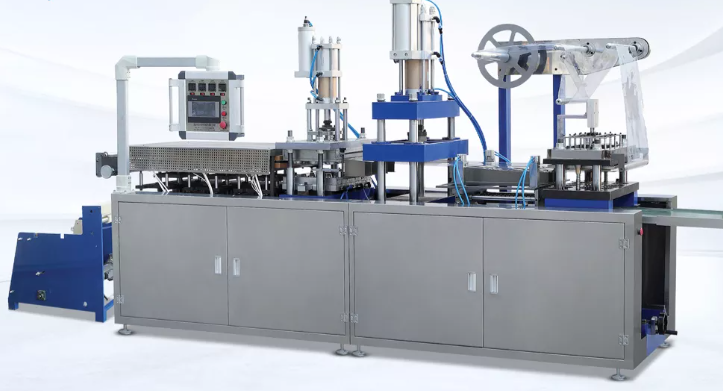
Retailers demand sustainable packaging solutions rapidly. You must transition from traditional PVC to PET or RPET. Machines respond differently to these polymer changes. PVC features a wide processing window. It softens easily and shrinks predictably. PET demands highly accurate thermal controls. It possesses a narrower glass transition phase. Overheating PET causes crystallization and brittleness. RPET contains recycled flakes. It requires higher cutting forces during the blanking stage. Your cutting dies will wear out faster. Operators must adjust heating profiles aggressively.
Retail packaging integrates diverse lidding materials. A robust machine handles more than just standard aluminum foil. High-security consumer goods often utilize Tyvek. Tyvek requires specific sealing temperatures to avoid melting the fibers. Alu-foil provides excellent moisture barriers for sensitive items. It seals quickly under roller pressure. Retail paperboard remains the standard for hanging displays. Paperboard absorbs ambient moisture. It demands intense platen pressure to activate the blister coating. Your equipment must switch between these materials smoothly. Dedicated unwinding spindles must regulate varying tension levels automatically.
Table 1: Material Behavior in Thermoforming Operations
| Material Type | Heating Window | Forming Characteristics | Cutting Tool Wear Rate |
|---|---|---|---|
| PVC | Wide / Forgiving | Excellent deep draw capability | Low |
| PET / APET | Narrow / Strict | High clarity, prone to webbing | Medium |
| RPET | Variable | Inconsistent shrinkage behavior | High |
| Tyvek (Lidding) | Low Temp Range | Requires precise tension control | Minimal |
Forming depth dictates the physical limitations of your packaging. You must define the maximum draw ratio early. Large retail consumer goods require deep pockets. Pushing material deep into a mold causes wall thinning. Corners become fragile if the plug assist mechanism fails. Small hardware or electronics require shallow, highly detailed cavities. Evaluate the plug assist material carefully. Teflon-coated plugs prevent sticking during deep draws. Optimize the vacuum distribution inside the mold. Proper air evacuation ensures crisp corner definition on deep forms.
Retail environments demand extreme flexibility. You will manage dozens of distinct SKUs weekly. Focusing purely on top operating speed is a mistake. Prioritize tooling changeover efficiency instead. We recommend aiming for sub-30-minute changeovers. True efficiency relies on tool-less mechanisms. Operators should use quick-release levers rather than wrenches. Poka-yoke design prevents incorrect mold insertion. Fast changeovers maximize available production time. Lengthy setup procedures erode your daily output severely. Evaluate a retail blister packaging machine solely on its ability to swap formats swiftly.
Manual feeding limits machine capability instantly. Automated feeding systems eliminate human bottlenecks. Assess the fragility and shape of your retail products carefully.
Choose the feeder that matches your product geometry exactly. Incorrect feeding causes high scrap rates and constant machine jams.
Inline inspection prevents defective products from reaching consumers. Relying on manual spot checks proves inadequate. Modern lines require integrated vision systems. High-speed cameras capture every indexed web segment. The software algorithms detect empty pockets instantly. They identify misaligned retail cards before the sealing station. Vision systems inspect seal integrity by reading thermal signatures. The machine must track defective packs through the line. It ejects them automatically after the punch station. This guarantees zero defects enter your shipping cartons.
Evaluate your facility layout realities before purchasing. Machines require specific utility clearances. You must supply chilled water for mold cooling. You need clean, dry compressed air for pneumatic valves. Measure your doorway access dimensions accurately. If your retail goods cross into cosmetics or nutraceuticals, GMP compliance applies. GMP execution demands sloped stainless steel surfaces. Enclosed cabling prevents dust accumulation. HEPA filter integration ensures positive air pressure over the feeding zone. Verify ISO cleanroom classifications with the manufacturer early.
Machine brochures highlight theoretical "cycles per minute". These numbers rarely match shop-floor realities. Overall Equipment Effectiveness (OEE) reveals the true operational truth. Minor stoppages destroy daily yields. You must identify common bottlenecks accurately. Product feeding systems jam if dimensional tolerances vary. Scrap web rewinding frequently causes tension faults. If the waste matrix snaps, the entire line halts. Operators spend minutes re-threading the scrap film. We advise monitoring these micro-stops aggressively. Demand performance guarantees based on continuous run times, not burst speeds.
A blister machine never operates in isolation. It feeds secondary packaging equipment. Linking the blister output creates complex engineering challenges. Output conveyors must match the infeed speed of end-of-line cartoners. Unsynchronized transfers cause product pile-ups. You need dynamic buffer zones between machines. Accumulators hold excess blisters temporarily if the cartoner faults. Checkweighers verify complete carton contents downstream. Case packers aggregate the final boxes. Every digital handshake between these distinct PLCs must function flawlessly.
Advanced machinery introduces steep learning curves. Your current operators may lack specialized automation experience. Human-Machine Interface (HMI) design determines troubleshooting success. Poorly designed HMIs confuse technicians. Screens should display color-coded fault zones immediately. Recipe management must remain intuitive. Recalling a saved format should set temperatures and speeds automatically. Clearing film jams remains a manual task. Guards must open easily. Operators need clear physical access to the forming stations. Extensive factory training minimizes this initial skill gap.
Aftermarket support defines long-term operational success. Evaluate the true capability of your chosen packaging line supplier thoroughly. Domestic spare parts availability is critical. Shipping proprietary components from overseas delays production for weeks. Investigate their remote diagnostic capabilities. Engineers should access your PLC securely via VPN. They can troubleshoot logic faults without traveling. Review preventive maintenance Service Level Agreement (SLA) clauses. Insist on guaranteed response times for critical line-down events.
Acquiring a high-performance blister line represents a comprehensive ecosystem purchase. It goes far beyond a standalone machine acquisition. You are integrating a complex network of heating, forming, and feeding technologies. Material constraints dictate your mechanical requirements. Automation limits determine your daily throughput.
We recommend standardizing a strict Request for Proposal (RFP). Demand clear OEE guarantees under continuous load conditions. Request detailed utility consumption data for accurate facility planning. Establish comprehensive tooling specifications for future SKU expansions. Vague vendor estimates invite severe operational bottlenecks later.
Prepare your product CAD files and precise material samples today. Use these assets to initiate a formal capability study. Establish a rigorous Factory Acceptance Test (FAT) protocol with your shortlisted suppliers. Physical testing eliminates theoretical assumptions entirely.
A: A realistic timeline spans 4 to 8 months. The first phase involves mechanical engineering and custom mold design. Manufacturing and assembly typically require 12 weeks. The FAT process takes another week. Site installation and site acceptance testing add the final month.
A: Yes, but it requires specific thermal and mechanical adjustments. PET demands tighter heating zone controls to prevent crystallization. You must upgrade cutting dies to handle the increased shear force required by tougher sustainable plastics.
A: Request detailed case studies of similar retail integrations. Require a live FAT using your actual packaging materials and products. Vet their localized aftermarket support network rigorously by checking spare parts inventory levels.
A: Industry benchmarks dictate a typical scrap rate between 5% and 10%. This depends heavily on your specific web layout. Modern edge-to-edge punching technology minimizes the waste matrix, reducing overall material waste significantly.


