
Views: 0 Author: Site Editor Publish Time: 2026-09-09 Origin: Site
The shift from traditional mechanical die-cutting to laser-integrated thermoforming marks a turning point for modern manufacturing. Manufacturers increasingly need zero-tooling changeovers, pristine edge quality, and rapid prototyping. High-volume packaging requires constant adaptation to shifting retail demands. Traditional blades often struggle to meet these demands without causing significant downtime. Every minute spent changing a heavy steel die cuts directly into your daily production quotas.
For packaging engineers and procurement teams, evaluating this new equipment requires a deep understanding of the underlying technology. You must grasp exactly how thermal forming and optical cutting interact within a single automated line. This interaction dictates everything from cycle speeds to safety protocols. We provide a transparent breakdown of the entire mechanical workflow and material limitations. You will also learn how production efficiencies compare directly to legacy systems. This knowledge helps you make highly informed equipment upgrades for your facility.
Modern packaging lines demand seamless synchronization. An automatic thermoforming machine with laser cutting delivers exactly this. It merges two traditionally separate processes into one continuous flow. We can break this complex operation into four distinct stages.
Web-fed thermoplastic rolls begin the journey. Servo-driven pin chains index the heavy material rolls through the machine. These advanced chains maintain strict tension across the entire web length. Dimensional stability is critical here. Even minor sagging or stretching can drastically misalign the downstream laser path. Precise tension control ensures every part forms and cuts exactly to specification.
Infrared or ceramic heaters precisely raise the plastic to its specific forming temperature. Operators program distinct heating zones to ensure uniform temperature distribution. Once pliable, the heated sheet enters the forming station. Integrating a robust pressure forming packaging machine module forcefully pushes the sheet into the mold. This captures high-definition textures and complex structural geometries. While vacuum forming remains common, positive pressure forming yields much sharper corners and rigid sidewalls.
The web then moves directly into the enclosed cutting station. Instead of striking a heavy mechanical press, a multi-axis CNC or galvanometer-steered CO2 laser takes over. A galvanometer uses rapidly tilting mirrors to steer the beam at incredible speeds. Optical sensors continuously read fiducial marks printed or formed on the web. They dynamically adjust the laser path in real-time. This dynamic shift compensates for natural material shrinkage or minor web drift. The laser smoothly cuts the formed parts out of the web without ever physically touching the plastic.
Robotic pick-and-place systems gently remove the finished parts. They stack them neatly for final quality inspection and automated boxing. Meanwhile, the skeletal waste rewinds tightly onto a secondary spool or drops into a heavy-duty shredder. You can easily recycle this cleanly cut scrap for future material runs. The lack of blade crush ensures the scrap remains perfectly reusable.
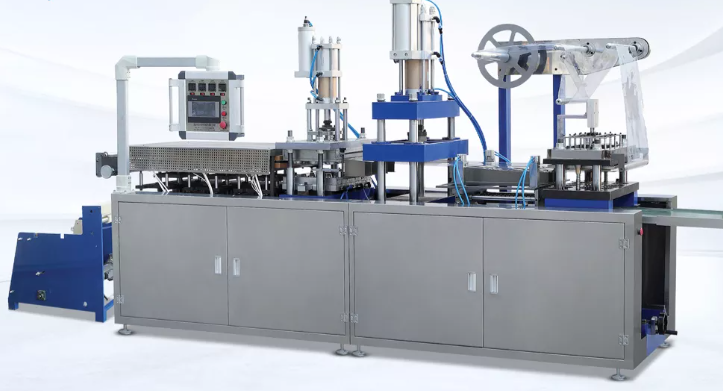
Mechanical presses have dominated packaging production lines for decades. However, the modern laser trimming thermoformer solves many inherited flaws. Let us look closely at how these two distinct manufacturing methods compare.
Mechanical dies physically degrade over time. Dull blades crush the plastic before they cut it. This crushing action causes "angel hairs," micro-dust, and highly irregular rough edges. This poses a massive operational risk. Dust contamination routinely ruins medical and food packaging batches. Such defects lead to costly recalls. Laser cutting completely vaporizes the material upon contact. It seals the edge cleanly as it cuts. This thermal sealing eliminates cross-contamination risks entirely. It meets the strictest cleanroom standards.
Custom steel-rule dies require massive physical storage space. They demand regular, expensive blade maintenance. Manual installation requires wrenches, alignment checks, and significant machine downtime. Conversely, you change laser profiles instantly using advanced CAD/CAM software. Operators simply load a new digital vector file from the control screen. The machine is completely ready for the next SKU in seconds. This flexibility allows for highly profitable short-run production.
Physical steel blades struggle with intricate curves, tight corners, and dense part nesting. Lasers easily execute incredibly complex geometries. You can program micro-perforations and variable data marking directly into the cut file. Mechanical blades physically cannot achieve or withstand these intricate details during high-speed production runs.
Comparison: Mechanical Die-Cutting vs. Laser Trimming
| Feature | Legacy Mechanical Die-Cutting | Laser Trimming Thermoformer |
|---|---|---|
| Edge Quality | Prone to micro-dust and "angel hairs" | Sealed, clean, zero-dust edges |
| Setup Time | Hours (physical die installation) | Minutes (digital file loading) |
| Tooling Maintenance | High (blade sharpening, physical storage) | Low (lens cleaning, software updates) |
| Design Flexibility | Limited by physical blade bending | Unlimited (complex curves, micro-cuts) |
You cannot simply cut every polymer with a concentrated thermal beam. Understanding exact material reactions is strictly vital for safe, high-yield laser cut plastic packaging.
Never run Polyvinyl Chloride (PVC) through a laser-equipped system. Lasering PVC instantly emits toxic chlorine gas and hydrochloric acid. These highly corrosive fumes rapidly destroy sensitive machine optics and corrode internal metal mechanics. More importantly, they pose severe, legally actionable occupational health risks to your facility operators.
Focal length realities directly dictate your maximum cutting depth. Lasers naturally lose cutting efficiency on exceptionally thick gauge plastics. Kerf straightness diminishes as the beam penetrates deeper into the material, creating a slight "V" shaped edge. Thin-gauge packaging responds best to optical cutting. If you process extremely thick extruded sheets, consult your equipment manufacturer. They can recommend specialized focal lenses or higher-wattage tubes.
Upgrading your production line requires careful, methodical technical evaluation. Keep these core procurement criteria in mind when drafting your requirements.
Assess your required line speed and expected material thickness. CO2 laser wattage typically ranges from a modest 100W to over 400W. Higher wattage allows significantly faster indexing speeds. A 400W system easily slices through denser plastics without ever slowing down the primary forming cycle. Do not underpower your machine to save initial costs.
Industrial chillers keep the laser tube at an optimal operating temperature. Heavy-duty HEPA and activated carbon filtration systems are absolutely non-negotiable. They protect operator respiratory health. They also actively prevent vaporized plastic fumes from coating and ruining sensitive machine optics.
Thermal distortion often occurs naturally after the plastic leaves the hot mold. You absolutely need closed-loop camera systems. These vision cameras detect slight web shifts or shrinkage dynamically. They feed positional data back to the laser controller instantly. The software then dynamically adjusts the cutting path just milliseconds before the laser fires.
Evaluate your available factory floor space. Some facilities strongly prefer an all-in-one, integrated chassis design. Others benefit greatly from system modularity. You might retrofit compact, modular laser cutting stations onto an already existing thermoforming line. Consider which layout ultimately minimizes your factory disruption during installation.
Adopting laser technology introduces entirely new operational dynamics to your facility. Factory managers must proactively prepare their teams for this technological shift.
Lenses and mirrors require incredibly strict maintenance schedules. Vaporized plastic off-gassing easily clouds optics if your extraction system underperforms even slightly. Dirty optics drastically reduce your effective cutting power. They cause jagged edges, incomplete cuts, and ruined packaging batches. Operators must clean lenses daily using approved optical-grade wipes.
Laser safety remains paramount. Your machinery must strictly meet Class 1 laser safety enclosure standards. Ensure your equipment features CE or FDA-compliant fail-safe interlocks. These magnetic interlocks immediately disable the high-power beam if an operator accidentally opens an access panel during production.
This transition fundamentally shifts your daily labor requirements. Operators no longer rely on heavy wrenches, mallets, and steel dies. Instead, they need high-level digital proficiency. They must expertly manage CAD files, adjust focal lengths, and tune complex laser parameters. Invest heavily in comprehensive initial software training for your key floor staff.
We must acknowledge the premium initial purchase price of laser-integrated systems. However, you should frame your expectations around tangible, long-term production gains. You permanently eliminate custom die purchases. You experience zero die-crush material waste. You achieve significantly faster time-to-market for custom prototypes. These daily operational wins typically justify the initial capital investment quite quickly.
A laser cutting thermoforming machine fundamentally shifts your entire packaging production strategy. It moves operations from a rigid, heavy mechanical process to an incredibly agile, digitally driven workflow. This advanced technology suits high-mix, low-to-medium volume runs perfectly. It thrives on complex part geometries and cleanroom-grade medical packaging where particulate dust is wholly unacceptable. However, we do not recommend this setup for operations entirely reliant on PVC materials. Ultra-high volume, low-margin runs might also still favor traditional die-cutting purely based on raw punching speed. Your next step is exceptionally clear. Consult directly with an experienced application engineer. Run a comprehensive material test matrix using your specific plastic gauge and composition before you issue a formal RFQ to any manufacturer.
A: It depends heavily on the complexity of the cut and your laser wattage. While the laser cycle is often slightly slower than a massive multi-cavity punch press, it quickly makes up for lost time. Zero-minute changeovers and the elimination of blade maintenance keep your overall daily throughput highly competitive.
A: Yes. You can integrate modular inline laser stations. However, this requires seamless synchronization. You must connect the continuous or indexing web feed directly with the laser's vision system. This integration ensures the system accurately compensates for material shrinkage and maintains incredibly tight tolerances during operation.
A: The kerf width typically falls between 0.1mm and 0.3mm. This precise measurement depends on your focal lens and the material thickness. A narrow kerf allows for incredibly tight nesting of parts on the web. Tighter nesting drastically reduces skeletal scrap and maximizes your material yield.


