
Views: 0 Author: Site Editor Publish Time: 2026-01-30 Origin: Site
Can thermoforming plastics be reshaped? Many wonder if it's possible to alter the shape of thermoformed parts after they've cooled and hardened. In this article, we’ll dive into the science behind thermoforming and discuss the challenges and techniques involved in reshaping plastics.
Thermoforming is a widely used manufacturing process that involves heating a plastic sheet until it becomes pliable, allowing it to be molded into a desired shape. The process typically begins by heating the plastic to a specific temperature, softening it so that it can be shaped. Once the plastic reaches the right temperature, it is formed over a mold using either a vacuum or pressure. The cooling phase follows, where the plastic solidifies in the mold, retaining its shape. Lastly, the excess material is trimmed to refine the product's edges and remove any unwanted plastic.
In this process, Mingdu’s Multi-Station Thermoforming Machines offer a streamlined approach by automating key steps such as forming, punching, cutting, and stacking in a synchronized manner. This automation significantly reduces labor costs and increases production efficiency, making it ideal for high-volume production environments. These machines are specifically designed for precision, ensuring that each part is consistently formed to meet stringent quality standards.
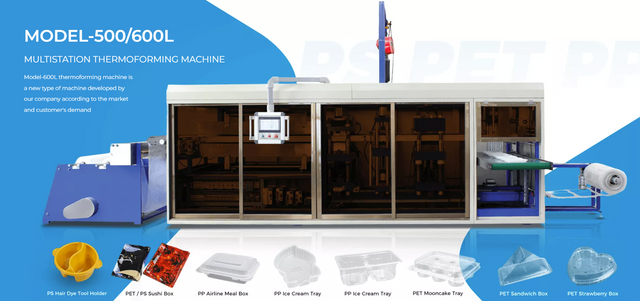
Thermoforming can be performed using various techniques, each suited to different manufacturing needs.
● Vacuum Forming: This is the most common method, where a heated plastic sheet is placed over a mold, and a vacuum pulls it tightly against the surface. It is widely used for creating packaging trays, clamshells, and similar products.
● Pressure Forming: This method applies high-pressure air to the heated sheet, forcing it onto the mold. This technique is ideal for producing parts with finer details and more complex geometries, such as automotive panels or medical device housings.
● Twin-Sheet Forming: In this process, two plastic sheets are heated and then simultaneously formed over separate molds. These sheets are then fused together to create a hollow part, offering enhanced strength and insulation. This method is commonly used for large, durable parts like automotive components and insulation panels.
Each of these methods serves a specific purpose, and the choice of method depends on factors such as the part’s complexity, the material being used, and the desired end product.
Choosing the right material is crucial for the success of the thermoforming process, as different thermoplastics offer various advantages depending on the application.
● PET (Polyethylene Terephthalate): PET is commonly used in food packaging due to its excellent barrier properties, making it ideal for preserving freshness and preventing contamination. It is also lightweight and recyclable, adding to its sustainability credentials.
● HDPE (High-Density Polyethylene): Known for its strength and resistance to chemicals, HDPE is used in applications that require durability, such as outdoor containers, pipes, and industrial parts.
● ABS (Acrylonitrile Butadiene Styrene): ABS is favored for its high impact resistance and ability to maintain a strong, stable form. It's often used in the production of automotive parts, household goods, and toys.
● Polycarbonate: Polycarbonate is valued for its exceptional strength and optical clarity, making it ideal for use in medical devices, eyewear, and other high-performance applications.
Mingdu’s versatile thermoforming machines are designed to work with a broad range of thermoplastics, including PP, PS, PET, and PVC, making them a flexible solution for various industries. Whether it's thin-gauge materials for consumer packaging or heavy-gauge plastics for automotive components, Mingdu's machines deliver precision and efficiency across multiple production scales.
These machines not only provide consistent results but also feature advanced temperature control systems that help maintain optimal forming conditions, ensuring the highest quality and minimal material waste. Whether you're producing lightweight trays or durable automotive panels, choosing the right material is crucial for achieving the best results in the thermoforming process.
Thermoformed plastics are known for their ability to retain the shape they were formed into. This characteristic is often referred to as "plastic memory." Once a thermoformed plastic has been cooled, the molecules in the material rearrange to create a fixed shape. This process makes it difficult to reshape the material once it has been set. Unlike thermoplastics, which can be reheated and reshaped multiple times, thermoformed plastics are generally more rigid after cooling.
The molecular structure of thermoplastics, especially those used in thermoforming, has a unique arrangement that allows them to soften when heated and harden when cooled. However, once they have undergone the thermoforming process, their molecular bonds are more stable and resistant to change, limiting the ability to reshape them.
For example, Mingdu’s precision thermoforming machines are designed for high accuracy during the forming process, but once the plastic is cooled and hardened, reshaping is much more challenging. This makes it essential for manufacturers to plan the forming process carefully, as any changes to the shape post-cooling can be complex and may require specialized equipment or techniques.
Reshaping thermoformed plastics is significantly more challenging compared to other thermoplastic materials. The primary reason lies in the "memory" effect, where the plastic retains the shape it was initially molded into. Here are some key factors that make reshaping difficult:
● Material Set During Cooling: When the plastic cools, it sets in the desired shape. The molecular structure becomes rigid, making it difficult for the plastic to return to its pliable state without applying significant heat.
● Temperature Sensitivity: Thermoformed plastics are more sensitive to temperature changes than their thermoplastic counterparts. Heating them enough to reshape the material can be tricky, as it risks damaging the structural integrity of the plastic.
● Thickness of the Part: The thicker the thermoformed part, the harder it is to reshape. Thicker materials require more heat to become pliable, and excessive heat can distort the overall shape.
While reshaping is possible with some methods, it typically requires reheating the plastic to a temperature close to its forming point. Mingdu’s thermoforming machines are engineered to provide precise temperature control, which is crucial when attempting to reshape thermoformed plastics. However, the process still requires careful handling to avoid damaging the material.
Factor | Challenge | Solution |
Material Set | Once cooled, the material retains its shape, making reshaping difficult | Reheating the material to its forming temperature |
Temperature Sensitivity | Overheating can cause deformation or damage | Precise temperature control is needed |
Thickness of Part | Thicker parts require more heat to become pliable | Thin-gauge materials are easier to reshape |
Reshaping thermoformed plastics is a delicate process, and one of the most common methods is reheating and reforming. In this process, the thermoformed part is carefully heated again to a temperature close to its original forming point. This makes the plastic pliable once more, allowing it to be reshaped or molded into a new form. Here's a step-by-step breakdown of the procedure:
1. Preparation: Start by assessing the shape and material of the thermoformed part. It’s essential to ensure the plastic is free of any cracks or defects before reheating.
2. Heating: The plastic part is heated using an oven, infrared heaters, or heated air. It's important to control the temperature to avoid damaging the material. The goal is to raise the temperature just enough to soften the plastic without melting it.
3. Shaping: Once pliable, the part can be reformed using a new mold or tool. This step may involve pressure or vacuum forming, depending on the complexity of the reshaping.
4. Cooling: After reshaping, the part must be cooled slowly to solidify in the new shape, ensuring it retains the desired form once it’s back to room temperature.
To make this process more efficient, Mingdu’s advanced control systems provide precise temperature regulation. This ensures that the plastic is heated evenly, minimizing the risk of warping or uneven softening, and enhancing the reshaping potential. Their multi-station thermoforming machines can handle both the heating and forming stages with high precision, making reshaping easier and more consistent.
Another technique to reshape thermoformed plastics is by heating the plastic just below its forming temperature. This approach helps to soften the plastic enough to make it flexible but prevents it from becoming overly soft or distorted.
● How It Works: By heating the plastic to a temperature below its typical forming range, it becomes pliable enough to allow for minor adjustments. This method is often used for parts that require less drastic reshaping or for smaller adjustments.
● Practical Considerations: When using this technique, it’s essential to carefully monitor the temperature. Overheating even slightly can lead to material damage or permanent deformation. It’s also important to ensure that the reshaped part cools evenly to avoid warping.
This technique is beneficial when working with thin-gauge materials, such as those used in Mingdu’s Thin-Gauge Thermoforming Machines. These machines provide automatic heating and forming processes that work seamlessly with materials like PET, PVC, and rPET, offering flexibility when reshaping without overcomplicating the process.
For more complex reshaping tasks, special techniques are sometimes necessary. In these cases, the use of new molds or specialized tools is required to achieve the desired result. The process generally involves:
1. New Molds or Tools: If the reshaping requires a significant change in shape, a new mold is used. This mold helps to guide the plastic into its new form while ensuring precise control over the reshaping process.
2. Vacuum or Pressure Forming: In some cases, vacuum or pressure forming is employed in combination with reheating to create intricate shapes with fine details.
3. Advanced Equipment: Mingdu’s multi-station thermoforming machines integrate forming, punching, and cutting in one synchronized process, improving efficiency when reshaping complex components. These machines allow for easy mold changes and precise control over the forming process, making them ideal for reshaping intricate plastic parts.
Process | Application | Advantages |
Reheating & Reforming | Moderate reshaping, small adjustments | Cost-effective, controlled reshaping |
Heat Below Forming Temperature | Light reshaping, minor corrections | Maintains material integrity |
Special Techniques | Complex reshaping, intricate components | High precision, versatile |
Mingdu’s machines excel in handling both simple and complex reshaping tasks, ensuring high-quality results even in challenging scenarios. With features like servo-assisted control and quick mold changes, Mingdu's multi-station thermoforming machines help manufacturers achieve reshaped components with enhanced efficiency.
These methods for reshaping thermoformed plastics provide manufacturers with flexible solutions, depending on the scale of reshaping required and the type of material used.
The type of thermoplastic used significantly affects how easily a thermoformed part can be reshaped. Different plastics have distinct properties that make some more suitable for reshaping than others.
● Polycarbonate (PC): Known for its excellent impact resistance and clarity, polycarbonate is one of the thermoplastics that can be reshaped relatively easily. It can withstand high temperatures, making it ideal for applications in automotive or medical devices.
● Polystyrene (PS): This plastic is commonly used in packaging but is more rigid compared to polycarbonate. It is harder to reshape once formed because it is more brittle at room temperature and requires higher temperatures to become pliable again.
Mingdu’s thermoforming machines are versatile and can process a wide variety of thermoplastics, such as polycarbonate, polystyrene, PET, and PVC. This flexibility allows manufacturers to choose the right material for their needs, ensuring efficient reshaping when required.
Material | Ease of Reshaping | Key Properties |
Polycarbonate | Easy to reshape | High impact resistance, clarity |
Polystyrene | Harder to reshape | Rigid, brittle at room temperature |
Polyethylene (PET) | Moderate reshaping | Flexible, good chemical resistance |
PVC | Moderate reshaping | Strong, durable, but sensitive to heat |
The ability to reshape these plastics largely depends on Mingdu’s advanced machines, which offer precise temperature control, making reshaping a more predictable process.
The thickness of the thermoformed part plays a crucial role in how easily it can be reshaped. Thicker materials are generally more difficult to work with when reheating for reshaping.
● Thicker Plastics: When the material is thicker, it requires significantly more heat to become pliable. This added heat can be challenging to control and may risk compromising the part’s integrity.
● Thinner Plastics: Thinner materials are easier to reshape because they heat up faster and become pliable at lower temperatures. These are ideal for applications where reshaping is needed, such as in food packaging or lightweight industrial components.
Mingdu’s thin-gauge thermoforming machines are perfect for rapid, high-volume processing of thinner materials. These machines offer high efficiency and speed, making them suitable for products that require reshaping with quick turnaround times.
Thickness of Plastic | Impact on Reshaping | Recommended Thermoforming Machine |
Thick Plastics | Requires more heat, harder to reshape | Heavy-gauge thermoforming machines |
Thin Plastics | Easier to reshape with less heat | Thin-gauge thermoforming machines |
The intended use of the reshaped thermoformed part will influence the methods and techniques used during the reshaping process. It’s essential to consider both functional and aesthetic requirements.
● Functional Requirements: If the reshaped part must meet specific mechanical or safety standards (e.g., in automotive or medical devices), the reshaping must be performed precisely. This could involve using advanced thermoforming techniques or specialized molds.
● Aesthetic Considerations: For products like consumer goods, reshaping may need to meet high visual standards, requiring flawless surfaces and edges. In these cases, precise control over temperature and mold design is crucial.
Mingdu’s multi-station thermoforming machines allow for highly detailed reshaping, ensuring parts meet both functional and aesthetic requirements. The integration of forming, cutting, and trimming in one automated process improves accuracy and reduces labor costs, which is vital for industries like packaging and medical.
Industry | Functional Requirements | Aesthetic Requirements |
Automotive | Strong, durable parts | Precision and detailed finishes |
Medical | Compliance with health standards | Clean, smooth surfaces |
Packaging | Lightweight, durable | Clear, precise designs |
Thermoforming plastics can be reshaped, but it requires careful consideration of factors like material type, thickness, and the intended use.
Mingdu's advanced thermoforming machines offer precise temperature control and efficient reshaping capabilities, making them ideal for high-quality production. Their versatility in handling various materials and the ability to reshape plastics with accuracy provide significant value to manufacturers across multiple industries.
A: Thermoforming is a process where a plastic sheet is heated, molded over a mold, and cooled to form a desired shape. It’s used in various industries, including packaging and automotive.
A: Thermoforming is cost-effective, fast, and ideal for producing large quantities of parts with complex shapes. It also allows for material efficiency and minimal waste.
A: Thermoforming offers flexibility, quick production cycles, lower costs, and the ability to handle a wide range of materials. It’s also great for creating lightweight, durable parts.
A: Thermoforming is faster and more cost-effective for low to medium-volume production, while injection molding is better for high precision and mass production of complex parts.
A: Thermoforming works best with thermoplastics like ABS, PVC, and polycarbonate, which can be reheated and reshaped.


