
You might ask what thermoforming is. Thermoforming is a way to make things. You heat a plastic sheet until it gets soft. Then you put it in a mold to shape it. After that, you cut it to finish the product.
The thermoforming machines market may grow about 4.1% each year from 2025 to 2035.
The thermoforming packaging market could grow 5-7% each year in the next five years.
Thermoforming is a cheap way to shape plastic sheets into many products. It works well for making a small or medium number of items.
Picking the right plastic is very important for your thermoforming project. Think about things like how strong it is, if it can handle heat, and how much it costs.
Checking quality at every step of thermoforming makes sure the final products are good. This helps stop problems like plastic being too thick or too thin.
The thermoforming process has simple steps. It changes plastic sheets into finished products. Each stage has a special job.
First, you heat a plastic sheet. The heat makes the plastic soft and bendy. This helps it fit into a mold. Thermoforming machines use different heaters. Some use infrared, contact, or fast air systems. Others use convection or radiant heating.
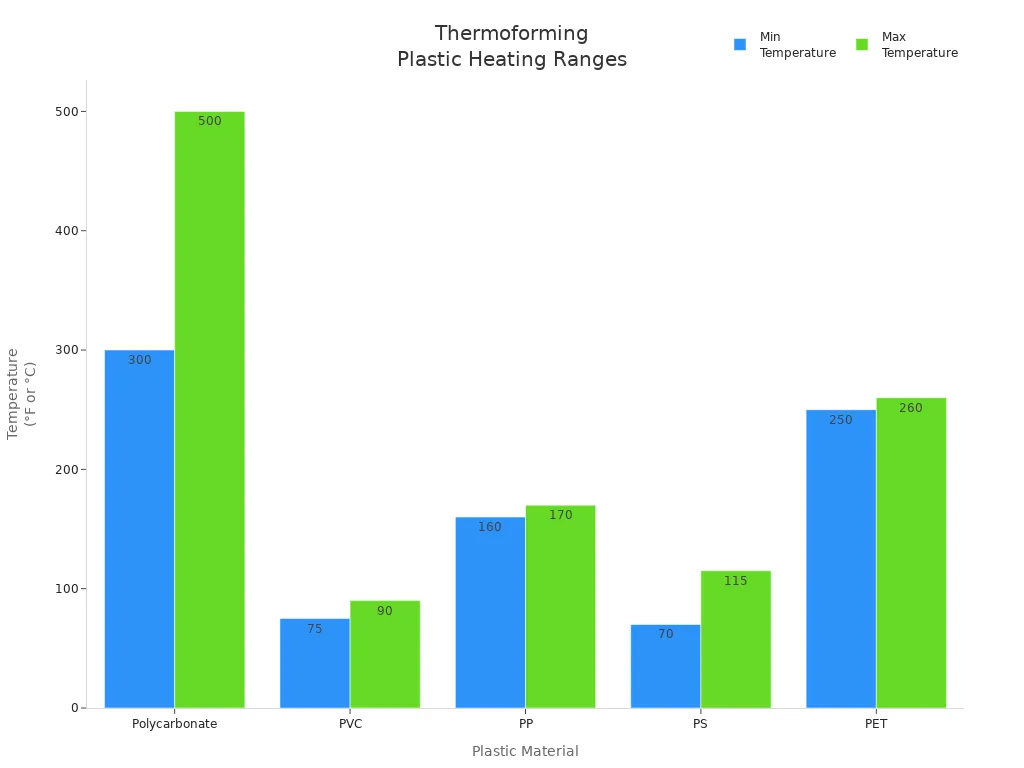
The right temperature depends on the plastic type. Here is a table with common plastics and their heat ranges:
Material | Temperature Range (°F) | Key Considerations |
|---|---|---|
Polycarbonate | 300–500 | Becomes flexible at higher temperatures; avoid over 450°F |
PVC | 75–90°C | Good for low-heat uses; avoid over 90°C |
PP (Polypropylene) | 160–170°C | Needs careful heating to prevent warping |
PS (Polystyrene) | 70–115°C | Can get brittle at higher temperatures |
PET | 250–260°C | Handles high heat, good for strong packaging |
You must heat the plastic evenly. If not, you can get bubbles or warping. Most machines use sensors to watch the heat. This keeps the process steady.
When the plastic is soft, you shape it. The machine moves the plastic over a mold. There are two main ways: vacuum forming and pressure forming.
Feature | Vacuum Forming | Pressure Forming |
|---|---|---|
Process | Uses a vacuum to pull heated plastic over a mold | Uses air pressure to push heated plastic over a mold |
Detail Level | Lower detail, good for thin materials | Higher detail, good for thick materials |
Common Mold Type | Male molds are common | Female molds are common |
Applications | Packaging, simple shapes | Parts needing high detail and texture |
Vacuum forming is good for easy shapes and packaging. Pressure forming gives more detail and works for thick plastics. After shaping, the plastic cools and keeps its new form. Cooling makes the product strong and steady.
Tip: New machines use robots and automation. This makes production faster and more accurate. These upgrades help industries like cars and medical fields.
After cooling, you trim and finish the product. Extra plastic is left on the edges. You need to cut this off for the final shape.
There are many ways to trim and finish:
CNC trimming: Fast and good for big batches.
Manual trimming: Best for small jobs or samples.
Die cutting: Works for thin plastics, but not as exact.
Bandsaw trimming: Good for straight cuts in large amounts.
Guillotining: Quick and neat for thin sheets.
Drilling: Makes holes for small jobs.
Roller cutting: Fast for big items, but less exact.
Vertical press cutting: Makes detailed cuts for some shapes.
You can also add finishes like paint, silk screen, or hot stamp. Some products get special coatings for UV or anti-static needs. Sometimes, you put together many thermoformed parts to make one product.
Trimming and finishing cost less than other plastic methods. You can add finishes during extrusion, which saves time and money. Tooling for thermoforming is cheaper than for injection molding. This makes thermoforming a smart choice for many projects.
Note: Thermoforming uses less energy than other methods. Some machines use up to 85% less energy. This saves money and helps the environment.
Quality control is important at every step. You must check the materials, watch the process, and look at the final product. This helps you find problems like uneven thickness or rough edges before shipping.
There are many plastics you can use for thermoforming. Some types work better for certain things. Here are the most common ones:
Polypropylene (PP) — This is the top choice. It has over 21% of the market. You see it in food packaging and containers.
Polystyrene (PS) — This plastic is in trays, cups, and lids.
Polyethylene terephthalate (PET) — This one is strong and clear. It is good for packaging.
Polyethylene (PE) — You use this for bottles and flexible packaging.
Polyvinyl chloride (PVC) — This plastic is used for blister packs and medical trays.
Acrylonitrile butadiene styrene (ABS) — You find this in car parts and other goods.
High impact polystyrene (HIPS) — This plastic is tough and easy to shape.
Food packaging uses the most thermoforming plastic. It makes up about 42% of the market. Vacuum forming is the main process. It has about 65% of the market.
You need to think about a few things when picking a thermoplastic. Each plastic has special features that change how it works. The right plastic helps your product last and look nice.
Property | Description |
|---|---|
Lightweight Properties | Plastics are lighter than metals. This makes products easier to move. |
Corrosion Resistance | Thermoforming materials do not rust and resist chemicals. |
Impact Resistance | Many plastics can take hits and do not break easily. |
Temperature Resistance | Some plastics stay strong in hot or cold places. |
You should also think about what your product will do. Does it need to be strong or handle heat? Cost is important too. Some plastics cost more because they need more heat or special care. Picking the right plastic makes sure your product works well and looks good.
Tip: Always choose a plastic with the right features for your project. This helps you get the best results from thermoforming.
Thermoforming lets people make many helpful products. Many industries use thermoforming for different things. This process helps make items fast and saves money. Most people think of packaging and displays when they hear about thermoforming. But it is also used in medical devices, car parts, and things people buy for their homes.
The biggest use for thermoforming is packaging. You can see this type of packaging in stores and hospitals. More than half of all thermoformed items are used for packaging. Food and drink packaging is a big part of this. Thermoformed packaging keeps food fresh and safe. It also protects electronics and shows off makeup.
Here are some types of thermoformed packaging you might know:
Food packaging: Trays and containers keep food safe and easy to use.
Medical packaging: Blister packs and trays keep medical tools clean.
Consumer electronics packaging: Special cases protect gadgets from harm.
Cosmetics packaging: Nice boxes show beauty items and keep them safe.
Food and beverage packaging: Clamshells and blister packs use strong plastics like PETG and HIPS.
Thermoformed packaging is strong, light, and clear. You can shape it to fit almost anything. This makes thermoforming very useful for many businesses.
Thermoforming is used in many other areas too. Car makers use it for inside and outside car parts. You can find dashboard panels, door panels, fenders, and bumpers made this way. Hospitals use thermoforming for covers, furniture, and waste bins.
People who make things for homes use thermoforming for easy-to-use designs. Lawn and garden tools have tough thermoformed parts. Big machines need large, exact pieces, and thermoforming helps with that.
Here is a table that shows how thermoforming helps different groups:
Sector | Benefits of Thermoforming Applications |
|---|---|
Consumer goods | Custom packaging and easy-to-use designs |
Industrial equipment | Makes big parts quickly and with care |
Lawn and garden | Strong and changeable parts |
Medical devices and equipment | Cheaper tools and faster making |
Packaging industry | Good plastic packaging for many things |
Technology industry | Strong parts for new devices |
More industries are starting to use thermoforming. You can trust thermoforming to give strong, flexible, and low-cost answers for packaging, home goods, and big machines.
Thermoforming has many good points. It helps save money and time. This is great for small or medium batches. You can get tools made fast, sometimes in two or three weeks. The tools cost much less than with injection molding. You might save up to 90% on tooling. You can also change molds quickly. This helps when you want to test new ideas or make samples.
Many kinds of plastics work for different jobs.
You can order from 50 to 5,000 pieces.
Big parts, up to 6 by 10 feet, can have good detail.
You can plan shipments to fit your needs and keep less stock.
Thermoforming lets you make many shapes and sizes. You can test and fix your product faster too.
Thermoforming has some limits. It works best for big, flat, or simple parts. You may not get very exact or tight fits like injection molding. If you need very detailed or tricky parts, you may need another way. The cost per piece can be higher if you make a lot.
You may get only fair fits and detail.
Some plastics, like HDPE, can shrink or change shape.
Not good for deep or tricky shapes.
Note: Thermoforming is not always the best pick. Think about your part’s size, shape, and how many you need.
You can look at thermoforming next to other ways like injection molding, extrusion, and blow molding. Thermoforming costs less for tools and lets you test ideas faster. You can change molds easily, but this is hard with injection molding. The process is simple and easy to repeat, so it is good for smaller batches.
Technique | Tolerance Level | Precision Level | Production Volume Capability |
|---|---|---|---|
Thermoforming | Moderate | Moderate | Lower |
Injection Molding | High | Very High | High |
Extrusion | Varies | Moderate | High |
Blow Molding | Limited | Moderate | Moderate |
Injection molding is better for huge amounts and very tight fits. Thermoforming is fast, flexible, and saves money. It is best when you need to test ideas or make fewer parts.
Thermoforming turns plastic sheets into things we can use. You learned how this process works and what plastics you can pick. Many businesses use thermoforming for making packages and parts.
Thermoforming saves money, lets you change designs, and is fast.
If you know the limits, you can plan and use it better.
Benefits of Thermoforming | Limitations of Thermoforming |
|---|---|
Lower equipment costs | Makes more leftover plastic |
Shorter lead time | Can’t make very tricky parts |
If you understand thermoforming, you can design better things. You can also make smart choices for your projects.
Thermoforming can make many things. You can make food trays and covers for medical devices. It also makes car panels and different kinds of packaging. This process works for lots of shapes and sizes. Many industries use thermoforming for their products.
Thermoforming uses heat to soften plastic sheets. These sheets are shaped over molds. Injection molding is different. It pushes melted plastic into a mold. Thermoforming is faster and costs less for some projects.
Yes, thermoforming is safe for food packaging. You can pick food-safe plastics for this process. These plastics help keep food fresh. They also protect food from germs and harm.


