
Views: 0 Author: Site Editor Publish Time: 2026-09-14 Origin: Site
Manufacturing cup lids presents a fundamental packaging challenge. You must achieve exact dimensional tolerances at extremely high cycle speeds. This precision prevents beverage leakage while maintaining low per-unit production costs. A minor deviation in the rim thickness can compromise the entire product seal.
A specialized plastic cup lid thermoforming machine directly bridges this gap. It transforms raw thermoplastic rolls into stack-ready, food-safe lids in a matter of seconds. These systems automate the complex transition from flat sheets to functional 3D geometries. You can produce thousands of identical, secure lids daily when the process runs smoothly.
Evaluating this critical equipment requires a thorough understanding of several factors. We will explore material compatibility and how different resins dictate machine settings. You will learn about the strict precision required during the production sequence. Finally, we will cover how to assess operational expenses to ensure long-term manufacturing profitability.
The choice of resin dictates much more than just the end-user product application. It determines the required heating capacity, the cooling timeline, and the cutting tonnage of your equipment. Different polymers react uniquely under thermal stress. You must align your machine specifications with your primary material to avoid high defect rates.
Manufacturers rely heavily on Polypropylene for hot beverages and microwavable applications. It withstands high temperatures without deforming, making it ideal for morning coffee service. However, it presents unique challenges on the factory floor.
Machine consideration: PP has a semi-crystalline structure. It requires a robust PP cup lid machine configuration due to its high shrinkage rates. The equipment must deliver intense, sustained heating to soften the sheet properly. You also need precise cooling mechanisms to prevent warping as the material solidifies. Tooling designers must oversize the molds slightly to compensate for the predictable post-mold shrinkage.
PET dominates the cold drink market. You will see it used extensively for iced coffee, sodas, and frappes. It offers exceptional clarity, giving consumers a premium view of their beverage. It also provides excellent crack resistance during transit and handling.
Machine consideration: Processing PET requires highly precise temperature control. If you heat the material too quickly or beyond its optimal window, it undergoes rapid crystallization. This turns the normally clear plastic cloudy and brittle. Your equipment needs advanced multi-zone heaters to bring the sheet to its forming temperature gently.
Polystyrene remains a traditional choice for hot drink lids. It offers excellent rigidity and remains highly cost-effective for mass production. It snaps onto paper cups with a satisfying, secure click.
Machine consideration: From an operational standpoint, PS is very forgiving. It requires lower temperatures to soften and less tonnage to cut. However, environmental regulations are rapidly phasing out polystyrene in many global regions. You should factor in local compliance laws before heavily investing in PS-only tooling.
Table 1: Resin Characteristics for Cup Lids
| Resin Type | Primary Application | Heating Requirement | Machine Tonnage / Shrinkage Need |
|---|---|---|---|
| PP (Polypropylene) | Hot beverages, Microwavable | High, sustained heat | High shrinkage compensation needed |
| PET (Polyethylene) | Cold drinks, Iced beverages | Precise, moderate heat | Standard tonnage, low shrinkage |
| PS (Polystyrene) | Hot drinks, rigid lids | Low heat | Low tonnage, highly formable |
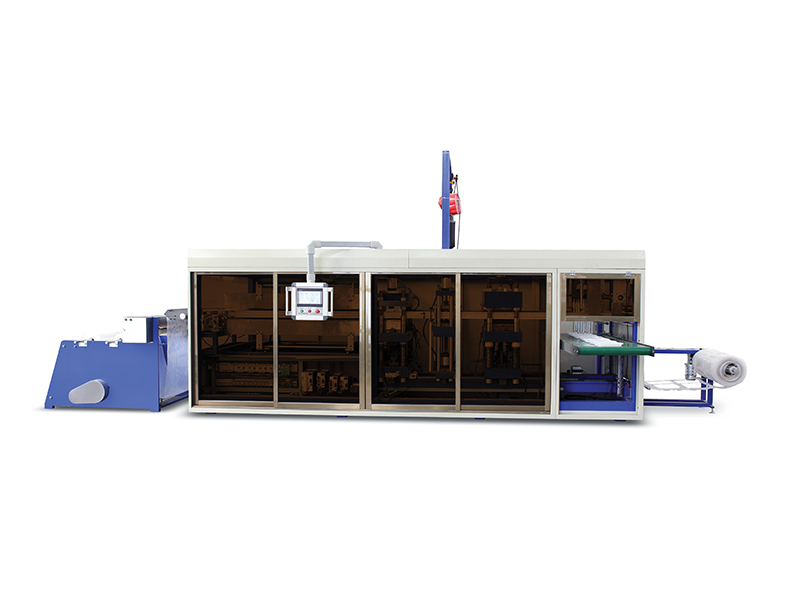
Understanding the internal sequence of operations helps you identify potential bottlenecks. It also allows you to evaluate the mechanical reliability of a prospective system. Every millisecond counts in high-volume packaging. Let us break down the exact journey the plastic takes from a raw roll to a finished product.
The process begins when servo-driven pin chains pull the continuous plastic sheet into the machine. These chains pierce the edges of the web, securing it tightly as it moves forward. Proper indexing ensures the material advances at the exact right speed.
Evaluation criteria: Look closely for automated tension control systems. If the material sags as it enters the oven, it heats unevenly. This sagging leads to inconsistent lid thickness. Operators call this "web droop," and it ruins production yields. A reliable machine maintains tight, continuous tension across the entire roll.
The sheet enters a thermal tunnel equipped with top and bottom heaters. Most modern units use ceramic or infrared heating elements. These heaters soften the plastic to its specific glass transition temperature.
Evaluation criteria: You must prioritize PID (Proportional-Integral-Derivative) temperature control systems. Standard heaters apply uniform heat, but the edges of the plastic sheet cool faster than the center. PID controllers allow granular adjustments across different zones. You can increase the edge heat independently, accommodating varied material widths and ensuring uniform formability.
This phase represents the core mechanical step. The softened sheet enters the mold station. Whether you are running dome lid thermoforming or using a flat lid forming machine setup, the physics remain similar. The machine applies positive air pressure from above while drawing a vacuum from below. This forces the plastic tightly against the chilled mold cavities.
Evaluation criteria: You must decide between in-mold cutting and post-mold cutting. In-mold cutting slices the lid out while it remains on the chilled mold. This ensures the highest dimensional accuracy because the plastic has not yet shrunk. For snap-on lids, this precision dictates whether the lid will leak or hold tight.
Many lid designs require secondary modifications. A mechanical press engages to punch straw slots, sip holes, and air release vents. This usually happens immediately after forming.
Evaluation criteria: Precision tooling is absolutely critical here. Dull punches or misaligned dies create plastic burrs, commonly known in the industry as "angel hair." These tiny plastic threads can fall into the beverage, creating a severe food safety hazard. Ensure the punching station features quick-change, hardened steel die sets.
The final inline step separates the finished product from the waste. Automated robotic arms or mechanical ejectors push the cut lids upward or downward. They stack them into precise, counted sleeves ready for boxing. Simultaneously, a rewinding motor collects the remaining skeletal web (the plastic frame left over) so you can send it for recycling.
Not all thermoformers are built equally. When you source a dedicated coffee cup lid machine, standard forming parameters fall short. You must upgrade the mechanical features to handle deeper draws and stricter locking tolerances.
Here are the primary features you should evaluate:
Purchasing the equipment is only the first step. You must anticipate the hidden costs of installation, operator training, and facility readiness. Poor planning during rollout can delay your production by months.
High-speed thermoforming draws substantial electrical amperage. You must ensure your factory grid can handle sudden spikes in power demand, especially when the heating banks cycle on. Furthermore, these machines require high-capacity, dry compressed air. If your factory compressor introduces moisture into the pneumatic lines, it will quickly destroy the internal valves. Invest in a commercial refrigerated air dryer.
Cup lids touch beverages directly. Therefore, you must treat your forming machine as food-grade equipment. Ensure the manufacturer designs the machine with food-grade lubricants on all exposed moving parts. Look for stainless steel contact surfaces wherever the plastic touches the metal. The equipment should carry CE/ISO certifications to help you meet FDA or local sanitary standard inspections.
A machine is only as efficient as the person running it. Complex HMIs (Human-Machine Interfaces) often cause severe production delays. If operators struggle to navigate menus to adjust temperatures, you will lose hours of runtime. Look for systems with intuitive touchscreens and recipe-saving functionalities. When changing products, operators can load saved parameters for specific lid molds instantly, eliminating the trial-and-error phase.
Navigating the equipment market requires a methodical approach. Follow these actionable steps to ensure you select the right system for your facility.
Investing in a specialized plastic cup lid thermoforming machine requires balancing multiple technical factors. You must align your material flexibility requirements—whether you run PP, PET, or PS—with the mechanical precision of the equipment. Upgrading to servo drives and in-mold cutting ensures the high-level accuracy needed for complex packaging.
Focusing on long-term reliability yields the best results. The lowest capital expenditure upfront often leads to higher scrap rates and heavy maintenance costs down the road. Prioritize overall equipment effectiveness (OEE) and leak-proof repeatability over the raw sticker price to build a profitable manufacturing line.
A: Yes, provided the machine has a deep enough draw capacity and allows for interchangeable tooling molds. You will need to ensure the forming station has the vertical clearance to accommodate the taller plug-assist mechanisms required for dome designs.
A: Speeds typically range from 20 to 40 cycles per minute. This output depends heavily on the chosen material, the mold cavitation (number of lids produced per mold strike), and whether the machine uses servo or pneumatic drives.
A: While not strictly necessary for simple blister packaging, it is highly recommended for cup lids. In-mold cutting secures the precise dimensional tolerances required for a secure, leak-proof seal on the cup rim, greatly reducing consumer complaints.


