
Views: 0 Author: Site Editor Publish Time: 2026-09-18 Origin: Site
The shift toward sustainable, closed-loop supply chains has accelerated the demand for durable plastic pallets. Logistics networks now require tougher, lighter, and highly adaptable load carriers to withstand demanding automated retrieval systems. Transitioning to or scaling pallet manufacturing requires heavy capital expenditure. Buyers must choose between injection molding and thermoforming. This critical manufacturing choice deeply impacts your financial viability and production agility. Thermoforming offers distinct advantages in tooling costs and lead times, giving manufacturers a competitive edge.
Procuring the right equipment goes beyond reading basic machine specifications. It requires aligning heating technology, clamping force, and mold engineering with specific production volume targets. You must also consider structural rigidity goals, especially regarding twin-sheet capabilities. We provide a clear, engineering-led framework for evaluating heavy-gauge equipment. You will discover how to assess mold designs to ensure viable long-term operations. This guide empowers you to make an informed, data-backed manufacturing decision.
Why do we select thermoforming over injection molding or structural foam molding? It solves essential business problems. Companies need fast market entry. They also require agile design capabilities to meet diverse logistical demands. Injection molding demands massive upfront tooling investments and long lead times. Thermoforming slashes these initial capital requirements. You can iterate designs quickly. This operational agility helps you respond instantly to changing supply chain demands.
Structural requirements dictate your manufacturing method. Injection molding offers complex internal ribbing for rigidity. However, twin-sheet thermoforming achieves comparable, and sometimes superior, load-bearing capacities. The process fuses two separate heavy-gauge sheets simultaneously. It creates an enclosed, hollow, rigid structure. This design delivers exceptional strength-to-weight ratios, making the pallets easier to handle while maintaining extreme durability.
Production volume thresholds ultimately guide your equipment decision. Thermoforming shines in low-to-medium volume scenarios. It provides the highest return on investment for highly customized runs. You might need footprint-specific pallets for a specialized automated warehouse. In these niche cases, thermoforming vastly outperforms alternative methods. High-volume, standardized pallets often favor injection molding. Finding your specific sweet spot ensures maximum profitability.
Table 1: Manufacturing Process Comparison for Pallets
| Feature | Twin-Sheet Thermoforming | Injection Molding |
|---|---|---|
| Tooling Cost | Low to Moderate | Extremely High |
| Lead Time to Market | 4 to 8 Weeks | 16 to 24 Weeks |
| Structural Approach | Hollow, fused twin-sheet structure | Solid structure with internal ribbing |
| Ideal Production Volume | Low to Medium (Highly customizable) | High (Standardized runs) |
Best Practice: Always conduct a structural finite element analysis (FEA) on your proposed twin-sheet design before committing to tooling. This ensures the hollow structure will meet your dynamic load requirements.
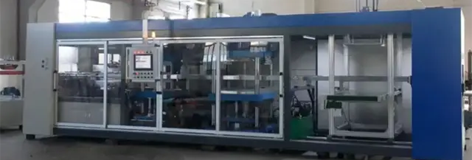
Twin-sheet capability remains paramount for pallet production. You need highly specialized equipment. A standard single-sheet machine cannot produce durable, load-bearing pallets. We recommend evaluating a thermoformed plastic pallet machine designed specifically for twin-sheet processing. It must feature independent, dual-station heating to bring both sheets to their precise forming temperatures simultaneously. High-pressure platen alignment then fuses the top and bottom decks flawlessly, creating the required structural weld.
Heating system precision dictates final part quality. You will generally encounter three primary heater types in heavy-gauge equipment:
You need precise, individually zoned temperature control. This micro-management prevents sheet sag during the heating phase. It ensures uniform material distribution for heavy-duty plastic forming. Uneven heating leads to thin walls and structural failures.
Clamping force ensures proper sheet fusion. You must thoroughly evaluate platen stability. The machine forms and seals thick materials. Starting sheet gauges often range from 0.250 to 0.500 inches per sheet. You need massive tonnage to compress these sheets together and forge the weld line. Any deflection or bending in the machine platens under pressure ruins the weld line, leading to defective pallets.
Automation handles the heavy lifting safely. Manual sheet handling introduces severe safety risks. It also destroys cycle time efficiency. Automated loading and unloading systems are absolutely mandatory. Robotic integration keeps the production line moving predictably. This logic applies whether you run a dedicated pallet line or a versatile large plastic container machine.
Mold material selection drives production speed. You can choose cast aluminum or CNC-machined billet aluminum. We strongly recommend temperature-controlled billet aluminum for continuous, high-volume runs. It offers superior thermal conductivity. Billet aluminum provides unmatched detail and structural durability. It serves exceptionally well in rigorous industrial pallet forming environments where molds undergo constant thermal cycling.
Cooling infrastructure creates the primary bottleneck. Thick-gauge thermoforming requires extensive cooling time before part ejection. You must engineer intricate cooling channels directly into the tool. Water-chilled molds reduce cycle times dramatically. Proper cooling prevents part warpage after ejection. Successful plastic pallet thermoforming relies entirely on optimal thermal management within the mold itself.
Draft angles facilitate clean part ejection. High-density polyethylene (HDPE) and polypropylene (PP) shrink significantly as they cool. Engineers must strictly account for these high shrinkage rates. Inadequate draft angles cause parts to lock onto the mold. This ruins production schedules, damages the pallets, and degrades the mold surface over time.
Vacuum and pressure zoning force semi-molten material into complex shapes. Strategic vacuum hole placement is critical for pulling the sheet tightly against the mold walls. Localized pressure-assist systems push the material from the opposite side. Deep draw areas, such as pallet legs and structural feet, require intense, localized pressure. This dual-action combination ensures uniform wall thickness across the entire pallet.
Common Mistake: Failing to add separate cooling circuits for the pallet feet. Since the feet feature the deepest draws and thickest material concentrations, they require independent, aggressive cooling channels to prevent extended cycle times.
Processing recycled content improves supply chain sustainability. However, regrind and post-consumer recycled (PCR) resins behave unpredictably. They vary constantly in melt flow indices and thermal consistency. Assess your machine’s ability to handle these variations dynamically. Advanced heating zones compensate for material irregularities. They allow you to process higher percentages of PCR without sacrificing pallet strength.
Material optimization directly reduces waste and material spend. Thickness profiling plays a crucial role here. The machine’s software must minimize sheet thinning during the forming process. Deep-draw areas are particularly vulnerable to dangerous thinning. Proper software profiling ensures structural integrity without requiring you to use excessively thick, expensive starting sheets.
Energy efficiency drives your daily operational costs. You must evaluate the machine's power consumption under full load. Consider the following energy-saving features:
Facility requirements dictate your initial setup success. Heavy-gauge thermoformers demand substantial floor space. You will need reinforced concrete foundations to handle the immense weight and mechanical vibration. The equipment also requires significant power drops and robust pneumatic systems. Plan your facility layout meticulously before purchasing machinery. Leave ample room for automated material loaders and secondary trimming stations.
Operator expertise often falls short in today's labor market. We face a persistent skills gap in heavy manufacturing. Modern UI systems bridge this gap effectively. Look for a robust Human-Machine Interface (HMI). Recipe-saving capabilities streamline changeovers between different pallet models. Predictive maintenance alerts prevent catastrophic machine failures. These digital tools significantly reduce your reliance on veteran operators.
Maintenance downtime kills manufacturing profitability. Identify common wear parts early in the procurement phase. Heater elements, vacuum seals, and secondary cutting tools need regular replacement. Evaluate the original equipment manufacturer carefully. Check their local parts availability. Ensure they offer remote diagnostic capabilities. Strong manufacturer support minimizes unexpected production interruptions and keeps your line running smoothly.
Performance guarantees protect your heavy equipment investment. Never accept theoretical cycle times from a sales brochure. Demand concrete performance data. The data must reflect your specific material gauge. It must also match your exact mold design and cooling layout. Hold vendors accountable to these numbers in the contract.
The Factory Acceptance Test (FAT) serves as your final technical checkpoint. You must establish strict, quantifiable criteria for sign-off before the machine leaves the manufacturer's floor. Key FAT criteria include:
Next-step actions move the project forward logically. Request a physical pilot run using your exact resins. Audit the vendor's Service Level Agreement to understand their emergency response times. Finalize your integration plan. You will need secondary trimming equipment, such as 5-axis CNC routers, to finish the pallet edges. Plan these subsequent steps carefully to ensure a seamless factory launch.
Investing in pallet manufacturing equipment is a highly strategic decision. It requires balancing lower tooling costs against the need for highly specialized, twin-sheet capable machinery. Thermoforming provides unmatched agility and structural performance when executed correctly.
The success of the production line rests equally on machine precision and advanced mold thermodynamics. You cannot succeed with a great machine and a poorly cooled mold. Heating, clamping, cooling, and vacuum distribution must work in perfect harmony.
Begin by auditing your specific load-bearing requirements. Determine your preferred material composition, including PCR percentages. Gather this data before requesting responses from equipment manufacturers to ensure you procure the perfect system for your operational needs.
A: Typically, no. Standard single-sheet machines cannot create the enclosed, structural hollow spaces required for high-load pallets. A specialized twin-sheet thermoforming machine is almost always necessary to fuse two separate sheets together, creating the rigid, internal geometry needed for industrial load-bearing applications.
A: Depending on the sheet thickness (gauge), material used (HDPE or PP), and the efficiency of the mold's cooling infrastructure, cycle times generally range from 3 to 6 minutes. Highly optimized machines with chilled billet aluminum molds can push toward the lower end of this spectrum.
A: Thermoforming molds are significantly less expensive—often 10% to 30% of the cost of an injection mold of the same size. This drastic reduction occurs because thermoforming uses lower pressures, allowing molds to be machined from softer, temperature-controlled aluminum rather than expensive, hardened tool steel.
A: High-Molecular-Weight Polyethylene (HMWPE) and High-Density Polyethylene (HDPE) are the dominant industry standards. Manufacturers favor them due to their exceptional impact resistance, excellent cold-weather performance, structural rigidity, and ease of recycling within closed-loop supply chains.


