
Views: 0 Author: Site Editor Publish Time: 2026-09-16 Origin: Site
Tier 1 and Tier 2 automotive suppliers face immense pressure today. You must meet strict OEM quality tolerances. You must adapt to an increasing demand for lightweight materials. The rapid shift toward electric vehicles (EVs) accelerates this trend. EVs require lighter interior components to maximize battery range. Simultaneously, you have to drastically reduce production cycle times to remain competitive. The modern automotive supply chain tolerates zero errors. Navigating these conflicting demands requires precise engineering solutions. This guide serves as a pragmatic, decision-stage framework for evaluating capital equipment. We move beyond basic technology definitions here. Instead, we focus on exact specification matching, comprehensive risk mitigation, and strict vendor validation. By standardizing your approach, you establish predictable yields and a measurable return on investment. Superficial marketing claims about "perfect quality" will not suffice. We focus strictly on the mechanical realities, control systems, and implementation strategies necessary for long-term production success. You will learn how to align equipment capabilities with strict manufacturing goals. You will also discover how to avoid costly downtime traps.
The primary business problem is balancing high-volume output requirements against manufacturing flexibility. Shorter vehicle lifecycle runs demand equipment capable of quick adaptations. A decade ago, vehicle platforms ran unchanged for seven years. Today, OEMs refresh interiors every three to four years. Manufacturers cannot afford rigid systems. You must remain agile to secure new contracts.
A successful equipment deployment requires defining clear success criteria early. You should target specific scrap rate reductions. For instance, achieving a sub-2% scrap rate indicates highly stable thermal control and process repeatability. You need quantifiable energy efficiency improvements. You must hit exact cycle time targets. Vague goals lead to poor purchasing decisions and misaligned expectations.
Your material strategy plays a massive role in these criteria. The machine must handle current and future automotive plastic panel forming requirements. The industry is rapidly transitioning toward sustainable, thinner gauge materials. You might process PC/ABS blends one shift and recycled PP the next. Manufacturers must process these advanced materials without sacrificing structural integrity. Lighter gauge plastics heat differently than traditional heavy stock. They cool faster and sag unpredictably in the oven. You will need advanced thermal controls and highly responsive vacuum systems. They ensure thin materials distribute evenly across complex mold geometries. By aligning machine capabilities with these material realities, you secure long-term operational viability.
Different interior programs require specific thermoforming methods. You must map the right technology to the corresponding application. Applying the wrong forming method leads to excessive material waste and frequent part rejections.
First, consider heavy-gauge vacuum forming. It excels for components like TPE floor liners and durable trunk mats. These parts need structural bulk and uniform stretching. Vacuum forming applies atmospheric pressure to pull the heated sheet over a tool. It offers cost-effective production for simpler, broad shapes.
Conversely, pressure forming becomes essential when handling sharper detailing. Complex dashboards and detailed center consoles require high-pressure systems. Pressure forming uses compressed air to force the material tightly against the tool surface. This process locks in critical textures and creates sharp radii mimicking injection-molded parts.
Table: Technology Classification by Component
| Technology Type | Typical Applications | Key Strengths | Material Focus |
|---|---|---|---|
| Heavy-Gauge Vacuum Forming | Floor liners, trunk mats, simple trims | Uniform stretching, lower tooling costs | TPE, heavy ABS |
| High-Pressure Forming | Dashboards, center consoles, instrument panels | Sharp detailing, texture retention, crisp radii | Advanced composites, PP, thin ABS |
Component specifics dictate precise machine configurations. For example, plastic door panel forming requires deep draw capabilities. It also requires highly precise zoned heating and robust plug assists. Deep draws stretch materials severely. Plug assists physically pre-stretch the heated sheet into deep cavities before vacuum application. This ensures uniform wall thickness across armrests and map pockets. Targeted heating prevents material thinning at sharp corners. When you map these requirements properly, you minimize material waste and improve overall part quality.
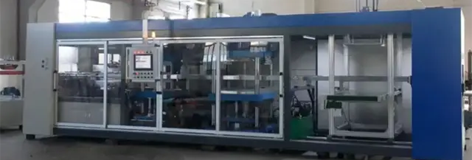
Thermal control dictates part quality. You need individually controlled quartz, halogen, or ceramic heating zones. Complex molds often require uneven material draw. Zoned heating lets you apply varied heat maps across a single sheet. This precision prevents webbing and tearing. Quartz heaters provide rapid response times, making them ideal for thin gauges. Ceramic elements offer long-lasting durability for heavy continuous runs. You must choose the element type matching your production cycles.
Next, evaluate automation and line integration capabilities. Fully automated systems often justify their initial capital expense rapidly. Consider these automation comparisons:
Tooling changeover efficiency directly impacts your annual capacity. Assess the machine's Quick Mold Change (QMC) systems. High-mix, low-volume production runs require rapid swaps. Hydraulic clamping systems and integrated roller beds reduce changeovers from hours to minutes. You should also evaluate mold cooling connections. Automated quick-disconnect water manifolds save immense time. Minutes saved during mold changes exponentially boost overall capacity.
Finally, evaluate structural rigidity. Frame integrity and platen stability are non-negotiable. A robust automotive interior thermoformer must maintain exact tolerances over millions of cycles. Weak frames bend under forming pressure. This deflection causes inconsistent part thicknesses and premature tooling wear. Look for heavy-duty welded steel frames and oversized platen guide shafts.
Many buyers overlook facility and infrastructure prerequisites. You must verify these elements before scheduling delivery. Overlooking these items delays installation by weeks.
Ensure you review the following infrastructure requirements:
Regional compliance and safety standards also demand strict attention. Verify CE marking, ISO certifications, or OSHA compliance depending on your facility location. Light curtains and mechanical safety interlocks protect operators. They also prevent catastrophic tool collisions during manual interventions. Modern machines should utilize dual-channel safety relays.
Beware of vague energy-saving marketing claims. Demand baseline energy consumption data per cycle from vendors. You need hard data to accurately model operating expenses. Ask for kilowatt-hour measurements based on specific material processing.
Finally, address the operator skills gap. Evaluate the intuitiveness of the Human-Machine Interface (HMI). Recipe management software should allow operators to recall optimal heating profiles instantly. Advanced HMIs store complex PID loops and motion profiles automatically. Complex, non-intuitive controls lead to operator errors. A steep operator training curve directly causes production downtime and increased scrap rates.
Comparing capital expenditures against operational expenses requires strict frameworks. You must analyze energy usage, wear parts replacement, and estimated maintenance hours. Do not rely solely on sticker prices. A cheaper machine often burns more electricity and requires frequent part replacements. Evaluate the Mean Time Between Failures (MTBF) for critical components like vacuum pumps and servo motors.
A Factory Acceptance Test (FAT) is absolutely mandatory. Require a rigorous FAT protocol before the equipment ships. Define strict criteria for sign-off. For instance, demand 100 consecutive defect-free parts. Use your exact material specifications and molds during this test. This prevents vendors from validating machines using generic, easy-to-form plastics. If the machine fails the FAT, the vendor must re-engineer and re-test at their own expense before shipping.
Scrutinize warranty fine print heavily. Check if the vendor measures warranties in spindle hours or calendar days. Verify the domestic supply chain for critical replacement components. You need local parts availability to prevent extended downtime. Ensure the vendor functions as a true partner during automotive parts machine integration. A broker simply sells equipment and disappears. A true partner assists with installation, initial programming, and long-term troubleshooting. Look for vendors offering secure VPN remote diagnostics. This allows factory engineers to troubleshoot PLC faults instantly without dispatching technicians.
Choosing the right equipment is an exercise in balancing immediate capital constraints against long-term flexibility. Investing in a thermoforming machine for automotive interior panels requires rigorous planning. You must prioritize automation needs early in the purchasing cycle to ensure long-term competitiveness.
Take these action-oriented next steps:
A: Supply chain realities heavily influence delivery schedules. Lead times typically range from 12 to 24 weeks. This timeframe depends directly on automation complexity and custom engineering requirements. Early vendor engagement helps secure manufacturing slots and mitigate delays.
A: Thin-sheet machines utilize roll-fed systems designed for small trims or lightweight packaging. In contrast, thick-sheet machines use sheet-fed, heavy-gauge systems. They process rigid materials necessary for structural automotive components, including heavy door panels and complex dashboards.
A: Yes, retrofitting is sometimes feasible. You can upgrade heating elements and install higher-capacity vacuum pumps. However, buyers must weigh these upgrade expenses against purchasing purpose-built modern equipment. Newer machines offer better long-term efficiency and natively support advanced TPE processing.


