
Views: 0 Author: Site Editor Publish Time: 2026-10-16 Origin: Site
Clamshell packaging is a rigid plastic package designed to enclose a product between two connected or separate formed sections. It is widely used for retail products because the clear package can display the product while providing physical protection and, depending on the closure design, tamper resistance.
For manufacturers, however, a successful clamshell is more than a clear plastic shell. Material selection, hinge design, cavity geometry, wall-thickness distribution, sealing method and thermoforming process all affect the final package.
This guide explains how plastic clamshell packaging is designed and manufactured, which materials are commonly used, and what to consider when selecting a thermoforming process.
A clamshell package typically consists of two formed sections that close around the product.
The two sections may be:
Connected by a formed hinge
Manufactured as separate front and back pieces
Designed with a snap-fit closure
Sealed around the perimeter
Combined with a printed insert or label
The main characteristic is that the product is enclosed by a plastic shell rather than simply sitting in an open tray.
Clamshells are commonly used for:
Consumer electronics
Hardware and tools
Toys
Personal care products
Small household products
Accessories
Produce and food products
Retail display items
Compared with a simple tray, a clamshell can provide greater product visibility and enclosure while also creating a package that can be displayed on a shelf or hang from a retail fixture.
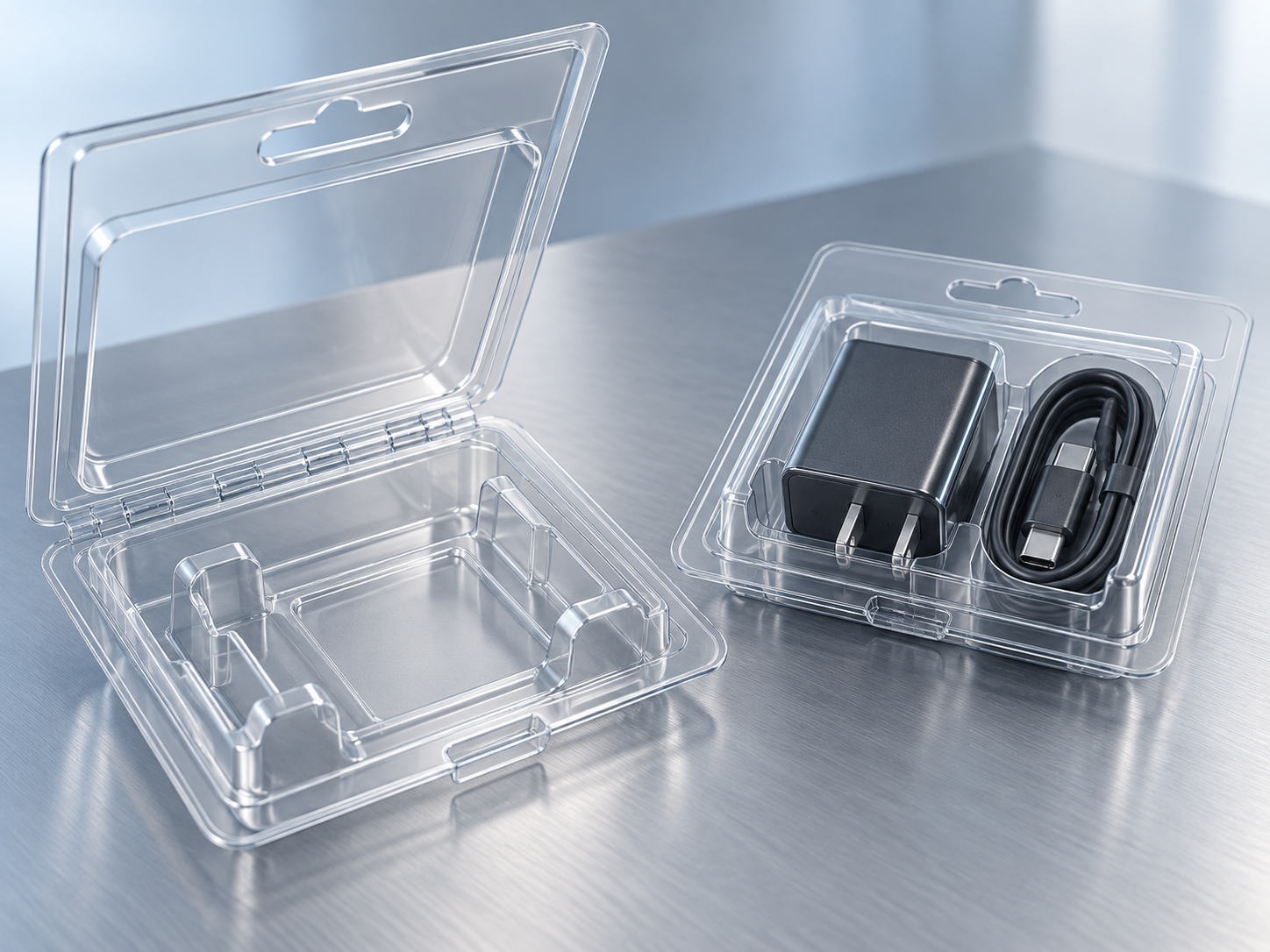
Clamshell designs vary according to how the package opens, closes and supports the product.
| Clamshell Type | Main Feature | Typical Application |
|---|---|---|
| Hinged clamshell | Front and back sections connected by a hinge | Retail products, electronics, hardware |
| Two-piece clamshell | Separate lid and base | Products requiring stronger or simpler closure |
| Tri-fold clamshell | Additional panel or supporting section | Wider products and display-oriented packaging |
| Snap-fit clamshell | Mechanical buttons or rails provide closure | Reclosable consumer products |
| Sealed clamshell | Perimeter is permanently sealed | Tamper-resistant retail packaging |
The best structure depends on the product weight, required protection, opening method, retail display requirements and downstream sealing process.
Material selection should begin with the finished package requirements rather than simply choosing the lowest-cost sheet.
Common materials include:
PET is widely considered for clear clamshell packaging because it combines good transparency, stiffness and practical thermoforming characteristics.
It can be suitable for:
Electronics accessories
Hardware
Consumer products
Produce packaging
Food containers
For a broader comparison of thermoforming plastics, see the Thermoforming Materials Guide.
RPET uses recycled PET content and can be considered when recycled-content targets are part of the packaging strategy.
However, the actual sheet specification should be evaluated for:
Clarity
Gauge consistency
Forming behavior
Recycled content
Food-contact requirements where applicable
Using recycled content does not eliminate the need for process validation.
PETG provides high clarity and is relatively easy to form into detailed shapes.
It may be considered when the clamshell requires:
Complex geometry
Deeper forming
Good impact performance
High visual clarity
PVC has historically been used for many retail clamshell applications because it forms readily and can work with certain sealing technologies.
However, material selection should also consider the destination market, recycling requirements and customer specifications. PVC should not automatically be selected simply because it is familiar.
PP can be useful when the package needs greater flexibility, chemical resistance or temperature resistance.
It can also be attractive for designs requiring repeated flexing, although its appearance and stiffness differ from PET-based materials.
| Requirement | Material Direction to Consider |
|---|---|
| High clarity | PET/APET, PETG |
| Recycled-content objective | PET/RPET |
| Detailed or deeper forming | PETG |
| Flexible or repeatedly flexed design | PP |
| Specific sealing requirements | Match material to sealing method |
| Lowest initial material cost | Evaluate the complete material + process cost |
The final material should always be confirmed against the actual grade, sheet specification and application requirements.
Good clamshell packaging design starts before the thermoforming machine is selected.
The cavity should hold the product securely without applying unnecessary pressure.
Consider:
Product dimensions
Product weight
Clearance
Contact points
Product orientation
Loading and unloading
A cavity that is too tight can make assembly difficult. A cavity that is too loose may allow the product to move during transportation.
The starting sheet thickness does not equal the final wall thickness everywhere.
During thermoforming, the sheet stretches over the mold. Deep cavities and sharp transitions can create thinner areas.
The design should therefore consider:
Forming depth
Draw ratio
Corner geometry
Sheet thickness
Heating distribution
Pre-stretching
The goal is not simply to use a thicker sheet. The goal is to achieve sufficient finished-part strength with efficient material usage.
Sharp corners can force the heated sheet to stretch rapidly and may create localized thinning.
Using suitable radii helps the material flow more gradually into the cavity.
This is especially important around:
Deep corners
Product contact points
Hinge transitions
Snap features
Draft allows the formed part to release from the mold.
Insufficient draft can cause:
Difficult demolding
Surface damage
Distortion
Increased release force
Draft requirements depend on material, mold geometry, surface texture and forming depth, so they should be established during mold design rather than added after the tool is completed.
The hinge is one of the most important features in a hinged clamshell.
A PET-based clamshell may use a formed or scored hinge designed for controlled folding. PP can be considered when the design requires repeated flexing.
The hinge area must be evaluated together with:
Sheet thickness
Forming direction
Local material distribution
Fold radius
Number of expected opening cycles
A hinge that looks acceptable in CAD can still fail if thermoforming causes excessive thinning in the hinge zone.
The perimeter flange provides the surface needed for sealing or closure.
The flange should have enough:
Width
Flatness
Thickness consistency
Alignment
to support the selected closure method.
An uneven flange can create inconsistent sealing or interfere with snap-fit features.
Retail clamshells may include:
Hang holes
Display feet
Product labels
Printed cards
Locking tabs
Tear features
These features should be considered during mold and trimming design.
The basic clamshell thermoforming process is:
Sheet Feeding → Heating → Forming → Cooling → Trimming → Inspection → Closure/Assembly
Plastic sheet or roll stock enters the thermoforming system.
The production team should confirm:
Material type
Sheet thickness
Sheet width
Surface quality
Roll or sheet condition
For high-volume thin-wall packaging, a Thin-Gauge Thermoforming Machine is a natural equipment direction.
The sheet is heated until it reaches a suitable forming condition.
The objective is not simply to reach a particular heater temperature. The actual sheet temperature and temperature distribution are more important.
Uneven heating can result in:
Uneven wall thickness
Wrinkles
Incomplete forming
Excessive thinning
Surface defects
The heated sheet is brought into contact with the mold.
Depending on the package geometry, forming may use:
Vacuum
Positive air pressure
Plug assist
A combination of forming methods
For clamshells with sharper details or more demanding geometry, Pressure Forming Machines may be considered.
The formed package must cool sufficiently to maintain its geometry after demolding.
Cooling affects:
Dimensional stability
Cycle time
Warpage
Surface quality
Reducing cooling time too aggressively can increase productivity on paper but create unstable parts in actual production.
The formed web is separated into individual clamshell components.
Depending on the production system, cutting may be performed:
In-line
With a punching mold
With a separate cutting tool
With another automated cutting method
MINGDU's Multistation Thermoforming Machine can be considered for production systems where forming and downstream operations need to be coordinated.
Finished components should be checked for:
Cavity dimensions
Wall-thickness distribution
Hinge integrity
Flange flatness
Locking performance
Surface appearance
Trim accuracy
The final package should also be tested with the actual product rather than evaluated only as an empty shell.
There is no single best closure method.
A snap-fit can make the package reclosable and avoids a permanent seal.
It can work well when consumers need to open and close the package.
Heat sealing can permanently bond compatible materials or sealing layers.
It is useful when tamper evidence and package security are more important than reclosability.
Ultrasonic welding can be considered for certain thermoformed materials and package designs, particularly where localized bonding is required.
The material and joint geometry must be validated together.
Radio-frequency sealing can be used with compatible materials and is traditionally associated with certain PVC packaging applications.
However, sealing performance is highly material-specific. Do not assume that every clear thermoplastic can be RF welded simply because it can be thermoformed.
A common mistake is to design the package first and think about manufacturing afterward.
A production-ready design should consider the complete chain:
Product → Cavity → Material → Heating → Forming → Cooling → Trimming → Closure → Packing
For example, changing from PET to PP may affect not only material appearance but also:
Heating conditions
Forming behavior
Hinge design
Closure design
Cooling
Sealing method
This is why packaging design and machine selection should be evaluated together.
For most thin-wall clamshell applications, the equipment decision should consider:
Forming area
Sheet or roll format
Material
Sheet thickness
Cavity count
Forming depth
Cutting method
Required output
Automation level
A Thin-Gauge Thermoforming Machine is suitable to consider for lightweight, high-volume packaging.
A Multistation Thermoforming Machine becomes more relevant when forming, punching, cutting and handling need to work as a coordinated production process.
For packages requiring greater forming detail, a Pressure And Vacuum Forming Machine can be evaluated.
Machine selection should always be based on the actual product drawing, material, sheet thickness, mold and target output.
Although both formats can use thermoformed plastic, their structures are different.
| Feature | Clamshell Packaging | Blister Packaging |
|---|---|---|
| Main structure | Plastic shell encloses product | Formed cavity combined with backing |
| Visibility | Often visible from multiple sides | Mainly front-facing |
| Printed surface | Can use labels or inserts | Backing card provides major print area |
| Closure | Snap, seal, weld or other methods | Usually card/lidding seal or mechanical structure |
| Typical products | Hardware, electronics, consumer goods | Small retail products, pharma, hardware |
| Reclosability | Possible with snap designs | Usually limited |
For a more detailed comparison of thermoforming with alternative plastic processes, see MINGDU's Thermoforming vs Injection Molding guide.
Excellent product visibility
Good physical protection
Custom cavity design
Suitable for retail display
Can integrate hanging or standing features
Compatible with a range of thermoplastic materials
Suitable for automated thin-gauge production
Some designs can be difficult for consumers to open
Deep cavities may create wall-thickness variation
Hinge performance depends strongly on material and geometry
Permanent sealing can reduce reusability
Material and closure choices affect recycling options
Trimming and material utilization must be optimized for cost
Before releasing a new clamshell package for production, review:
Product dimensions and weight
Cavity clearance
Material and sheet thickness
Forming depth
Draft angle
Corner radius
Hinge geometry
Flange width
Closure method
Hang-hole or display features
Trimming method
Required output
Material utilization
Product loading process
Shipping and handling conditions
A prototype forming trial is particularly useful when the package contains deep cavities, complex hinges or tight dimensional requirements.
Clamshell packaging is a plastic package in which a product is enclosed between two formed sections. The sections may be hinged, snapped together or permanently sealed.
PET/APET, RPET, PETG, PVC and PP can all be considered for different clamshell applications. The correct choice depends on clarity, stiffness, flexibility, sealing, temperature exposure, recycling requirements and the product itself.
Many clear plastic retail clamshells are produced by thermoforming plastic sheet. The sheet is heated, formed against a mold, cooled and then trimmed.
PET/APET and PETG are common options when high transparency is important. The best material depends on the required stiffness, forming depth, closure method, recycled content and end-use requirements.
Start with the product cavity, then evaluate sheet thickness, draw depth, corner radii, draft angles, hinge geometry, flange design and closure method. These features should be developed together with the forming and trimming process.
Thin-gauge thermoforming equipment is commonly considered for lightweight clamshell production. High-volume applications may use multistation equipment with integrated forming and cutting operations.
Clamshell packaging combines product protection, visibility and retail presentation in a thermoformed plastic structure. However, the quality of the finished package depends on much more than the forming machine.
Material selection, cavity geometry, wall-thickness distribution, hinge design, flange dimensions, closure method and trimming must all work together.
For manufacturers developing a new clamshell, the most effective approach is to evaluate the product, material, mold, forming process and production volume as one system.
MINGDU provides multiple thermoforming configurations for packaging production, including Thin-Gauge Thermoforming Machines, Multistation Thermoforming Machines, and Pressure Forming Machines. The appropriate configuration should be determined from the actual packaging design, sheet material, mold and required production output.


