
Views: 0 Author: Site Editor Publish Time: 2026-10-10 Origin: Site
Choosing the right thermoforming material is one of the most important decisions in a plastic forming project.
The plastic sheet must not only soften and form correctly. It also needs to provide the required clarity, impact strength, stiffness, heat resistance, chemical resistance and finished appearance.
Common plastics for thermoforming include PET, PP, PS, HIPS, ABS, PETG, PVC, polycarbonate, HDPE and acrylic. However, these materials behave differently during heating, stretching, cooling and trimming.
A material that works well for a clear food tray may not be suitable for an equipment housing, automotive panel or reusable plastic component.
This guide explains the most common thermoplastic sheets for thermoforming, their main properties, forming considerations and typical applications.
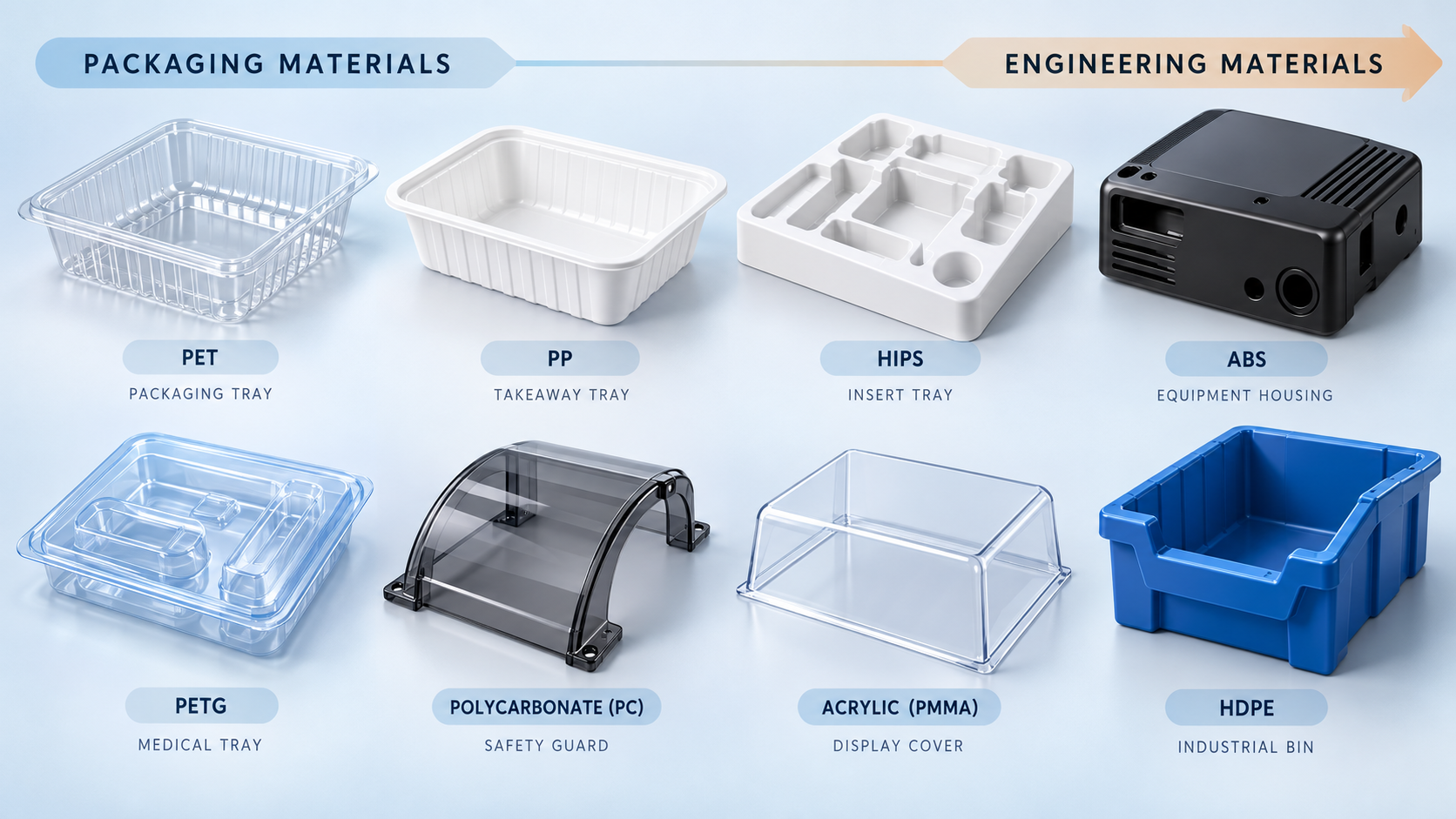
Thermoforming works with thermoplastics—plastics that soften when heated and become rigid again when cooled.
Common thermoforming plastics include:
PET and APET
RPET
Polypropylene (PP)
Polystyrene (PS)
High Impact Polystyrene (HIPS)
ABS
PETG
PVC
Polycarbonate (PC)
HDPE
Acrylic (PMMA)
PLA
These materials are available as rolls or individual plastic sheets depending on the product, sheet thickness and thermoforming process.
In general, amorphous materials such as ABS, PETG, polycarbonate and acrylic have relatively broad softening ranges and can be easier to control during thermoforming.
Semi-crystalline plastics such as PP and HDPE can also be thermoformed successfully, but their processing windows can be narrower and may require tighter control of sheet temperature, sag and cooling.
The best choice therefore depends on much more than whether a plastic is technically thermoformable.
The following table provides a practical starting point when comparing common thermoplastic sheet materials.
| Material | Main Advantages | Forming Considerations | Typical Applications |
|---|---|---|---|
| PET / APET | Clear, stiff, widely used in packaging | Heating and material condition must be controlled | Food trays, clamshells, clear packaging |
| RPET | Recycled-content option for PET applications | Sheet consistency should be validated | Sustainable packaging, trays |
| PP | Lightweight, chemical resistant, useful heat performance | Narrower forming window and greater sag can require careful control | Food containers, trays, industrial products |
| PS | Economical and easy to process | Lower impact performance than some alternatives | Disposable packaging, cups, trays |
| HIPS | Good formability and improved impact strength | Limited outdoor/UV performance unless modified | Packaging, inserts, appliance components |
| ABS | Impact resistant, good appearance, easy to machine | Some grades require pre-drying | Housings, automotive parts, equipment covers |
| PETG | Excellent clarity and good formability | Heating uniformity is important | Medical trays, displays, transparent packaging |
| PVC | Clear grades available, good forming behavior | Processing conditions and formulation must be reviewed | Blister packs, packaging |
| Polycarbonate | Very high impact strength and useful heat resistance | Often requires drying and higher processing control | Guards, covers, technical components |
| HDPE | Tough and chemically resistant | Higher shrinkage and challenging sag behavior | Industrial parts, reusable products |
| Acrylic | Excellent transparency and surface appearance | More brittle than PC or ABS | Displays, covers, visual components |
| PLA | Bio-based option for selected packaging | Processing window and heat performance require attention | Disposable packaging |
This table should be treated as a selection guide rather than a substitute for the technical data sheet of a specific sheet grade.
There is no single best plastic for every thermoforming application.
Before selecting a material, evaluate the finished product requirements first.
Start with how the product will actually be used.
Ask:
Is it food packaging?
Does the product need to be transparent?
Will it experience impact?
Does it contact chemicals?
Will it be exposed to high temperatures?
Is it used indoors or outdoors?
Does it need to be rigid or flexible?
Is recycled content required?
For example, PET may be attractive for a clear packaging tray, while ABS may make more sense for an industrial housing requiring impact resistance.
Thermoforming sheet thickness affects both material behavior and machine selection.
Thin thermoplastic sheets are commonly used for:
Food trays
Lids
Cups
Clamshells
Blister packaging
Medical trays
These products are often manufactured using roll-fed thin-gauge thermoforming machines.
Thicker sheets are more commonly associated with:
Machine covers
Equipment housings
Automotive panels
Industrial components
Structural plastic parts
Thicker material generally requires more heating energy and longer heating and cooling cycles.
One of the most common questions is:
What temperature should plastic be heated to for thermoforming?
There is no universal thermoforming temperature.
The correct temperature depends on:
Polymer type
Material grade
Sheet thickness
Surface coating
Color
Recycled content
Moisture level
Heating method
Heater distance
Forming depth
Machine cycle
The objective is to heat the sheet uniformly into its correct forming window without degrading the surface or allowing uncontrolled sag.
This is why engineers should distinguish between:
heater temperature
and
actual sheet temperature.
They are not the same.
The heater may operate at a much higher temperature than the plastic sheet itself.
Material suppliers normally provide recommended processing conditions for a specific sheet grade. Those values should be used as the starting point and then validated on the actual thermoforming machine.
For example, PETG sheet suppliers may specify a defined sheet-temperature window for forming, while ABS manufacturers can recommend different processing conditions depending on sheet construction, thickness and surface layer.
For production, the safest engineering approach is:
Supplier data → machine trial → part measurement → process optimization.
PET is one of the most important materials for thermoformed packaging.
Typical advantages include:
Good clarity
High stiffness
Good product visibility
Wide availability in packaging applications
Compatibility with recycled PET content in suitable sheet structures
Common applications include:
Food trays
Bakery containers
Fruit packaging
Clamshell containers
Transparent packaging
PET is especially important in thin-gauge thermoforming and high-volume packaging production.
When forming PET, manufacturers should pay attention to sheet condition, heating uniformity, forming depth and cooling.
For packaging production, PET is commonly processed on pressure-and-vacuum or multi-station thermoforming systems.
Polypropylene is widely used when lightweight construction, chemical resistance and useful heat performance are required.
Common applications include:
Food containers
Takeaway packaging
Trays
Cups
Industrial products
PP behaves differently from many amorphous plastics.
Its processing window can be relatively narrow, and heated PP sheet may sag significantly. This means temperature control and material support become particularly important.
Manufacturers should pay attention to:
Sheet sag
Heater-zone control
Mold temperature
Cooling
Shrinkage
Product release
PP is a useful thermoforming material, but stable production usually requires good process control.
ABS is widely used in industrial thermoforming because it combines:
Impact resistance
Good surface appearance
Good formability
Machinability
Color and texture options
Typical applications include:
Equipment housings
Machine covers
Automotive interior components
Appliance parts
Electronic enclosures
ABS is particularly suitable for pressure forming when the product requires stronger surface definition or detailed geometry.
Moisture should be considered before processing. Depending on the ABS grade and storage conditions, pre-drying may be required to reduce the risk of surface defects.
For detailed processing recommendations, the sheet manufacturer's technical data should always be checked.
HIPS, or High Impact Polystyrene, is widely used because it is economical and relatively easy to thermoform.
It is commonly selected for:
Trays
Packaging inserts
Point-of-purchase displays
Appliance liners
Consumer packaging
Compared with standard polystyrene, HIPS provides improved toughness while maintaining good forming characteristics.
Its combination of cost and formability makes it especially useful where very high material performance is not required.
However, standard HIPS generally has limited resistance to long-term UV exposure, so outdoor applications should be evaluated carefully.
PETG is a popular material when transparency and thermoformability are both important.
Its advantages include:
High clarity
Good impact resistance
Good forming characteristics
Good reproduction of mold detail
Common applications include:
Medical packaging
Transparent trays
Point-of-purchase displays
Protective covers
Retail packaging
PETG can form complex shapes with relatively good material distribution when heating is controlled properly.
However, even an easy-to-form material can develop defects when different areas of the sheet are heated unevenly.
For deep or detailed products, heater zoning, mold design and forming pressure remain important.
Polycarbonate is considered when the finished product requires higher impact resistance than many standard plastics can provide.
Typical applications include:
Protective guards
Equipment covers
Transportation components
Technical housings
Transparent impact-resistant parts
Compared with common packaging plastics, polycarbonate requires more demanding processing conditions.
Moisture control is particularly important. Polycarbonate sheet may require pre-drying before heating to prevent bubbles or surface defects.
Machine heating capacity and temperature uniformity should therefore be evaluated before selecting PC for a project.
PVC has historically been widely used in blister and transparent packaging applications.
Depending on formulation, its advantages can include:
Good clarity
Good forming characteristics
Chemical resistance
Reliable mold-detail reproduction
Common applications include:
Blister packaging
Trays
Retail packaging
Selected medical packaging products
PVC formulations vary significantly, so processing temperatures, regulatory requirements and end-use suitability should be confirmed for the specific material grade.
HDPE offers:
Good toughness
Strong chemical resistance
Low moisture absorption
Good durability
It can be used for:
Industrial components
Material-handling products
Reusable containers
Large formed plastic products
However, HDPE can be more difficult to thermoform than ABS or PETG because its processing window, sag behavior and shrinkage require greater control.
Product dimensions and mold compensation should be evaluated carefully.
Acrylic, also known as PMMA, is primarily selected when transparency and appearance are critical.
Typical products include:
Displays
Signs
Covers
Lighting components
Decorative panels
Its optical clarity is an important advantage.
However, acrylic is generally more brittle than materials such as polycarbonate or ABS, so impact requirements should be considered before material selection.
Material names alone do not determine forming performance.
Several physical properties directly influence the thermoforming process.
When heated, the sheet must remain stable enough to move into the mold in a controlled way.
Excessive sag can:
Reduce wall thickness
Cause webbing
Create inconsistent material distribution
Increase the risk of the sheet contacting equipment
This is particularly important with deep products and large sheets.
Products such as machine housings, transportation components and protective covers may require significantly higher impact strength than disposable packaging.
ABS and polycarbonate are often considered for these applications.
When consumers need to see the packaged product, optical appearance becomes a major selection factor.
PET, PETG, acrylic, polycarbonate and selected PVC grades may be considered depending on the application.
Chemical exposure matters for:
Industrial trays
Medical applications
Equipment components
Food-contact applications
Reusable containers
PP and HDPE are often considered where chemical resistance is important.
A material that forms easily is not automatically suitable for a high-temperature application.
The service temperature of the finished product must be evaluated separately from the temperature used to thermoform it.
Plastic contracts during cooling.
Different polymers shrink by different amounts, which can affect:
Product dimensions
Mold dimensions
Part release
Warpage
Assembly tolerance
Material shrinkage should therefore be considered during both mold design and process development.
Some thermoforming plastics absorb moisture during storage.
When moisture-containing sheet is heated, the water can turn into vapor and produce:
Bubbles
Blisters
Surface defects
Reduced appearance quality
Materials such as ABS and polycarbonate may require drying depending on grade, sheet thickness and storage conditions.
Other materials may be less moisture sensitive.
Instead of applying one drying rule to every plastic, manufacturers should follow the sheet supplier's recommended storage and drying conditions.
Both vacuum forming and pressure forming can process many of the same plastics.
The difference is usually determined by the required product geometry and surface detail rather than material alone.
PET
HIPS
ABS
PETG
PVC
Acrylic
HDPE
PP
depending on sheet grade and product design.
Sharper detail is required
Surface texture must be reproduced
Corners are more defined
Product appearance is important
Deeper or more complex geometry must be formed
ABS, PETG and other suitable thermoplastic sheets are frequently considered for pressure-formed industrial parts.
The final decision should consider material, mold and machine as a complete system.
Material choice is also connected to the manufacturing process.
Common materials include:
PET
RPET
PP
PS
HIPS
PVC
PLA
Typical products include trays, cups, lids, clamshells and blister packaging.
High-volume production often uses roll-fed material with automated forming, cutting and stacking.
Common materials include:
ABS
HIPS
HDPE
PETG
Polycarbonate
Acrylic
Typical applications include housings, panels, covers, guards and automotive components.
These projects often require greater attention to wall-thickness distribution, heating zones, mold cooling and secondary trimming.
Before finalizing a material, manufacturers should answer the following questions:
What is the finished product used for?
Is clarity required?
What impact load must the product withstand?
What temperatures will it experience in service?
Will it contact food, chemicals or medical products?
What sheet thickness is required?
How deep is the part?
Is the product vacuum formed or pressure formed?
Is it thin-gauge or heavy-gauge?
Does the material require drying?
How much shrinkage can the design tolerate?
Is recyclability or recycled content required?
What production volume is expected?
Which trimming process will be used?
Only after these questions are answered should the final plastic for thermoforming be selected.
Material selection and machine selection should not be treated as separate decisions.
The thermoforming machine must provide sufficient:
Heating capacity
Heating-zone control
Forming pressure
Vacuum capacity
Forming depth
Cooling
Mold compatibility
Cutting or trimming capability
For high-volume packaging, a Thin-Gauge Thermoforming Machine or Multistation Thermoforming Machine may be appropriate.
For products requiring stronger surface definition, an industrial Pressure Forming Machine may be more suitable.
Projects requiring both vacuum and compressed air can use a Pressure and Vacuum Forming Machine.
Hollow or double-wall industrial products may require a Twin Sheet Forming Machine.
The correct system should always be selected according to the material, finished product, mold and target production output.
There is no single best material. PET is widely used for clear packaging, PP for lightweight and chemically resistant products, HIPS for economical forming, ABS for industrial housings, PETG for clear detailed parts, and polycarbonate for high-impact applications.
Materials such as HIPS, ABS and PETG are generally considered relatively thermoformable because they provide useful forming characteristics and manageable processing windows. The exact behavior still depends on the sheet grade and thickness.
Yes. PP is widely thermoformed for containers, trays and industrial products. However, its sheet sag, shrinkage and relatively narrow forming window require careful temperature control.
Yes. ABS is one of the most widely used materials for industrial thermoforming and pressure forming, particularly for housings, covers and automotive parts.
No. Processing temperature depends on material grade, sheet thickness, heater configuration and product geometry. The sheet manufacturer's technical data should be used as the starting point.
PET, RPET, PP, PS, HIPS, PLA and selected other materials may be used depending on the package design, temperature requirements and applicable food-contact requirements.
Selecting the right thermoforming material requires balancing processability with the performance required from the finished product.
PET, PP and HIPS are widely used in packaging. ABS is a strong option for industrial housings and panels. PETG provides good clarity and formability, while polycarbonate can be selected when higher impact performance is required.
But the polymer name alone is not enough.
Sheet thickness, material grade, forming temperature, moisture, shrinkage, mold geometry, forming depth, cooling and machine configuration all influence the final result.
For a new thermoforming project, the most reliable approach is to evaluate the product, plastic sheet, mold and thermoforming machine together, then confirm the process through material supplier data and production trials.

