
Views: 0 Author: Site Editor Publish Time: 2026-10-16 Origin: Site
HDPE thermoforming is widely used for industrial parts that require toughness, chemical resistance, moisture resistance and durability.
High-density polyethylene, or HDPE, can be formed into products such as material-handling trays, liners, agricultural components, transportation parts, reusable containers and other rugged plastic products.
However, thermoforming HDPE requires tighter process control than many amorphous plastics.
Because HDPE is a semi-crystalline material, manufacturers need to pay particular attention to:
Forming temperature
Sheet sag
Heating uniformity
Shrinkage
Cooling
Mold design
Wall-thickness distribution
This guide explains the key factors to consider when thermoforming HDPE sheet and when the material is a good choice for industrial applications.
For a broader comparison of HDPE, ABS, PETG, HIPS, polycarbonate and other plastics, see our Thermoforming Materials Guide.
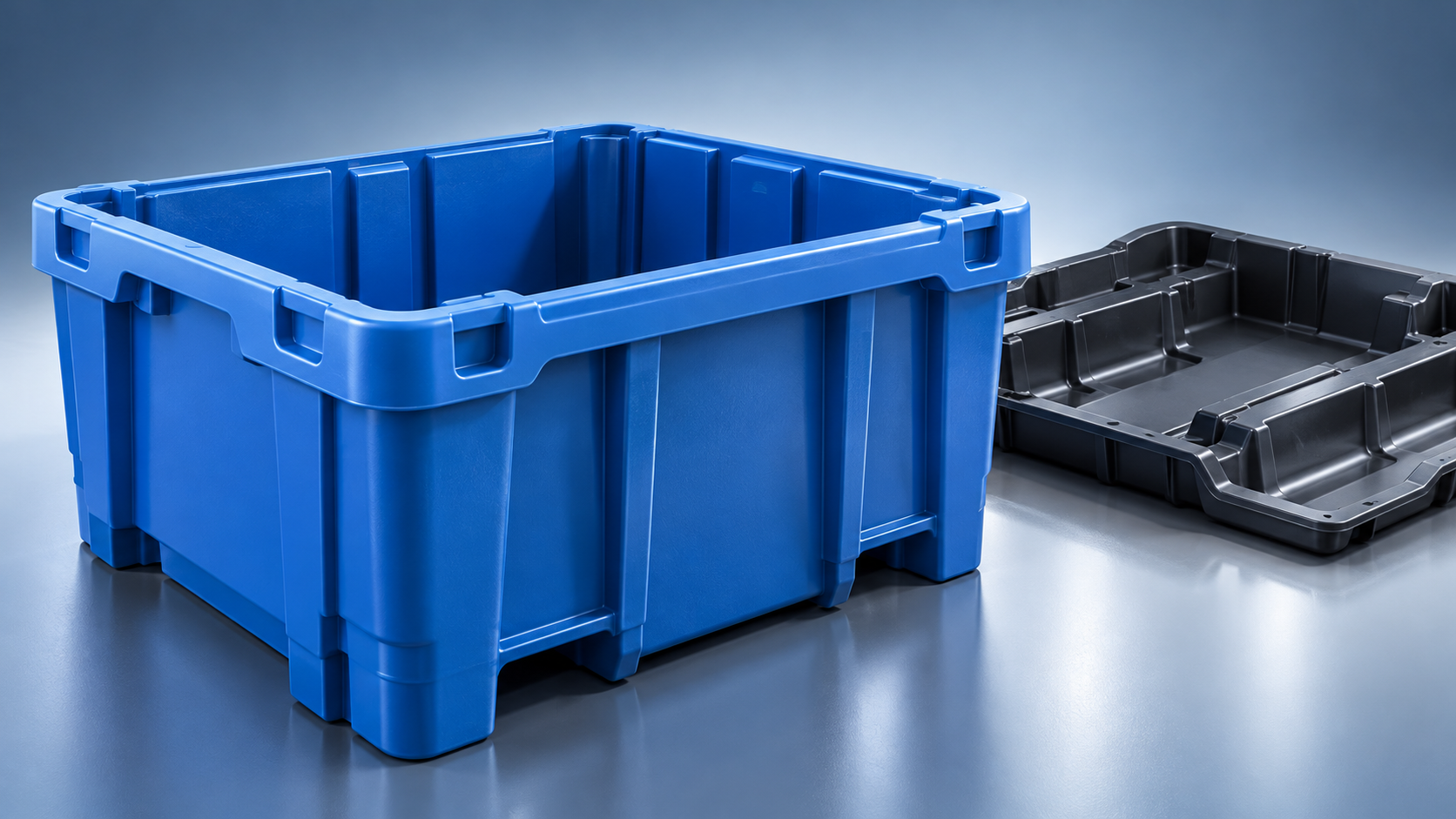
HDPE combines several properties that are useful for durable thermoformed products.
Typical advantages include:
High toughness
Good impact resistance
Excellent chemical resistance
Low moisture absorption
Good abrasion resistance
Low density
Good low-temperature performance
Availability in different colors and UV-stabilized grades
Commercial polyethylene thermoforming sheet is commonly used for transportation products, material-handling trays, pallets, agricultural equipment, liners and outdoor products.
HDPE is particularly attractive when appearance and optical clarity are less important than durability and chemical resistance.
HDPE can be thermoformed successfully, but it is generally more demanding than ABS, PETG or HIPS.
The reason is its semi-crystalline structure.
Compared with many amorphous thermoplastics, HDPE has:
A narrower useful forming window
Lower melt strength at forming temperature
More pronounced sheet sag
Greater cooling shrinkage
As the sheet approaches its forming condition, it can move from relatively stiff to very soft over a comparatively narrow temperature range.
This means good heater-zone control and consistent cycle timing are especially important.
The challenge is not whether HDPE can be thermoformed.
The challenge is keeping the sheet under control while it is hot enough to form.
There is no universal HDPE forming temperature.
Published manufacturer data demonstrates why grade-specific information is important.
Spartech lists a thermoforming range for one class of high-density polyethylene sheet of approximately:
330–400°F (166–204°C)
with an ideal reference temperature around:
370°F (188°C).
Other commercial HDPE sheet products use different processing windows. Röchling's Polystone G, for example, lists a thermoforming range around:
285–300°F (141–149°C).
The difference is significant and reflects differences in resin, molecular weight, additives and sheet formulation.
For this reason, the correct process should always begin with:
specific sheet grade → supplier TDS → machine trial → part measurement.
Do not assume a temperature taken from another HDPE product will work for your sheet.
Sheet sag is one of the most important issues in HDPE thermoforming.
As HDPE reaches forming temperature, its hot strength decreases and the unsupported sheet begins to sag under its own weight.
Some sag is expected.
Too much sag can create:
Uneven wall thickness
Premature contact with the mold or machine
Webbing
Difficult sheet positioning
Excessive thinning
Poor cavity-to-cavity consistency
The problem becomes more important with:
Large sheets
Thin sheets
Long heating cycles
Deep products
Multiple-cavity molds
Several process adjustments can help.
Not every area of the sheet needs exactly the same amount of heat.
Heating zones can be adjusted to control which areas stretch more easily.
This is particularly useful when one region of the part is deeper than another.
Longer heating is not always better.
Once HDPE reaches the required forming condition, unnecessary additional heating can rapidly increase sag.
Large-format sheets may require careful clamp design or other process measures to prevent excessive movement before forming.
A repeatable sag profile is a useful process indicator.
If the same sheet grade behaves very differently between cycles, operators should check heater output, starting sheet temperature and machine conditions.
Shrinkage is another major consideration when thermoforming HDPE.
Because HDPE is semi-crystalline, it generally contracts more during cooling than materials such as ABS or PETG.
Spartech's thermoforming data lists mold shrinkage for high-density polyethylene at approximately:
0.022–0.030 inch per inch
or roughly 2.2–3.0% for the referenced sheet family.
This number should not be copied directly into every mold design.
Actual shrinkage depends on:
HDPE grade
Sheet orientation
Forming temperature
Product geometry
Mold temperature
Cooling rate
Wall thickness
For dimensionally critical parts, prototype trials are important before finalizing tooling compensation.
If shrinkage is not considered, the finished part may be smaller than expected after cooling.
Potential problems include:
Poor fit with metal frames
Misaligned mounting holes
Assembly problems
Warpage
Different dimensions in machine and transverse sheet directions
Designers should therefore evaluate final dimensions after the part has cooled completely, not immediately after demolding.
Cooling consistency is just as important as initial mold compensation.
Yes, HDPE can be formed into relatively deep products.
However, deep drawing increases the challenge of controlling material distribution.
During forming, the original flat sheet must stretch over a larger three-dimensional surface.
The deepest walls and corners therefore tend to become thinner.
Factors affecting deep-draw performance include:
Starting sheet thickness
Draw ratio
Product depth
Corner radii
Heating profile
Mold orientation
Pre-stretching
Plug assist
Because hot HDPE has relatively low melt strength, controlling material before final mold contact is especially important.
Very sharp corners concentrate stretching in a small area.
Larger transitions allow material to distribute more gradually.
A plug can mechanically pre-stretch the hot sheet before vacuum or pressure completes the forming cycle.
This can help move material into deep areas more evenly.
Air pre-stretching can create a controlled bubble before the sheet contacts the mold.
The objective is to distribute material before final forming.
Areas that are too thin may sometimes be corrected by changing local sheet temperature rather than simply increasing starting thickness.
Good deep-forming practice focuses on material distribution, not only total material quantity.
Chemical resistance is one of HDPE's strongest advantages.
Commercial HDPE sheet is resistant to many:
Acids
Alkalis
Salts
Oils
Cleaning chemicals
Water-based solutions
This is why HDPE is frequently used for:
Chemical liners
Industrial trays
Agricultural components
Material-handling equipment
Marine applications
Reusable containers
Röchling's Polystone G chemical-resistance data shows compatibility with a wide range of acids, salts, oils and aqueous chemicals, although resistance varies by concentration and temperature.
Material compatibility should therefore always be checked against the exact chemical and operating conditions.
Pre-drying is usually not a central requirement for HDPE in the way it is for hygroscopic materials such as polycarbonate.
HDPE has low moisture absorption.
However, sheet condition still matters.
Surface contamination, condensation or unsuitable storage conditions can affect heating and surface quality.
For specialized or filled HDPE grades, manufacturers should still follow the sheet supplier's processing instructions.
HDPE can be vacuum formed for relatively simple or moderately detailed industrial products.
Typical examples include:
Liners
Trays
Covers
Agricultural panels
Material-handling products
Vacuum forming may be sufficient when the product does not require extremely sharp mold detail.
Good venting is important because the material must contact the mold before it cools below the useful forming range.
Pressure forming can provide additional forming force when a part requires:
Better mold definition
More controlled corner formation
More complex geometry
Improved surface reproduction
For industrial HDPE components with demanding geometry, a Pressure Forming Machine may offer more process control than vacuum alone.
The benefit should still be evaluated against HDPE's material characteristics because additional pressure does not solve problems caused by poor heating or uncontrolled sag.
HDPE is also a useful material for hollow or double-wall structures.
Twin-sheet thermoforming forms two heated sheets and joins them during the forming cycle.
This method can be used for products such as:
Reusable pallets
Material-handling components
Hollow industrial parts
Transport packaging
Double-wall structures
HDPE's toughness and chemical resistance make it attractive for products that must tolerate repeated handling or industrial environments.
A Twin Sheet Forming Machine is used when the product requires two formed surfaces joined into one hollow structure.
HDPE trays can withstand repeated handling while offering good resistance to moisture and many chemicals.
Products such as pallets, dunnage and returnable packaging can benefit from HDPE's toughness.
Typical examples include:
Fenders
Liners
Covers
Feeders
Equipment panels
Commercial polyethylene sheet suppliers specifically list agricultural and transportation applications among common uses.
HDPE can be used where the formed surface needs chemical resistance or moisture protection.
Applications can include:
Bed liners
Fenders
Protective panels
Interior or utility components
HDPE and ABS are both used for industrial parts, but their strengths are different.
| Requirement | HDPE | ABS |
|---|---|---|
| Chemical resistance | Excellent | Moderate |
| Impact toughness | Very good | Very good |
| Surface detail | Moderate | Very good |
| Shrinkage | Higher | Lower |
| Forming window | Narrower | Broader |
| Outdoor grades | Available | Often requires weatherable modification |
| Cosmetic surface | Functional | Better for high-detail appearance |
| Typical applications | Trays, liners, pallets, industrial parts | Housings, covers, automotive interiors |
Choose HDPE when chemical resistance, toughness and rugged service are major priorities.
Choose ABS when surface definition, dimensional control and cosmetic appearance are more important.
HDPE and polypropylene are both semi-crystalline polyolefins.
Both can require careful control of sag and shrinkage.
In general:
HDPE is often selected for:
Tough industrial products
Chemical-resistant parts
Material handling
Outdoor and transportation applications
PP is commonly selected for:
Food containers
Heat-resistant packaging
Lightweight trays
Products requiring repeated flexing
The final choice should consider service temperature, stiffness, chemical exposure and product design.
Check:
Sheet temperature
Heating time
Heater zoning
Sheet support
Possible causes include:
High draw ratio
Uneven heating
Sharp corners
Poor pre-stretching
Review:
Material grade
Forming temperature
Mold compensation
Cooling consistency
Possible causes include:
Uneven cooling
Different wall thicknesses
Premature demolding
Possible causes include:
Sheet too cool
Slow forming
Poor venting
Insufficient vacuum or pressure
Machine selection should start with the finished product.
Important information includes:
HDPE sheet grade
Sheet dimensions
Sheet thickness
Product depth
Mold dimensions
Required wall thickness
Target output
Forming method
The heating system is particularly important because HDPE requires stable temperature control within a relatively narrow useful forming window.
For detailed single-sheet industrial parts, a Pressure Forming Machine may be appropriate.
For hollow or double-wall HDPE products, a Twin Sheet Forming Machine may be the better solution.
The machine, sheet and mold should be evaluated as one production system.
Yes. HDPE can be vacuum formed, pressure formed and used in twin-sheet thermoforming for many industrial applications.
There is no universal temperature. Published commercial HDPE sheet data ranges from roughly 141–149°C for some grades to approximately 166–204°C for others. Always follow the technical data for the actual sheet grade.
HDPE has relatively low melt strength at forming temperature. As it becomes hot enough to form, the unsupported sheet can sag significantly under its own weight.
Yes. HDPE generally has greater cooling shrinkage than amorphous materials such as ABS or PETG, so tooling and cooling must account for dimensional change.
Yes, but deep HDPE parts require careful control of heating and material distribution. Plug assist, pre-stretching and larger radii can help reduce excessive thinning.
Yes. Chemical resistance is one of HDPE's key strengths, although compatibility should always be checked for the specific chemical, concentration and operating temperature.
HDPE is a strong thermoforming material for products that require toughness, chemical resistance, moisture resistance and durable industrial performance.
Its biggest processing challenges are sheet sag and shrinkage.
Unlike many amorphous plastics, HDPE has a comparatively narrow forming window and can lose hot strength quickly as it reaches forming temperature.
Successful HDPE thermoforming therefore depends on precise heating, controlled material distribution, suitable mold geometry and consistent cooling.
For rugged trays, liners and industrial parts, conventional vacuum or pressure forming may be appropriate. For hollow or double-wall products such as reusable pallets and transport components, twin-sheet thermoforming can provide an effective production route.
For a new HDPE project, evaluate the sheet grade, forming temperature, shrinkage, product geometry, mold and machine together before finalizing the process.


