
Views: 0 Author: Site Editor Publish Time: 2026-08-11 Origin: Site
Vacuum forming is an affordable way to make a small or medium number of items. You can create custom plastic parts fast without spending a lot of money upfront.
Lower starting tool costs make this method much cheaper than injection molding. You can build simple molds out of wood, 3D printing, or aluminum. These low-cost materials greatly lower your money risks when launching a new product.
While injection molding needs expensive steel tools, vacuum forming keeps your setup costs low. You can test new product designs, check local markets, and grow your business easily. This method creates dependable plastic parts while saving your money.
Vacuum forming keeps starting tool prices quite low when matched against pricey steel injection molds.
Basic mold materials like wood and 3D printed plastic reduce starting costs for making new products.
Vacuum forming saves the most money when you make small batches under 3,000 items.
Making parts with vacuum forming is much faster and less expensive than using 3D printing for medium-sized orders.
Pick your mold material depending on how many parts you plan to make. Simple wood shapes cost just $1 to $50 for fast test models. FDM 3D printed molds cost between $1 and $200. These cheap tools let you easily change your design early in the process. SLA 3D printed choices cost from $10 up to $100. Wood shapes with epoxy coating cost $200 to $2,000 for bigger project orders. Molds for vacuum forming cost two to three times less than injection molding tools.
Mold Material | Price Range (USD) | Best Usage |
|---|---|---|
Uncoated Wood / MDF | 1–50 | Basic prototypes |
FDM 3D Printed | 1–200 | Quick testing |
SLA 3D Printed | 10–100 | Smooth prototypes |
Epoxy Coated Wood | 200–2,000 | Mid-volume runs |
Selecting aluminum vacuum forming cores saves money when making large product batches. Old-style injection molding needs pricey metal equipment. Hard injection molding designs create higher money risks for your project. High costs for injection molding can easily hurt small company budgets. Molds made from steel require very large amounts of cash. Special tools for injection molding need several months to build. New companies usually skip injection molding for their first product launches. Most businesses wait for sales to rise before buying injection tools. On the other hand, vacuum forming keeps your beginning costs affordable.
Select the right plastic sheet that fits your specific project needs. Popular plastic options include ABS, HIPS, PS, PVC, and PETG. The type of plastic you pick changes your total item cost. Thicker plastic sheets cost more money to buy than thinner sheets.
Arrange your sheet setup better to waste less plastic during the heating process. Cutting your sheets correctly stops extra trash from piling up during trimming. High amounts of trash raise the price of every single part. Using your materials wisely keeps your price per piece low. Plan your sheet layout well to manage all your spending.
You need machines to warm up plastic sheets and form custom shapes. Small new machines cost at least $5,000, but larger floor models cost $11,000 to $16,000. Big factory setups run $65,000 to $93,000, and automatic thick-plastic machines start at $85,000. These versatile machines differ from the rigid equipment used in injection molding. Standard injection molding setups need massive starting cash, which adds big financial risks.
Your daily operating choices directly affect hourly machine expenses during production. Manual setups need more hands-on work, but semi-automatic tools help lower active worker costs. Multi-cavity molds cut single-item expenses faster than high-volume injection molding equipment can. Factories using injection molding often struggle to pay off equipment costs on small orders. Meanwhile, vacuum forming keeps machine running expenses very low for small product batches.
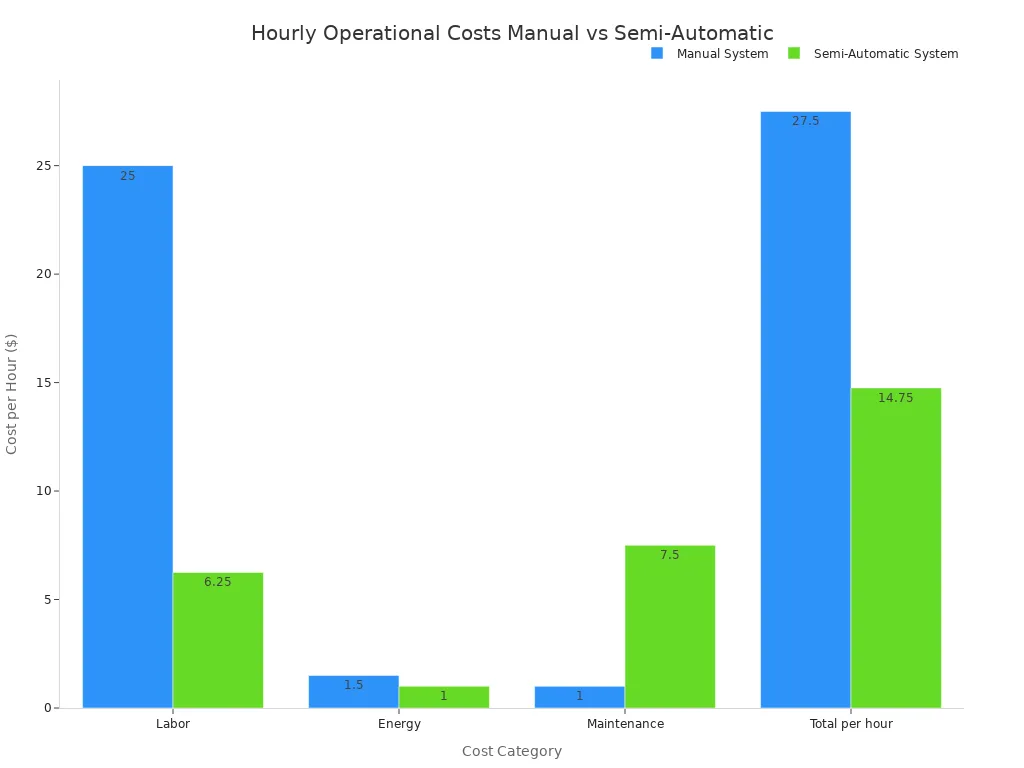
Operating Expense Category | Manual System (per hour) | Semi-Automatic System (per hour) |
|---|---|---|
Labor | $25.00 | $6.25 |
Energy | $1.50 | $1.00 |
Maintenance | $1.00 | $7.50 |
Total per hour | $27.50 | $14.75 |
Once vacuum forming shapes your plastic, workers must cut off all extra material. These trimming expenses depend mostly on your cutting method and worker speed. Injection molding parts leave molds with smooth edges, but vacuum forming needs extra trimming. Hand cutting raises your total cost, while steel rule die presses lower labor fees. Big production runs using injection molding skip these extra steps completely.
Trimming complex shapes takes careful work and precise cuts to protect overall part strength.
Intricate profiles can add significant post-processing time and cost.
A CNC router with a fixture costs $110 to $183 for every 1,000 parts. Hand knife trimming costs $275 to $550 per 1,000 parts, but metal die presses cost $18 to $37. Choosing injection molding avoids hand trimming entirely. Companies looking at injection molding still pick thermoforming to save cash on smaller product orders.
You achieve maximum financial efficiency when you select vacuum forming for smaller annual runs between 250 and 300 units. Low tooling fees let you start production without spending massive capital. Injection molding requires expensive tooling upfront. Injection molding delays your delivery schedule due to long mold creation times. Injection molding tools take months to build. Companies evaluate injection molding when planning future expansion. Choosing vacuum forming protects your cash flow.
The main crossover point happens between 3,000 and 5,000 units. Below 3,000 units, vacuum forming remains much more economical for your business. Above 5,000 units, injection molding offers a lower per-part unit price that offsets its initial tool price. Injection molding creates parts faster during massive manufacturing runs. However, injection molding carries higher financial risks if your product design changes later. Injection molding demands high initial sales to justify equipment expenses. Injection molding processes yield precise parts at scale, so injection molding dominates high-volume manufacturing. Vacuum forming works best before your total production volume reaches that high scale.
You save money by switching from industrial 3D printing to vacuum forming once orders reach 50 to 150 units. For a medium ABS part, industrial 3D printing costs $80 to $200 per unit at 500 units per year. In contrast, vacuum forming drops your price to $8 to $25. At volumes over 100 units per year, vacuum forming provides a unit cost that is 60% to 90% lower than 3D printing. For larger parts, 3D printing costs $150 to $400 per unit, while vacuum forming costs $15 to $50 per unit.
| Metric | 3D Printing | Vacuum Forming | | Tooling Cost | $0 upfront | $2,000–$5,000 one-time | | Unit Price | $25.00+ typical | $4.00–$8.00 typical | | Total for 500 Units | $12,500+ | $6,500 | | Cycle Time | 10 hours | 3 minutes | | Daily Output | ~8 parts | ~150 parts | | Failure Rate | High | Low (<1%) |
Production speed and reliability favor thermoforming for batch runs. 3D printing takes 10 hours per part, yielding roughly 8 parts across 10 machines per shift. A single machine produces roughly 150 parts in an 8-hour shift with a 3-minute cycle time. Vacuum forming maintains a low reject rate under 1%. 3D printing suffers from high failure rates due to layer adhesion issues.
To keep manufacturing costs low, adjust your mold shapes before starting large factory runs. Building standard injection molding setups costs a lot, so smart design changes save real cash early on. Outer molds need at least a 3° slant, but a 5° angle fits tricky shapes better. Inner molds need a 1° slant minimum, while deep hollow parts work best with 3°. For rough surfaces, add another 2° to 3° of slant.
Calculating draw ratios wrong creates thin spots that snap when used. A design with a 2.0 draw ratio and a 3mm final thickness needs plastic starting at 6mm thick. Stretched deep areas end up with just 30% to 40% of their starting plastic thickness.
Design Feature | Tooling and Financial Impact | Recommended Strategy |
|---|---|---|
Undercuts | Increases tooling costs above simple single-part tooling | Add secondary component installation |
Surface Texture | Increases required draft angle | Apply finish using post-process painting |
Insufficient Draft | Causes stuck parts and damages tools | Add 1°–1.5° draft per 0.001 inch texture depth |
Skip tricky internal cutouts to build simpler one-piece molds. Fancy features in injection molding molds need moving parts that drive prices up. Joining extra pieces after molding helps you avoid costly injection molding tools. Simple tool designs in vacuum forming help lower your early money risks.
Testing test models with cheap materials first gives you high design choices. Wooden molds let you check real shapes without buying injection molding setups. Fast 3D printed molds let you try several design changes within hours. Injection molding relies on costly steel tools that stop quick updates.
yield = good units / total units x 100
Changing plastic types lets you check parts without buying new molds. Normal injection molding stops easy plastic switches because parts shrink differently. Using light foam molds saves money when shaping bigger parts. Foam shapes cut down on raw material use during initial testing. You protect your cash by holding off on pricey injection molding tools. Using vacuum forming keeps upfront expenses low until you need big injection molding runs.
Vacuum forming mixes low initial mold prices with clear production limits. Starting new plastic items this way prevents the huge money risks brought by injection molding. Buying metal tools for injection molding costs a massive amount of cash at first. Even so, making items in massive amounts eventually drops the price per piece with injection molding.
Choosing vacuum forming gives you the best price when making under 3,000 items. This process lets you check customer interest before switching over to injection molding. Moving to injection molding is smart only after your item sales increase a lot. While high-volume injection molding cuts single-item costs over time, injection molding still requires huge upfront spending. Send your design files now to receive exact price quotes from suppliers before deciding on injection molding.
Pick vacuum forming when making fewer than 3,000 total items. This smart choice lowers your starting expenses. Your initial mold prices drop compared to expensive injection molding. Plus, you can check custom designs fast before moving up to high-volume injection molding.
Tooling costs for injection molding run high since shops carve exact metal tools from tough steel or aluminum. These heavy molds resist huge pressure during factory work. Meanwhile, soft non-metal molds cut early spending before you buy full-scale injection molding setups.
Yes, switching to injection molding works great as product sales climb. Using simple mold designs helps you test buyer interest with low risk. When your order numbers pass 5,000 pieces, shifting your project to injection molding reduces your individual part price.
Yes, injection molding creates almost zero trash. This method fills hollow spaces neatly without extra plastic margins. Vacuum forming forces employees to cut off leftover plastic sheet borders after forming, which creates extra labor costs for your business.


