
Views: 0 Author: Site Editor Publish Time: 2026-09-16 Origin: Site
In high-volume thermoforming, production agility often dictates profitability. Packaging manufacturers increasingly seek equipment capable of handling multiple polymers to adapt to shifting market demands.
While many vendors advertise a universal PP PET PS thermoforming machine, the thermodynamic and mechanical realities of these plastics differ wildly. Treating them interchangeably leads to high scrap rates, tooling wear, and poor product clarity. You cannot simply swap polymer rolls and expect identical production speeds.
This guide provides a technical and commercial framework for evaluating multi-material machines. You will learn how to align hardware specifications with your specific product applications and chosen materials. Read on to discover actionable steps for optimizing your production line.
You must understand the distinct chemical characteristics of each polymer. This knowledge dictates your hardware requirements. Let us explore the three dominant materials used in thermoforming today.
Polypropylene is a semi-crystalline polymer. It is highly durable and resists heat exceptionally well. Manufacturers often use it for microwavable food containers, hot-fill packaging, and living-hinge applications.
However, PP introduces significant manufacturing challenges. It requires massive amounts of thermal energy to reach a pliable state. Once heated, it becomes prone to thermal sag inside the oven. After forming, it shrinks drastically.
A dedicated PP thermoforming machine demands specific hardware configurations. You will need longer heating ovens to penetrate the material evenly. You also need powerful vacuum and pressure systems to force the stiff polymer into mold cavities. Finally, heavy-duty cutting presses are mandatory to trim the resilient plastic without leaving frayed edges.
PET, commonly used in its amorphous forms like APET or RPET, offers excellent optical clarity. It provides strong barrier properties against moisture and oxygen. It is also highly recyclable. This makes it perfect for cold food packaging, clamshells, bakery trays, and retail blister packs.
Operating a PET thermoforming machine requires finesse rather than brute force. The processing temperature window is extremely narrow. Precise heater controls are essential. If you overheat PET, it begins to crystallize. This crystallization turns the normally transparent plastic milky and brittle.
Best Practice: Use zoned quartz heaters when running PET. They respond quickly to temperature adjustments, preventing accidental crystallization during unexpected line stoppages.
Polystyrene is an amorphous plastic. It is famously easy to form. It has a low specific heat, meaning it warms up and cools down very quickly. Standard PS is rigid but can be brittle. To solve this, manufacturers often blend it with rubber to create High Impact Polystyrene (HIPS).
You will typically use PS for disposable plates, cup lids, seedling trays, and inexpensive insert packaging.
A dedicated PS forming machine generally operates at rapid cycle times. Because the material softens easily, it requires less heating energy. It also requires significantly less cutting force compared to PP and PET.
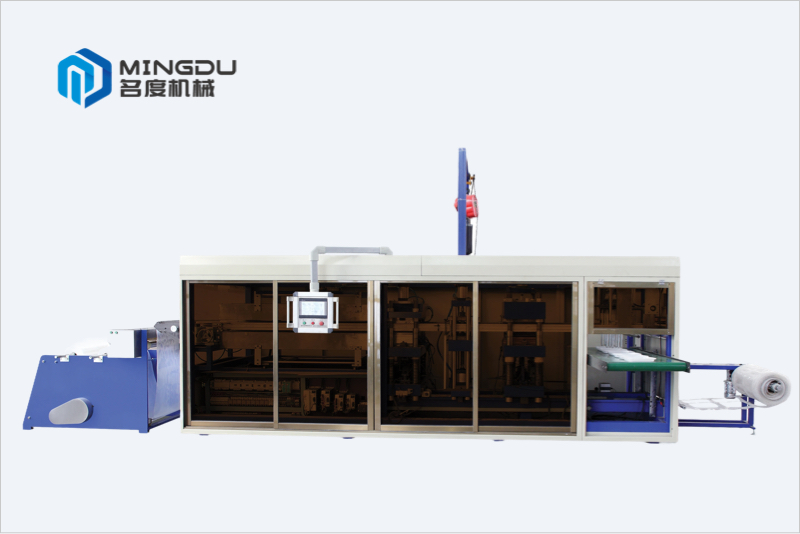
If you want a single machine to handle all three materials, you must scrutinize its hardware. Basic machines will struggle to cross the divide between stiff PP and delicate PET. Here are the core components you need.
Your oven must feature ceramic or quartz heaters with granular, multi-zone temperature control.
This matters because processing windows vary wildly. PS forms at much lower temperatures. PP needs deep, consistent heat to avoid webbing in the corners of your mold. If your machine only offers basic top-and-bottom heat zones, you will fail to process PET and PP efficiently. Independent zones allow you to profile the heat, sending more energy to the sheet edges and less to the center.
A multi-material machine must include servo-driven plug assists. Pneumatic plugs lack the necessary control.
You need fully programmable plug speeds and depths. PET and PP often require precise pre-stretching before the vacuum activates. This ensures uniform wall thickness in deep-draw products like beverage cups. Shallow PS products might not need complex plug assists, but the hardware must be present for your harder polymers.
Multi-material production requires high-tonnage, heavily reinforced cutting stations. You cannot afford chassis flex during the cutting phase.
Common Mistake: Using the exact same blade temperature and clearance settings for all three plastics. You must adjust your cutting station mechanics for each specific polymer.
Cooling dictates your cycle time. Your machine needs chilled aluminum tooling compatibility and high-velocity air cooling.
PP retains heat much longer than PS. Without aggressive cooling systems, your cycle times will plummet. If you eject PP too early, the parts will warp on the conveyor belt. A robust machine uses water-cooled molds alongside industrial fans to shock the material into its final rigid state.
Choosing the correct polymer goes beyond machine compatibility. You must align your material with end-user requirements and regional legislation. Proper plastic sheet material selection ensures market viability.
Start by analyzing the consumer's interaction with the packaging. Ask your team these fundamental questions:
You must assess local legislation regarding single-use plastics. Many regional governments are actively phasing out certain polymers. Polystyrene (PS), particularly expanded polystyrene, faces strict bans in several major global markets.
This legislative pressure drives a massive industry transition toward PET and PP. RPET offers an excellent circular economy narrative. If sustainability mandates apply to your business, ensure you can source reliable, local recycled content. Your machine must handle the slight inconsistencies inherent in recycled sheet extrusions.
Table 1: Quick Reference Guide for Polymer Selection
| Polymer Type | Forming Difficulty | Shrinkage Rate | Primary Advantage | Ideal Application |
|---|---|---|---|---|
| Polypropylene (PP) | High | 1.5% - 2.0% | High heat resistance | Microwaveable food containers |
| Polyethylene Terephthalate (PET) | Medium | 0.4% - 0.7% | Excellent clarity | Cold food clamshells |
| Polystyrene (PS) | Low | 0.4% - 0.6% | Fast cycle times | Disposable lids and plates |
A versatile machine is powerful, but it requires strict operational discipline. Switching between polymers introduces hidden challenges. You must proactively manage these risks to maintain profitability.
Many novice manufacturers assume they can swap a roll of PET for PP and use the same mold. This is a critical error.
As noted, PP has a shrinkage rate of roughly 1.5% to 2.0%. Meanwhile, PET and PS shrink only about 0.4% to 0.7%. If you form PP in a mold designed for PET, the final PP product will be noticeably smaller.
Mitigation: You must budget for material-specific tooling. If your product requires precise dimensional tolerances, such as a snap-fit lid on a deli container, sharing a mold across different polymers will result in lids that leak or pop off.
Switching polymers takes time. It requires a full oven temperature reset. The cooling system needs adjustment. You often have to replace cutting blades or fine-tune clearances.
Relying on an operator's memory to perform these tasks causes scrap and delays.
Mitigation: Evaluate the machine’s HMI (Human-Machine Interface). Look for robust recipe saving features. A modern control panel allows you to save exact heater profiles, plug depths, and cooling times for specific materials. Automated set-point adjustments drastically reduce your reliance on tribal knowledge.
Thermoforming generates skeletal scrap. Most facilities grind this scrap and sell it or re-extrude it.
If you mix PET and PP in your skeletal scrap grinder, you will ruin the recyclable value of the scrap. The two plastics have vastly different melting points. Mixed regrind creates useless, degraded pellets.
Mitigation: Enforce strict factory floor discipline. Implement thorough purging and cleaning protocols for your grinders between production runs. Color-code your scrap bins to prevent accidental mixing.
Before you sign a purchase order, you must validate the manufacturer's claims. Buying a multi-material system is a major commitment. You need tangible proof of performance.
Do not accept sample runs on easy materials. A vendor might gladly show you their machine running thin PS at lightning speed. This proves very little.
Force the vendor to run your thickest, most difficult PP or RPET formulation. Require them to produce your actual part design if possible. During the FAT, measure the exact cycle time. Inspect the trimmed edges for angel hair. Verify that the product meets your exact dimensional tolerances.
Choose vendors who are transparent about production trade-offs. Running multiple materials inherently involves thermodynamic compromises.
If a machine runs PP, it uses heavier cutting stations and longer ovens. When that same machine runs PS, it might carry unnecessary mass, slightly capping its maximum speed compared to a dedicated PS line. A trustworthy vendor will openly discuss these realities. If a salesperson claims "zero compromise across all materials," you should remain highly skeptical.
Investing in a versatile thermoforming machine provides a strategic hedge against market volatility. However, true multi-material capability requires sophisticated hardware. You cannot cut corners on heating zones, plug assists, or cooling systems.
The key to high returns lies in operational discipline. You must manage tooling shrinkage carefully. You need strict recipe management on your HMI. You also must enforce rigorous changeover protocols to prevent scrap contamination.
Next Step: Audit your current product mix today. Determine your highest-volume, most difficult material. Then, require your shortlisted machine manufacturers to prove their equipment's capability on that exact specification before you commit to a purchase.
A: Yes, provided the machine has robust multi-zone heating and high-tonnage cutting presses. PP needs high heat, while PET requires a narrow, precise temperature window. However, because their shrinkage rates differ greatly, you will likely need entirely separate molds for each material to maintain accurate product dimensions.
A: PP has a higher specific heat. It requires more thermal energy and time to heat up and cool down. It is also highly prone to "thermal sag" in the oven. Furthermore, PP is incredibly resilient, making it significantly harder to die-cut cleanly compared to brittle PS.
A: The machine itself does not inherently slow down, but the material dictates the ultimate speed. Running PP on a multi-material machine will always yield slower cycle times than running PS on that exact same equipment. This limitation is driven by basic thermodynamics, not mechanical flaws.
A: Because plastics shrink at different rates after cooling, precise parts require specific molds. A PP snap-fit lid needs a different mold cavity size than a PET lid. Universal molds only work for products with very loose dimensional tolerances, meaning you must budget for material-specific tooling.


