
Views: 0 Author: Site Editor Publish Time: 2026-09-21 Origin: Site
In high-volume plastics manufacturing, fractions of a second dictate profit margins. A machine's cycle time is the ultimate governor of your floor's profitability. Many manufacturers struggle to scale because they treat cycle time as a static number. They fail to isolate the specific bottlenecks within heating, cooling, or material handling. These hidden constraints severely throttle their overall thermoforming production rate. This guide breaks down the anatomy of a machine's production cycle. By analyzing how heating precision, cooling infrastructure, and automated stacking interact, buyers and production managers can better evaluate equipment. You will learn to identify upgrade triggers and calculate accurate returns for new machinery investments. We outline clear, actionable strategies to help you maximize daily throughput without sacrificing part quality.
Optimizing your thermoforming machine cycle time requires dissecting each sequential step. You cannot improve what you do not measure. A standard production cycle consists of several distinct phases working in harmony. If one phase lags, the entire machine must wait.
We can break down the typical continuous thermoforming sequence into these specific phases:
You must identify your "pacing" phase. This is the slowest step acting as the limiting factor. In continuous roll-fed thermoforming, cooling usually dictates the pace. Thin-gauge packaging heats quickly but struggles to shed heat fast enough. Conversely, in heavy-gauge sheet-fed operations, heating becomes the primary bottleneck. Thick sheets require prolonged soaking times to ensure the core reaches formability without burning the surface.
Shaving just one or two seconds off a cycle yields massive returns. If your machine runs a 12-second cycle, reducing it to 10 seconds increases your output by 20%. Over a three-shift operation running six days a week, those two seconds translate into millions of extra parts annually. This is why buyers should demand transparent cycle estimates from equipment vendors. Do not accept best-case-scenario spec sheets. Request estimates based on your exact materials and mold layouts.
Common Pacing Phases by Production Type
| Process Type | Primary Pacing Phase | Typical Material Gauge | Optimization Focus |
|---|---|---|---|
| Roll-fed (Thin-gauge) | Cooling | 0.2mm - 1.5mm | Mold chilling capacity, chilled air |
| Sheet-fed (Heavy-gauge) | Heating | 1.5mm - 10.0mm+ | Zoned IR heaters, double-sided ovens |
| High-speed Packaging | Stacking/Trimming | Under 1.0mm | Robotic handling, inline automation |
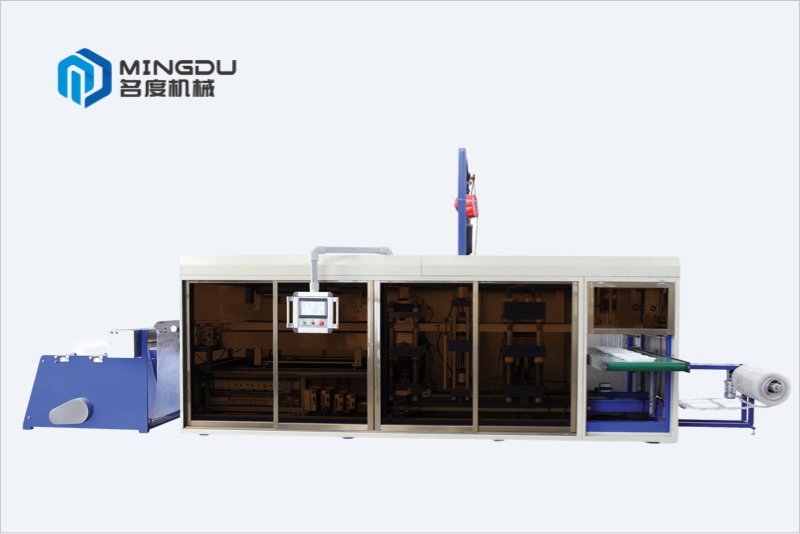
The physics of heating plastic dictate strict boundaries for machine speeds. Different polymers absorb thermal energy at drastically different rates. Polyethylene Terephthalate (PET), Polypropylene (PP), and Polystyrene (PS) each have unique molecular structures. You cannot apply a universal heating strategy across all materials. Pushing heat too fast causes severe surface degradation. The outside layers burn while the core remains rigid. This ruins core formability and leads to rejected parts.
Traditional heating systems often rely on basic calrod or standard ceramic elements. They struggle to deliver uniform heat distribution. Operators usually compensate for cold spots by extending the soak time. They force the machine to wait until the sheet's center matches the temperature of the edges. This outdated approach wastes energy and limits production capacity.
Upgrading to advanced infrared (IR) zoning changes everything. Modern machines utilize targeted IR sensors and individually controllable heating zones. They measure the exact surface temperature of the plastic web in real-time. This allows for rapid, uniform heat penetration. Zoned control pushes more energy to the center of the sheet while backing off the edges, safely minimizing heating time.
Best Practices for Evaluating Oven Configurations:
Many floor managers overlook cooling infrastructure when diagnosing slow production. The trade-off between speed and warpage represents a daily challenge. If you eject a part before it cools below its heat deflection temperature, it will warp. The part loses its structural integrity. However, leaving the part in the mold too long destroys your output targets. You must strike a perfect balance.
Passive cooling systems rely heavily on ambient air. They quickly hit their limitations in high-speed applications. Ambient air simply cannot extract heat fast enough to support aggressive cycle speeds. You need active cooling interventions.
Active cooling systems utilize internal water-cooled mold circuits. High-efficiency chillers pump freezing fluid through intricate channels cut directly into the aluminum tooling. Chilled air blowers and micro-misting systems also accelerate heat extraction from the top surface of the web. This dual-sided approach dramatically shrinks the required cooling time.
Material selection heavily influences your cooling strategy. Crystalline materials like Polypropylene (PP) release latent heat slowly. They demand aggressive chilling strategies and naturally require longer cooling cycles. Amorphous materials like PET cool much faster and hold their shape reliably at higher ejection temperatures.
When evaluating a new machine, scrutinize its chilling capacity. Check the BTU removal rate of the supplied chillers. Furthermore, ask the OEM about their expertise in designing molds. A poorly designed mold with suboptimal thermal conductivity will negate the benefits of a high-end chiller.
A thermoforming machine can only run as fast as its exit mechanism. We call this the downstream ripple effect. If your finished parts cannot be trimmed and stacked efficiently, you must throttle the forming station. It does not matter how fast you can heat and form the plastic if the exit conveyor backs up.
There are several types of stacking solutions available today. Up-stackers push formed parts upward into a catching mechanism. They work well for simple, nestable geometries. Down-stackers operate in reverse, pulling parts downward onto a moving belt. For complex geometries, fragile packaging, or heavy industrial parts, robotic pick-and-place systems offer the best solution. Multi-axis robots gently remove parts and stack them with perfect precision.
Automated handling protects consistency and yield. Relying on manual labor to catch, count, and stack parts introduces a human variable. Operator fatigue eventually dictates the machine's pace. A tired worker forces the machine operator to slow the cycle down. Automation ensures 100% synchronization with the primary forming cycle. The stacker never tires, never loses count, and never forces the oven to pause.
Stacking Evaluation Criteria for Buyers:
Evaluating new equipment goes beyond reviewing spec sheets. You must look at how the machine's underlying architecture supports sustained speeds. Control systems and automation play a pivotal role. Advanced Programmable Logic Controllers (PLCs) and intuitive Human-Machine Interfaces (HMIs) allow operators to save material recipes. When an operator recalls a recipe, the machine instantly resets oven temperatures, index lengths, and timing delays. This guarantees cycle repeatability across different shifts and eliminates guesswork.
Equipment versatility also matters. You must balance the need for speed with the ability to handle multi-product changeovers quickly. Look for machines featuring universal tooling compatibility and motorized adjustable chain rails. Quick-change mold bases allow you to swap products in minutes rather than hours. This keeps the machine running and producing revenue.
Preventive Maintenance (PM) integration heavily influences long-term output. Over several months, failing heating elements or clogged mold cooling lines secretly degrade cycle speeds. The machine runs hotter and slower. Look for modern equipment featuring built-in PM alerts. The HMI should notify operators when a specific heater band fails or when chiller pressure drops. Accessible maintenance points help technicians resolve issues quickly to maintain day-one speeds.
When shortlisting vendors, move beyond the initial sticker price. Evaluate these thermoforming cycle time factors based on operational performance. Calculate the total output value by factoring in the guaranteed production rate and energy consumption per cycle. A cheaper machine that requires a three-second longer cycle will cost you millions in lost revenue over its lifespan. Finally, assess the OEM's local support network. Fast access to process optimization engineers ensures your machine stays dialed in for maximum throughput.
Optimizing thermoforming output requires a holistic view of heating, cooling, and downstream handling. Fixing one bottleneck often reveals another. Upgrading your heating elements might expose inadequacies in your chiller system. Solving the cooling issue might overwhelm your manual stacking crew. You must treat the entire machine as an interconnected ecosystem.
When procuring new equipment, require vendors to prove their claims. Force them to run cycle simulations using your exact materials and part designs. Demand transparency regarding energy consumption and tooling limitations.
Your next step is to audit your current floor. Measure your active cycle times and isolate your specific bottlenecks. Consult with an equipment engineer to evaluate ROI-justified machine upgrades. By investing in precision heating, active cooling, and seamless automation, you will dramatically increase your hourly yield and widen your profit margins.
A: It ranges widely based on the application. For thin-gauge packaging, a cycle typically lasts 2 to 4 seconds. Heavy-gauge industrial parts may require cycles lasting several minutes. The total duration depends entirely on material thickness, polymer type, and the efficiency of the cooling infrastructure.
A: Material thickness shares a non-linear relationship with heat penetration. Doubling the sheet thickness often more than doubles the required heating time. Thick sheets require slow, soaking heat to penetrate the core without burning the outer layers. Double-sided heating ovens are critical for thicker materials.
A: Yes, provided you upgrade your tooling and infrastructure. You must use temperature-controlled aluminum tooling equipped with optimized water channels. Pairing these molds with appropriately sized industrial chillers accelerates heat extraction safely, preventing warpage while minimizing cycle delays.
A: Spec sheets display dry-cycle speeds under ideal conditions. Real-world variables reduce actual output. Common culprits include material inconsistencies, inadequate chiller sizing, manual stacking delays, and sub-optimal recipe settings. Eliminating these variables through automation and recipe recall bridges the gap.


