
Views: 0 Author: Site Editor Publish Time: 2025-08-25 Origin: Site
Want to get better results from pressure forming? Begin with these tips:
Pick the best material for your project.
Make molds that show clear details.
Use the right temperature and pressure each time.
Solve common problems quickly.
Test new ways for creative pressure forming.
Even small changes in your steps can help a lot. You can make great parts if you make smart choices.
Pick the best thermoplastic material for your project. This helps make strong parts and is good for the environment.
Make molds with clear details and smooth surfaces. This makes parts better and helps them get made faster.
Watch the temperature and pressure during forming. This helps you get the best results.
Use good inspection steps to find problems early. This keeps your parts high quality.
Use machines and lean manufacturing to lower costs. This also helps make production faster and better.
Picking the right thermoplastic is very important. You need a material that fits what your part needs. Some common choices are:
Acrylic
Acrylonitrile Butadiene Styrene (ABS)
Acrylic Styrene Acrylonitrile (ASA)
Conductive Plastics
High-Density Polyethylene (HDPE)
High Impact Polystyrene (HIPS)
High Molecular Weight Polyethylene (HMWPE)
Polyester Terephthalate Glycol (PETG)
Polyvinyl Chloride (PC)
Thermoplastic Olefin (TPO)
Every material has its own benefits. HDPE and PETG are better for the environment. Polypropylene uses less energy and makes fewer greenhouse gases. If you want to help the planet, try recycled materials. Even a little recycled polyamide is good for nature.
The thickness of your sheet is important. Thicker sheets make parts stronger and tougher. These are good for things like electronic cases. Thin sheets help you make small details and smooth surfaces. This is great for testing ideas or making fancy designs.
| Factor | Thicker Materials | Thinner Materials |
|---|---|---|
| Mold Design | Need deeper, detailed molds | Need simpler molds |
| Structural Integrity | More durable | Less durable |
| Surface Quality | Can be uneven if not designed well | Allow for intricate designs |
| Material Cost | Usually cost more | Cost-effective for large production |
You must get your thermoplastic sheets ready before pressure forming. This helps you stop problems and get a nice finish. Many plastics need to be dried first. ABS should be dried at 70–80°C for 2–3 hours. Acrylic needs 70–100°C for 2–6 hours. Polycarbonate dries best at 120°C for 4–6 hours. Always check how long and how hot to dry your material.
Tip: Wear clean gloves when you touch your sheets. This keeps dust and oil away. Store sheets flat so they do not bend.
Lots of thermoplastics can be recycled, but not every recycling center takes all types. If you want to help the earth, pick HDPE, PETG, or TPO. These choices are better for your project and the environment.
You want your mold to make parts with sharp details. Smooth finishes are important too. The right features help a lot. Look for these important mold design parts:
| Feature | Description |
|---|---|
| Surface Detail | Pressure forming lets you make clear textures and patterns. |
| Styling Features | You can add logos and designs that look like injection molded parts. |
| Defined Edge and Corner Radii | Sharp corners are possible, which is hard with vacuum forming. |
| Significant Depth of Draw | Deep molds help you create three-dimensional shapes. |
| Undercuts | You can make lips that go inward or areas that are lower for tricky parts. |
| Tooling Design Considerations | Drafts, undercuts, and corner radii help you get a good fit and easy release. |
A good mold gives you detailed parts every time. You also get faster production and parts that look the same. Good tooling design means less downtime and fewer mistakes. You spend less time fixing problems and more time making good parts.
Tip: Think about the final part when you plan your mold. Each feature changes how the part looks and how strong it is.
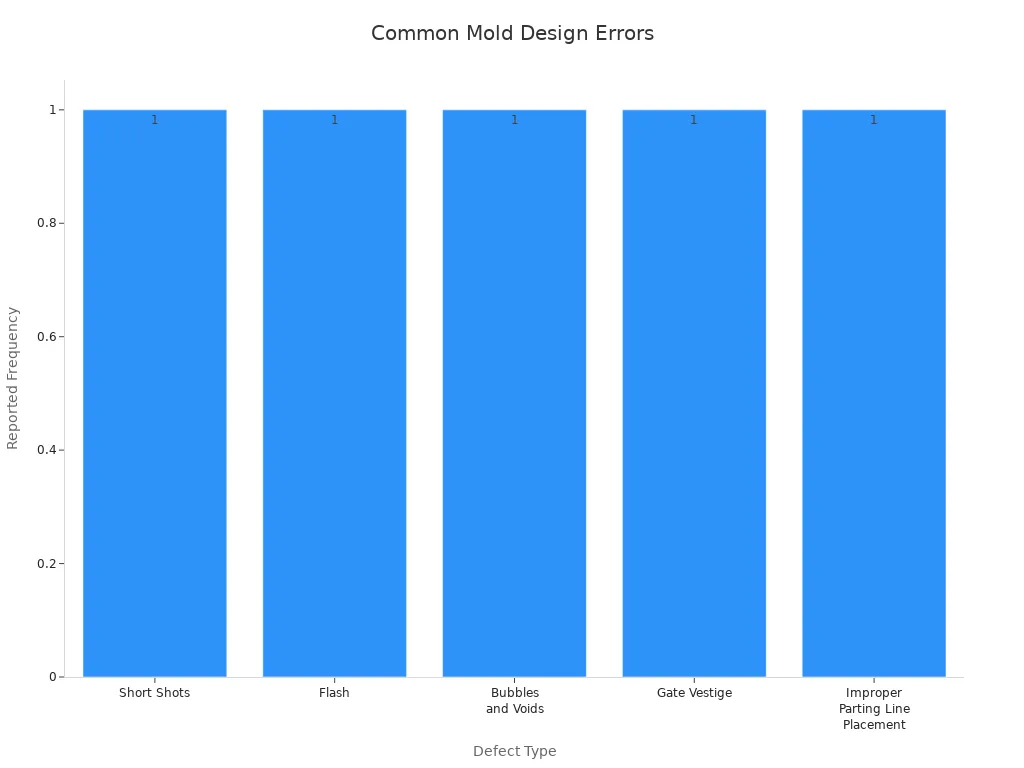
Many projects have problems because of mold design mistakes. You can avoid these problems if you know what to look for.
| Defect Type | Description | Root Causes | Design Fixes |
|---|---|---|---|
| Short Shots | Mold does not fill all the way. Parts get thrown away. | Thin spots, sudden changes, long flow paths, low pressure. | Keep wall thickness the same. Use smooth changes. Test flow before making the mold. |
| Flash | Thin pieces show up along parting lines. | Too much pressure, bad mold fit, old tooling. | Put parting lines away from corners. Use the same draft angles. Check parting line spots early. |
| Bubbles and Voids | Bubbles or empty spots make the part weak. | Wet material, bad venting, quick thickness changes. | Keep wall thickness the same. Do not change thickness quickly. Add ribs for packing. Use vents. |
| Gate Vestige | Marks show where plastic goes into the mold. | Big gates, bad spots. | Put gates on hidden areas. Use tunnel gates. Plan trimming when you design. |
| Improper Parting Line Placement | Seams or flash show up from bad parting line spots. | Bad checking, poor alignment. | Plan parting lines early. Do not put them over important areas. Line up with sharp edges to hide them. |
You can make parts the same each time by setting fill speed and hold pressure right. These steps help you get even parts and better cooling. Always check your mold for wear and alignment before you start a new batch.
Note: Fixing mold mistakes early saves you time and money. Check your design and test with a sample run.
You can make better parts by setting the right temperature and pressure. Each material needs its own settings to work well. For example, PEEK plates need 400 °C, 30 minutes of compression, and 2.5 MPa pressure. If you use too little pressure, you will not get small details. If you use too much, you might get problems. You need to find the best amount for each job.
| Aspect | Description |
|---|---|
| Technology Focus | Fluid pressure forming technology for complex thin-walled components. |
| Key Areas of Study | Deformation behavior, stress state adjustment, defect prevention. |
| Application Industries | Aerospace, aircraft, automobile, high-speed train industries. |
| Importance of Pressure Settings | Pressure settings are crucial for achieving desired deformation behavior and preventing defects, which directly impacts the formation of fine details in parts. |
You must watch temperature and pressure closely during pressure forming. Sensors help you do this job well. Pressure sensors help you use plastic and machine time better. Thermocouples give fast temperature readings. RTDs help keep the temperature steady. Thermistors show big changes when the temperature changes.
| Sensor Type | Key Features | Advantages |
|---|---|---|
| Pressure Sensors | Optimize number and location | Ensures optimal use of plastics and machine time |
| Thermocouples (T/C) | Short response time | Quick temperature measurement |
| Resistance Temperature Detectors (RTD) | Stability and predictability | Less drift and easier calibration |
| Thermistors (TMs) | High resistance dependence | Large change in resistance with small temperature change |
Tip: Always check your sensors before you start. This helps you find problems early and keeps your process running well.
Changing temperature and pressure can make your parts stronger. If you raise the temperature or keep pressure longer, your parts can get tougher. If you use too much pressure, you may not see more improvement. You should test your settings to see what works best for your material.
You want to make parts quickly, but you also want good quality. Pressure forming makes complex parts faster than vacuum forming. Thermoforming takes longer than injection molding, but it costs less for small batches.
Pressure forming can make complex parts faster than vacuum forming.
Thermoforming takes longer than injection molding but is cheaper for small amounts.
You can make your cycle time shorter by making smart choices. Here are some ways to do that:
Use thinner walls. Thin walls fill and cool faster.
Adjust machine settings. Change pressure and speed to stop delays and problems.
Pick the right materials. Materials that flow better fill molds faster.
Make cooling better. Good cooling channels and regular checks make cooling quicker.
Good mold design helps you put cooling channels and gates in the best places.
Materials that flow well move through the mold faster.
Changing injection speed and mold temperature can make cycles faster and keep quality high.
Cooling is often the longest part of the cycle. To make it shorter, use special cooling systems that cool parts fast and evenly without losing quality.
You should watch your cycle time every time you pressure form. If you see slowdowns, check your cooling system first. You can also try different materials and machine settings to find the fastest way that still makes strong, detailed parts.
You will see defects in pressure forming. Most problems can be fixed if you know what to do. Here are some common issues and why they happen:
Warping: Parts bend if cooling is not even or the material is wrong.
Sink Marks: Not enough material makes dents in the part.
Short Shots: The mold does not fill, so parts are not complete.
Flashing: Extra material leaks out and makes thin edges.
Burn Marks: Material gets too hot and leaves dark spots.
Flow Lines: Cooling speed or wall thickness changes make lines.
Flow Marks: Slow injection speed causes patterns and uneven cooling.
Tip: Check your material and machine settings before you start. Small changes can stop big problems from happening.
You can fix these defects by doing a few things:
Look at your raw materials before you use them. Bad materials can cause warping and delamination.
Tune your machines often. Machines that are not set right can make flashing and short shots.
Watch your process with sensors and data. This helps you find problems like uneven cooling or pressure drops early.
Here is a table to help you solve problems fast:
| Checkpoint | Description | Importance |
|---|---|---|
| Material Inspection | Check raw material quality | Stops defects like delamination |
| Equipment Calibration | Tune machines often | Keeps product quality the same |
| Process Monitoring | Use sensors and data | Helps you find and stop defects |
Note: If you see warping or sink marks, try changing the cooling time or use better material. For flashing, check your mold fit and pressure settings.
You need good inspection methods to make sure your pressure forming parts are high quality. Different ways help you find surface and inside defects.
| Inspection Method | Description | Applications |
|---|---|---|
| Visual Inspection | Look at the part to find surface problems. You need training and sometimes special tools. | Surface defects and welds |
| Ultrasonic Inspection | Uses sound waves to find hidden problems inside parts. | Aerospace, automotive, manufacturing |
| Radiographic Inspection | Uses X-rays or gamma rays to see inside and find voids or scratches. | Voids, scratches, material thickness |
| Liquid Penetrant Inspection | Puts liquid on the surface to show cracks and leaks. | Hard-to-find surface defects |
| Hydrostatic Testing | Fills parts with fluid under pressure to check for leaks. | Pressure vessels and pipes |
| Pneumatic Testing | Uses pressurized gas to find leaks, good for systems that cannot use water. | Small leaks in sensitive systems |
| Thermographic Testing | Uses infrared cameras to spot temperature changes that show defects. | Building and mechanical system inspections |
| Shearography | Measures surface changes under stress to find defects in composites. | Aerospace and automotive |
New technology makes inspection better. You can use phased array ultrasonics for real-time pictures and faster defect finding. Smart sensors and IoT systems let you watch your process all the time. Machine learning helps you find defects quickly and more accurately.
Here is a table of new inspection tools and what they do:
| Technology | Benefits |
|---|---|
| Phased Array Ultrasonics | Finds defects fast, gives real-time pictures |
| Drones | Safer checks, faster data collection |
| Smart Sensors | Always watching, predicts when to fix things |
| IoT Integration | Better data and trend spotting |
| Machine Learning | Finds defects automatically, more accurate |
You should follow industry rules for quality control. Always check your materials before you use them. Make sure your team is trained and certified. Store your materials and tools the right way. Keep good records of every check and test.
| Aspect | Description |
|---|---|
| Material Inspection | Check materials to meet code rules |
| Welder Qualification | Certify welders as your quality manual says |
| Welding Consumables Handling | Store and track filler metals the right way |
| Visual Inspection | Quality manager checks welds for rules |
| Non-Destructive Testing | Look at NDE reports to meet code rules |
| Documentation | Finish a Manufacturer’s Data Report near project end |
Remember: Good inspection and quality control keep your products safe and strong. You save time and money by finding problems early.
You can make pressure forming parts look better and last longer. Start by working on the mold. Add textures or patterns to the mold surface. This gives your parts clear details and a nice look. You can use sandblasting, chemical etching, or laser engraving for textures. These methods help hide small flaws. They also make your parts stand out.
Secondary finishing steps are important too. When you finish metal parts, you change the surface. This makes them stronger and better looking. It protects parts from rust and damage. For plastic parts, pick finishing steps that fit the material and your budget. Good finishing helps parts last longer and look nicer. It also meets what customers want for style and strength.
Tip: Pick finishing steps that match your part’s material and use. This helps you get the best look and strength for every project.
You can spend less and make more money by using smart steps. Top manufacturers save money by using the same workflow every time. When you follow the same steps, you make fewer mistakes and work faster. Automation helps lower labor costs and improve quality. Machines do hard jobs, so your team can focus on important work.
Lean manufacturing is another way to save money. You remove waste and use resources better. This means you spend less and finish jobs faster. You also get lower tooling cost when you design molds for easy prototyping. If you pick materials that work well, you get more good parts and less waste. Testing materials before you start helps you avoid problems and keeps costs down.
Here are some ways to save money:
Use the same workflow to make fewer mistakes.
Get automation to speed up production.
Use lean ideas to cut waste.
Pick materials that give you more good parts.
Design molds for easy prototyping to lower tooling cost.
| Strategy | Benefit |
|---|---|
| Standardized Workflow | 5-10% cost reduction |
| Automation | Lower labor cost, better quality |
| Lean Manufacturing | Less waste, faster production |
| Material Optimization | Lower cost, higher reliability |
Note: When you use materials wisely, you get safer and stronger parts and spend less. Good planning helps you lower tooling costs and get better results.
You can get better pressure forming results if you pick good materials. Smart mold design helps a lot too. Setting the right process steps is important. Many companies do much better when they use new methods.
| Improvement Type | Percentage Improvement |
|---|---|
| Energy savings | Up to 23% |
| Production increase | 18% |
| Reduction in sheet breaks | 62% |
Try a new tip for your next project. You can share your ideas or ask questions below. Every small change helps you make stronger and better parts.
You should match the material to your part’s needs. Look at strength, thickness, and finish. Try recycled plastics for eco-friendly projects. Ask your supplier for samples before you decide.
You can keep cooling even across the mold. Use the right material for your design. Watch your machine settings. Test a small batch first to spot problems early.
Wet material or poor venting causes bubbles. Dry your sheets before forming. Add vents to your mold. Check for sudden thickness changes in your design.
Visual inspection finds surface flaws fast. Use ultrasonic or radiographic testing for hidden defects. Train your team to spot problems early. Keep records of every check.
You can use automation to lower labor costs. Pick materials that give you more good parts. Design molds for easy changes. Follow the same workflow every time to avoid mistakes.


