
Views: 0 Author: Site Editor Publish Time: 2026-10-21 Origin: Site
Clamshell and blister packaging are both widely used thermoformed retail packaging formats, but they solve different packaging problems.
A clamshell usually encloses the product between two formed plastic sections, often connected by a hinge. A blister package normally uses one formed plastic cavity attached to a printed card, film or other backing.
Neither format is automatically better. The right choice depends on what matters most for your product: cost, visibility, security, branding, tooling, packing method and automation.
For a broader overview of thermoformed packaging formats and production methods, see the Thermoformed Packaging Guide.
| Factor | Clamshell Packaging | Blister Packaging |
|---|---|---|
| Structure | Plastic encloses most or all of the product | Formed plastic cavity + backing |
| Product visibility | Usually excellent from multiple sides | Primarily through the plastic front |
| Branding area | Usually insert card or label | Large printed card area |
| Plastic use | Often higher | Often lower |
| Security | Can be high with sealed designs | Moderate to high depending on structure |
| Reclosability | Possible with snap-fit designs | Usually limited |
| Tooling | Forming tool may be more complex | Forming tool often simpler, but sealing tooling is also needed |
| Packing | Snap, fold, seal or weld | Product loading + card positioning + sealing |
| Automation | Possible, but closure method matters | Well suited to integrated loading and sealing systems |
| Typical products | Tools, electronics, hardware, accessories | Batteries, small hardware, cosmetics, accessories |
The key point is that the package should be evaluated as a complete production system, not only as a formed piece of plastic.
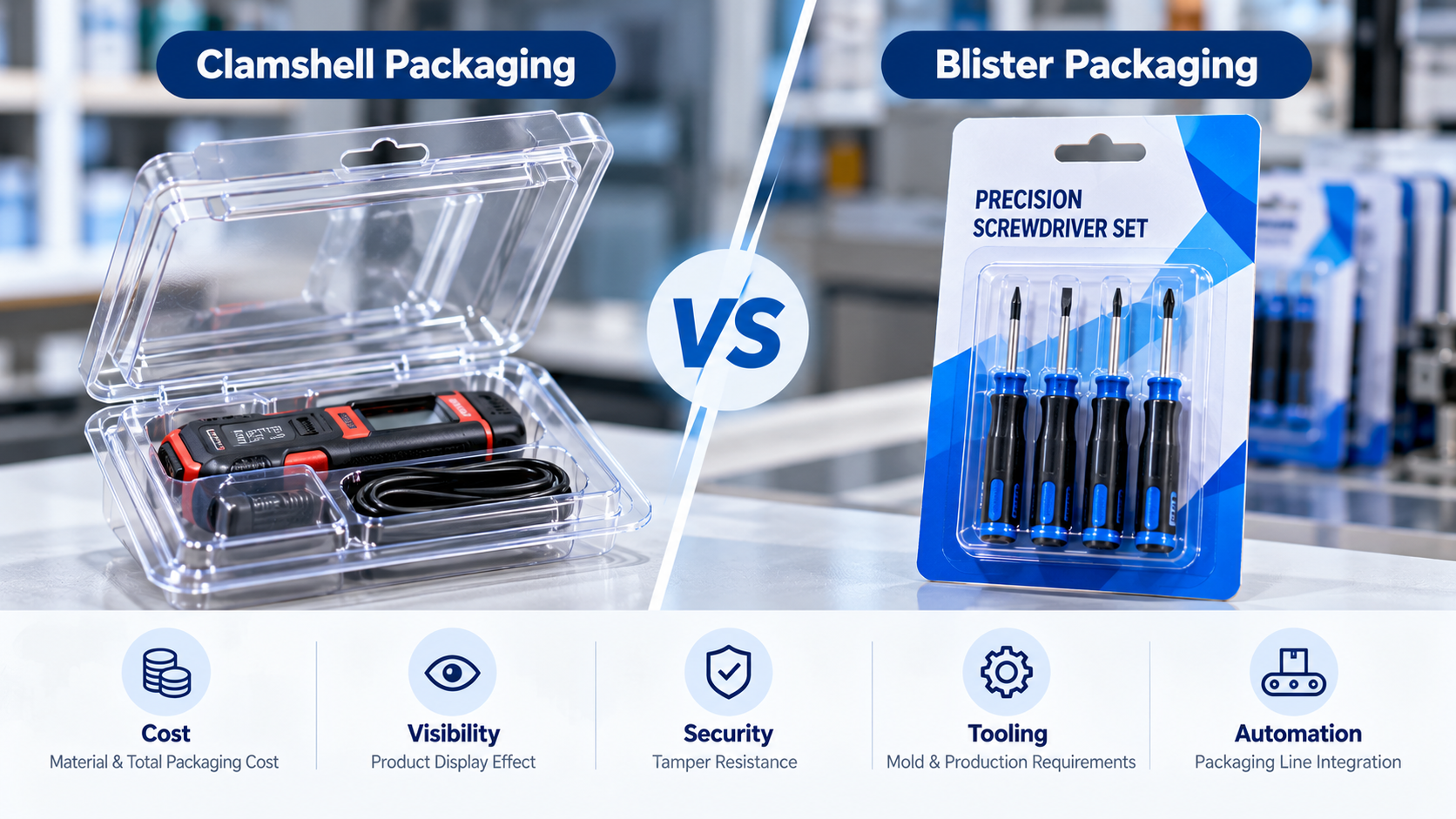
The main difference is the package structure.
A typical clamshell uses thermoformed plastic for both the front and back of the package.
The two sides may be:
Connected by a hinge
Closed with snap features
Heat sealed
Welded around the perimeter
Combined with an insert card
Because plastic surrounds more of the product, a clamshell can provide strong physical enclosure and excellent product visibility.
For more detail on material and hinge design, see Clamshell Packaging: Materials, Design & Thermoforming Process.
A typical retail blister uses a thermoformed plastic cavity on the front and a flat backing card behind it.
The card can carry:
Branding
Product specifications
Instructions
Barcodes
Warnings
Promotional graphics
The plastic therefore focuses mainly on holding and displaying the product, while the card performs much of the communication and structural backing.
Blister packaging often uses less plastic than a comparable full clamshell because only one side of the package is thermoformed.
That can reduce plastic material cost.
However, this does not mean blister packaging is always cheaper.
A complete blister cost may also include:
Printed cards
Card coating
Die cutting
Heat-seal tooling
Sealing equipment
Loading labor
Registration and inspection
A clamshell may use more plastic but can sometimes eliminate the separate backing card and card-sealing operation.
Instead of asking:
Which package has the lowest plastic cost?
A better question is:
Which package has the lowest total cost for my required production volume?
A useful comparison is:
Total Packaging Cost = Plastic + Printing/Card + Tooling + Forming + Assembly + Sealing + Labor + Scrap + Secondary Packaging
For a small lightweight product with strong printed branding requirements, blister packaging may have an economic advantage.
For a product that can be loaded into a snap-fit clamshell without heat sealing, the difference may become much smaller.
Production volume also matters because tooling and equipment costs are amortized over the number of packages produced.
If the product itself is an important part of the sales presentation, clamshell packaging usually has an advantage.
A clear clamshell can allow customers to see:
Front
Back
Side profile
Product shape
Accessories inside the package
This can be valuable for:
Hand tools
Hardware
Cables
Electronics accessories
Toys
Products where appearance affects purchase decisions
A blister normally provides strong front-facing visibility, but the card covers much or all of the rear view.
That can actually be an advantage when the product needs explanation.
For example, a printed blister card can communicate:
Compatibility
Product specifications
Usage instructions
Brand messaging
Certifications
Variant information
So the decision is not simply:
More visibility = better packaging.
Instead, ask:
Does the product sell itself visually, or does the package need to explain the product?
If the product itself should dominate the presentation, clamshell often performs well.
If branding and information are more important, blister card packaging may be more effective.
Security depends more on the closure method than on the package name.
A simple snap-fit clamshell can be intentionally easy to reopen.
A perimeter-sealed clamshell, however, can be much more difficult to open without visible damage.
This makes sealed clamshells useful where manufacturers require:
Tamper evidence
Product containment
Theft deterrence
Protection during retail handling
But greater security can reduce opening convenience for the final customer.
Blister security also varies by structure.
A face-seal blister, trapped blister and slide blister do not provide the same opening resistance.
Security is affected by:
Card strength
Seal area
Seal strength
Flange design
Plastic thickness
Backing structure
A properly designed sealed blister can provide useful tamper evidence while using less plastic than a full clamshell.
The strongest package is not always the best package.
Excessively difficult opening can create poor user experience and unnecessary packaging cost.
Security should match the actual risk:
Low-risk product → easy opening may be more valuable
High-value or theft-sensitive product → stronger containment may be justified
Both formats require thermoforming tooling, but the tooling system is different.
A hinged clamshell may require forming:
Front cavity
Back cavity
Hinge
Locking features
Perimeter geometry
Display features
Because both sides of the package are formed, the total forming area and tool geometry can be greater than for a simple blister cavity.
Complex snap features or detailed hinges also increase design requirements.
A basic blister may require a relatively straightforward forming cavity and flange.
However, the complete packaging system can also require:
Forming mold
Cutting tool
Card die
Heat-seal fixture or sealing plate
So blister packaging should not be evaluated by thermoforming tool cost alone.
The best approach is to compare:
Complete clamshell tooling
versus
Blister forming + cutting + card + sealing tooling
This gives procurement teams a more realistic comparison.
Both formats can be automated, but their production flows are different.
Sheet Feeding → Heating → Forming → Cutting → Product Loading → Folding/Closing → Inspection
Depending on the closure design, the package may then be:
Snap closed
Heat sealed
Ultrasonically welded
Otherwise secured
A simple snap-fit structure can reduce downstream sealing requirements.
However, automatic folding and closure become more demanding when clamshell geometry is large or irregular.
Sheet Feeding → Heating → Forming → Cutting → Product Loading → Card Placement → Heat Sealing → Inspection
This process adds card handling and sealing but is well suited to structured automation when:
Product orientation is stable
Blister position is repeatable
Cards can be automatically fed
Seal conditions are controlled
For high-volume retail packaging, blister systems can integrate forming with downstream loading and sealing operations.
Do not select the package based only on which thermoforming cycle is faster.
Review:
Product loading
Card feeding
Sealing
Closing
Cutting
Inspection
Labeling
Case packing
A fast forming machine does not automatically create a fast packaging line if the downstream operation becomes the bottleneck.
For print-heavy retail packaging, blister packaging usually has the clearer advantage.
A printed backing card provides space for:
Brand colors
Product benefits
Technical information
Instructions
Barcodes
Marketing claims
Clamshell packaging can still use:
Insert cards
Labels
Printed films
Embossed features
but the package structure itself provides less flat printable surface.
Therefore:
High branding/information requirement → consider blister
High product-display requirement → consider clamshell
Clamshell packaging generally uses plastic to cover more of the product.
That can provide additional rigidity and protection, but it can also increase:
Plastic consumption
Package volume
Storage space
Blister packages typically use plastic only around the product cavity, with paperboard forming the backing.
This can improve material efficiency for some products.
However, the environmental and logistics comparison should consider the full system, including:
Plastic weight
Card weight
Recycled content
Recyclability
Empty-package transport
Finished-package carton density
Product damage rate
A lower-plastic package is not automatically the lower-impact package if it causes higher product damage or requires additional protective materials.
A practical decision can be made using the following framework.
360-degree or multi-angle product visibility is important
The product needs stronger plastic enclosure
A reclosable snap design is useful
The product is relatively heavy or irregular
Tamper resistance is important
A large printed card is not essential
The product is small or relatively lightweight
Large printed branding space is important
Plastic consumption needs to be minimized
Peg-hook retail display is important
High-volume card sealing can be automated
Product information needs to remain highly visible
| Product | Likely Starting Direction | Why |
|---|---|---|
| AA batteries | Blister card | Strong branding and compact retail display |
| USB cable | Either | Depends on security and branding needs |
| Hand tool | Clamshell | Visibility and stronger enclosure |
| Small screws/anchors | Blister | Lightweight and card provides product information |
| Premium accessory | Clamshell | Product presentation may justify greater enclosure |
| Small cosmetic item | Blister | Printed branding surface is valuable |
These are only starting points. Package geometry, retailer requirements and production volume can change the final choice.
They can often be produced using similar thermoforming principles because both begin with thermoplastic sheet.
The sheet is heated and shaped using:
Vacuum
Pressure
Plug assist
Combined forming methods
However, machine configuration should still match:
Material
Sheet thickness
Package dimensions
Forming depth
Cavity count
Required definition
Cutting method
Production output
The downstream process is where the two formats often differ more significantly.
Clamshell production needs to consider folding and closure.
Blister card production needs to consider card handling and sealing.
For a wider view of these package types and how thermoforming equipment fits different packaging structures, see MINGDU's Thermoformed Packaging Guide.
A blister usually consists of a thermoformed plastic cavity attached to a card or other backing. A clamshell typically uses formed plastic on both sides of the product, often connected by a hinge.
Often, a clamshell uses more plastic, while a blister uses a separate printed card and sealing process. The lower-cost option depends on package size, material, tooling, printing, assembly method and production volume.
Clamshell packaging generally provides greater visibility around the product. Blister packaging typically provides strong front visibility while using the backing card for branding and information.
It depends on the closure. A permanently sealed clamshell can provide high tamper resistance, while well-sealed blister structures can also provide strong tamper evidence. Snap-fit or slide-open versions are easier to access.
Blister packaging can work well with automated product loading, card feeding and heat sealing. Clamshell packaging can also be automated, but the folding, locking or sealing process depends strongly on package geometry.
Simple blister forming tooling may be less complex than hinged clamshell tooling, but a complete blister line may also require card dies and heat-sealing tooling. Compare the complete packaging system rather than the forming mold alone.
The clamshell vs blister packaging decision should not be made from appearance or unit plastic price alone.
Evaluate five questions first:
Cost: What is the total formed, printed, assembled and sealed package cost?
Visibility: Does the customer need to see the product from multiple sides?
Security: How much tamper resistance does the product actually require?
Tooling: What forming, cutting and sealing tools are required?
Automation: How will the package move from forming through product loading and final closure?
Choose a clamshell when product visibility, enclosure and security are the main priorities.
Choose a blister when efficient material use, printed branding and structured card-sealing automation are more important.
For packaging manufacturers, the best decision comes from evaluating the finished package, tooling and complete production flow together, rather than choosing a format first and trying to adapt the production line afterward.


