
Views: 0 Author: Site Editor Publish Time: 2026-10-20 Origin: Site
Thermoformed packaging is made by heating plastic sheet until it becomes formable, shaping it against a mould with vacuum, pressure or both, cooling the formed sheet and trimming it into the finished package.
The process is widely used for trays, blister packs, clamshells, food containers, electronics trays, medical packaging and custom protective inserts.
Its main advantage is flexibility. Manufacturers can combine different sheet materials, cavity layouts, tooling designs and automation levels to produce anything from lightweight retail packaging to precision trays used in electronics manufacturing.
However, good thermoformed packaging depends on more than choosing a machine. The package design, material, mould, forming process, cutting method and required production volume must work together.
This guide explains the main thermoformed packaging types, materials, design principles and manufacturing decisions that should be considered before production begins.
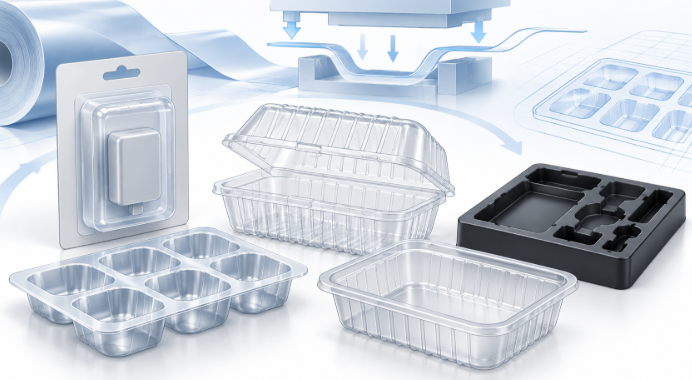
Thermoformed packaging starts with thermoplastic sheet or roll stock.
The basic manufacturing sequence is:
Plastic Sheet → Heating → Forming → Cooling → Cutting → Stacking or Assembly
During forming, heated plastic is pulled or pushed against a mould surface.
Depending on the package geometry, the process may use:
Vacuum forming
Positive pressure forming
Pressure and vacuum forming
Plug assist
Mechanical pre-stretching
Combinations of these methods
After forming, the package is cooled, removed or indexed from the mould, and trimmed from the surrounding web.
Additional operations can include:
Punching
Product loading
Card sealing
Film sealing
Folding
Stacking
Inspection
Automated handling
The exact process depends on the package being manufactured.
Thermoforming can produce many packaging structures, but most projects fall into several common categories.
| Packaging Type | Main Function | Typical Applications |
|---|---|---|
| Trays | Hold, separate or protect products | Food, electronics, industrial components |
| Clamshells | Enclose and display products | Retail, tools, electronics, food |
| Blister packaging | Display product against card or lidding | Hardware, batteries, cosmetics, pharmaceutical |
| Protective inserts | Locate products inside secondary packaging | Electronics, equipment, industrial goods |
| ESD trays | Protect static-sensitive components | Electronics and semiconductor manufacturing |
| Food containers | Contain and protect food products | Produce, bakery, meat, ready meals |
| Custom packaging | Match a specific product or production process | Consumer, medical, industrial and electronics |
The correct packaging format should be selected according to the product and distribution process rather than appearance alone.
A clamshell generally uses two formed sections that surround the product.
The sections may be connected by a thermoformed hinge or manufactured as separate pieces.
Common closure methods include:
Snap fit
Heat sealing
Ultrasonic welding
Mechanical locking features
Clamshells are useful when product visibility and physical enclosure are important.
Typical applications include:
Tools
Cables
Electronics accessories
Hardware
Toys
Produce
Consumer goods
Material choice, hinge geometry and flange design all influence whether the package opens, closes and forms reliably.
For detailed design and material considerations, see Clamshell Packaging: Materials, Design & Thermoforming Process.
Blister packaging normally uses a formed plastic cavity combined with a card, film or other backing material.
Retail blister packaging is widely used for:
Batteries
Small tools
Hardware
Electronics accessories
Cosmetics
Consumer products
The blister provides product visibility and containment, while the backing can provide branding, instructions and other information.
Different blister structures include:
Face-seal blister
Full-face blister
Trapped blister
Slide blister
Pharmaceutical blister formats
A detailed overview of materials and manufacturing can be found in Blister Packaging: Types, Materials & Thermoforming Process.
Not all card-backed blister packaging is assembled in the same way.
In face-seal packaging, the plastic flange is bonded directly to the coated face of a backing card.
In a trapped blister, the flange is captured between card layers.
That difference changes:
Card construction
Sealing method
Tooling
Registration
Production cost
Package appearance
See Face-Seal vs Trapped Blister Packaging: Design and Production Differences for a more detailed comparison.
For projects using printed backing cards, the complete forming and sealing flow is covered in Blister Card Packaging: How It Is Designed and Manufactured.
Thermoformed trays can be among the simplest-looking packages, but their engineering requirements vary widely.
A tray may be designed to:
Contain food
Hold individual components
Organize products
Protect sensitive surfaces
Stack when loaded
Nest when empty
Present parts to a robot
Move through an automated production line
The cavity layout should therefore reflect how the tray will actually be used.
For electronics manufacturing, for example, cavity location and component orientation may be more important than package appearance.
MINGDU's guide to Thermoformed ESD Trays for Electronics explains how ESD material, precision cavities, nesting and automation requirements work together.
Clamshells and blisters are both common retail thermoformed packages, but they serve different priorities.
A simplified comparison is:
| Requirement | Clamshell | Blister |
|---|---|---|
| Multi-angle product visibility | Strong | Moderate |
| Large printing area | Usually requires insert/label | Strong |
| Reclosability | Possible | Usually limited |
| Plastic use | Often higher | Often lower |
| Card requirement | Optional | Usually required |
| Tamper resistance | Depends on closure | Depends on seal/card |
| High-volume automation | Possible | Well suited to structured card sealing |
The choice should consider total packaging cost rather than plastic use alone.
For a full decision framework covering cost, visibility, security, tooling and automation, see Clamshell vs Blister Packaging: Which Is Better for Your Product?.
Material selection depends on the package function, forming geometry and end-use requirements.
Common materials include:
PET is widely used where manufacturers need:
High clarity
Good stiffness
Retail presentation
Tray and blister applications
It is also widely considered in packaging strategies focused on PET recycling.
RPET incorporates recycled PET content.
It can be considered for packaging where recycled content is part of the material strategy, but manufacturers should still verify:
Sheet consistency
Clarity
Forming behavior
Application requirements
PETG can provide:
High clarity
Good forming behavior
Detailed cavity formation
It is often considered for more demanding transparent packaging geometries.
PVC has historically been used in many blister applications because of its forming and sealing characteristics.
Material selection should also consider customer specifications, regional requirements and the intended recovery system.
PP can be useful when packaging requires:
Chemical resistance
Different temperature performance
Greater flexibility
Its forming behavior differs from PET, so tooling and process parameters need to be matched to the specific grade.
HIPS is widely used for trays and packaging where:
Cost matters
Easy forming is important
High optical clarity is not required
PLA can be considered for selected bio-based and compostable packaging strategies, provided the specific grade, finished package and intended waste-management route meet the relevant requirements.
For detailed comparisons of thermoforming plastics, properties and processing considerations, see the Thermoforming Materials Guide.
Sustainable packaging does not mean choosing one universal “green” resin.
A better approach considers:
Material reduction
Mono-material structures
Recycled content
Package weight
Recyclability
Collection infrastructure
Product protection
Production scrap
For many clear clamshell applications, PET and RPET remain important materials because they can combine product visibility with PET-based recycling and recycled-content strategies.
Other projects may evaluate PLA or different polymer systems according to the intended end-of-life route.
Design decisions are equally important.
A recyclable main resin can still become more difficult to recover if the package uses incompatible:
Labels
Sleeves
Adhesives
Inserts
Laminates
For a deeper discussion of PET, RPET, PLA and mono-material strategies, see Sustainable Clamshell Packaging: RPET, PET and Recyclable Material Options.
Material alone does not determine whether a package can be manufactured successfully.
The package geometry must also work with the thermoforming process.
Important design factors include:
Deeper cavities cause greater sheet stretching.
This can lead to reduced wall thickness in:
Bottom corners
Sidewalls
Narrow sections
Deep cavities should therefore be reviewed together with material, starting sheet thickness and forming method.
Draft helps the formed package release from the mould.
Too little draft can increase:
Release resistance
Surface damage
Distortion
Cycle instability
Required draft depends on material, mould orientation, surface finish and cavity depth.
Sharp corners can create localized thinning.
A suitable radius helps heated material flow more gradually into the mould.
The flange may provide:
Seal area
Trim area
Structural support
Positioning surface
Its size should reflect the final packaging operation.
Air trapped between the plastic and mould must escape during forming.
Poor vent placement can cause incomplete details, especially in deep corners and small features.
For blister-specific design considerations, see the Blister Packaging Design Guide.
One important thermoforming principle is:
Starting sheet thickness is not the same as finished wall thickness.
The sheet stretches during forming.
As a result, different areas of the package can have different final thicknesses.
Wall distribution depends on:
Draw depth
Material
Heating profile
Cavity geometry
Plug assist
Vacuum
Pressure
Pre-stretching
The design goal should therefore not simply be “use a thicker sheet.”
A better objective is:
Achieve sufficient minimum wall thickness where the package actually needs strength.
Once the package design is approved, it needs to be converted into production tooling.
Depending on the project, the tooling system may include:
Forming mould
Plug assist
Vacuum passages
Cooling channels
Pressure box
Punching mould
Cutting tool
Trim fixture
MINGDU provides thermoforming mould solutions for forming, punching and cutting applications.
Prototype or development tooling may be appropriate when the package still needs validation.
High-volume production usually benefits from more durable and carefully engineered tooling with attention to:
Thermal control
Cavity repeatability
Venting
Cooling
Cutting
Tool life
For a detailed breakdown of what affects mold price, see Thermoformed Packaging Tooling Cost: What Determines Mold Price?.
A typical custom packaging project follows this sequence:
Requirement → Design → Material → Mould → Trial → Approval → Production
The manufacturer first needs to understand:
Product dimensions
Product weight
Protection requirements
Packaging format
Expected volume
Automation requirements
The cavity and package are designed around the product and forming process.
The material is chosen according to forming and end-use requirements.
A forming mould and any necessary cutting or punching tools are produced.
Initial samples are evaluated for:
Fit
Wall thickness
Appearance
Release
Stacking
Trimming
The approved drawing, material and sample become the production reference.
Machine settings and tooling are optimized for repeatability and output.
The complete development process is explained in How Custom Thermoformed Packaging Is Manufactured.
Once tooling and materials are approved, high-volume manufacturing generally follows a controlled production cycle.
Plastic enters the thermoforming line as roll stock or sheet.
The material is heated into its forming window.
Heating should be controlled across the entire forming area because temperature variation can affect wall thickness and cavity definition.
Vacuum, pressure or both bring the heated sheet against the mould.
The formed part cools sufficiently to maintain its shape.
Cooling has a direct effect on both:
Dimensional stability
Cycle time
The finished package is separated from the surrounding web.
Depending on the product, the package may then move to:
Automatic stacking
Product loading
Card sealing
Film sealing
Inspection
Case packing
There is no single machine configuration for every thermoformed package.
Machine selection should be based on:
Material
Sheet thickness
Forming area
Draw depth
Package geometry
Cavity count
Cutting method
Production output
Automation requirements
Thin-Gauge Thermoforming Machines are commonly used for lightweight packaging such as:
Trays
Blisters
Clamshells
Containers
Pressure and Vacuum Forming Machines can be considered when package geometry benefits from controlled vacuum and positive-pressure forming.
Pressure Forming Machines can provide stronger mould definition where package geometry requires more detailed forming.
For high-volume packaging where forming, punching, cutting and stacking need to operate as an integrated process, Multistation Thermoforming Machines can be evaluated.
The machine should be selected after the packaging specification is understood, not before.
For high-volume production, thermoforming is only one part of the manufacturing line.
Packaging automation may also include:
Sheet feeding
Forming
Punching
Cutting
Stacking
Product loading
Card feeding
Sealing
Robotic pick-and-place
Inspection
A machine with a fast forming cycle does not necessarily create a fast packaging line if downstream handling becomes the bottleneck.
This is particularly important for:
Blister card packaging
Electronics trays
Multi-cavity packaging
Automated food packaging
The complete production flow should therefore be evaluated during the package-design stage.
The cost per package usually includes:
Material + Machine Time + Labor + Scrap + Secondary Operations + Tooling Amortization
Important cost drivers include:
Resin price
Starting sheet thickness
Package dimensions
Cavity count
Forming cycle
Cutting method
Packaging automation
Tooling investment
Production volume
A design that reduces tool cost but significantly increases material usage or cycle time may not reduce total production cost.
This is why package, mould and machine economics should be evaluated together.
A useful decision process is:
Define:
Dimensions
Weight
Sensitivity
Product visibility
Distribution conditions
Decide whether the product needs:
Tray
Clamshell
Blister
Protective insert
Specialized ESD packaging
Review:
Clarity
Rigidity
Impact resistance
Heat resistance
Chemical resistance
Recycled content
End-of-life requirements
Review:
Depth
Draft
Radius
Flange
Wall thickness
Venting
Determine:
Prototype or production tool
Number of cavities
Cutting system
Cooling
Expected annual production
Only after these variables are defined should the machine configuration be finalized.
Before requesting tooling or equipment, prepare:
| Requirement | Information to Provide |
|---|---|
| Product | Drawing, CAD or physical sample |
| Packaging type | Tray, blister, clamshell, insert |
| Material | PET, RPET, PP, PVC, HIPS, etc. |
| Sheet thickness | Proposed or required range |
| Forming depth | Maximum depth |
| Dimensions | Finished package size |
| Production | Annual quantity / target output |
| Cavity count | Existing or proposed layout |
| Cutting | Punch, trim, in-line cutting |
| Automation | Manual, semi-auto or automatic |
| Special requirements | ESD, food contact, sealing, stacking |
Providing this information early allows packaging design, tooling and machine selection to be evaluated as one system.
Thermoformed packaging is plastic packaging produced by heating thermoplastic sheet, forming it against a mould, cooling it and trimming the finished package.
Common thermoformed packages include trays, blister packs, clamshells, food containers, electronics trays, medical trays and protective inserts.
PET, RPET, PETG, PVC, PP, HIPS, ABS and PLA are among the materials used for different applications. Selection depends on product and processing requirements.
A blister usually uses a formed plastic cavity combined with a card or lidding material. A clamshell generally uses formed plastic sections that enclose the product.
Yes. Thin-gauge and multistation thermoforming systems can support high-volume packaging production, especially when forming, cutting and stacking are automated.
Tooling cost depends on mould dimensions, cavity count, material, geometry, cooling, venting, cutting requirements and production volume.
Yes, suitable recycled-content sheet such as RPET can be thermoformed, provided the material grade and finished packaging requirements are validated for the intended application.
The normal process is product review, package design, material selection, mould development, forming trials, sample approval and production.
Thermoformed packaging is not one package type or one manufacturing method.
It is a flexible production platform that can create:
Blisters
Clamshells
Trays
Containers
ESD packaging
Custom protective packaging
Successful production depends on making the right decisions in the right order:
Product → Package Type → Material → Design → Mould → Trial → Machine → Production
Starting with the product rather than the equipment makes it easier to control material usage, tooling investment, package quality and production cost.
For custom packaging projects, MINGDU provides thermoforming mould solutions together with Thin-Gauge Thermoforming Machines, Pressure and Vacuum Forming Machines, Pressure Forming Machines and Multistation Thermoforming Machines that can be evaluated according to the package design, material, tooling and required production output.


