
Views: 0 Author: Site Editor Publish Time: 2026-10-16 Origin: Site
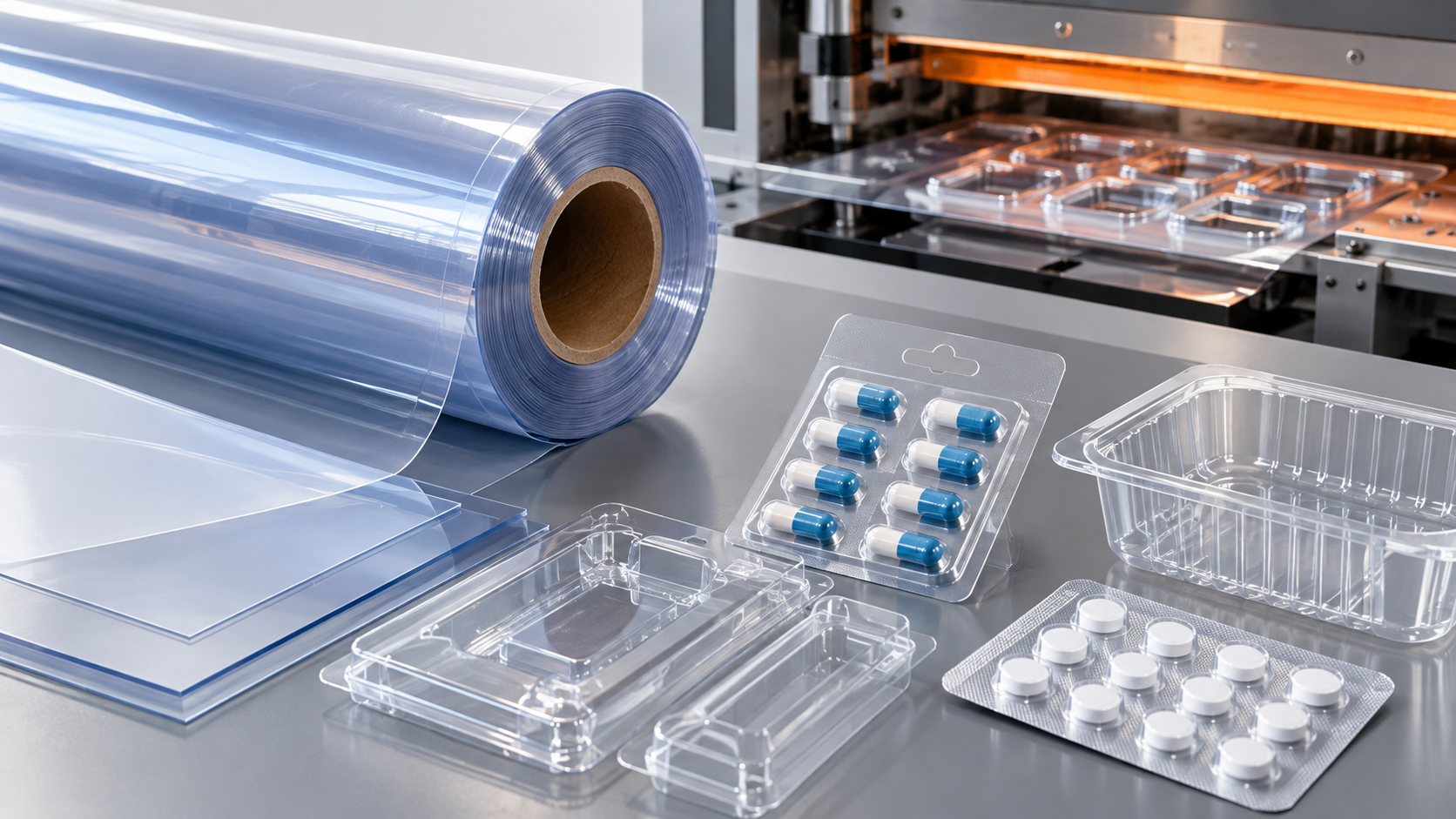
PVC thermoforming is widely used for blister packs, pharmaceutical packaging, retail packaging and other products that require good clarity, cavity definition and efficient high-volume forming.
PVC, or polyvinyl chloride, can be supplied as rigid thermoforming sheet or film in clear, colored and coated structures.
Its main advantages include:
Good thermoformability
Clear grades for product visibility
Good dimensional stability
Reliable cavity definition
Good cutting and sealing performance
Compatibility with high-volume packaging equipment
However, thermoforming PVC requires careful temperature control.
PVC is more heat-sensitive than many other thermoplastics. If it is held at excessive temperature for too long, the material can discolor and begin to degrade.
For a broader comparison of PVC, PET, PP, ABS, PETG, HIPS and other plastics, see our Thermoforming Materials Guide.
This guide focuses on the PVC forming window, blister packaging applications, processing advantages and the controls required for stable production.
PVC thermoforming uses heat to soften rigid PVC sheet or film before vacuum, pressure or mechanical force shapes it against a mold.
A typical packaging process includes:
sheet feeding → heating → forming → cooling → cutting → stacking or sealing
PVC is particularly well established in thin-gauge applications where large quantities of relatively small products must be produced consistently.
Typical uses include:
Pharmaceutical blister packs
Medical packaging
Retail blister packs
Small product trays
Consumer packaging
Clear packaging inserts
Commercial PVC packaging films are specifically designed to provide good thermoformability, clarity and dimensional stability.
There is no universal temperature that applies to every PVC sheet.
PVC formulations can differ in:
Resin type
Additives
Stabilizers
Sheet thickness
Surface coatings
Barrier layers
As one useful reference, Spartech lists a forming range for Straight PVC sheet of approximately:
330–370°F (166–188°C)
with an ideal reference forming temperature around:
355°F (179°C).
These values apply to the referenced sheet family and should not be treated as universal settings.
The correct forming temperature should always come from:
sheet supplier TDS → machine trial → part inspection → process optimization
The important number is also the actual sheet temperature, not simply the heater setting.
PVC is relatively heat sensitive.
The material must become hot enough to stretch and reproduce the mold, but unnecessary overheating can begin to degrade the polymer.
This makes three process variables especially important:
The sheet needs to reach its forming condition without excessive overheating.
Even if the nominal temperature appears acceptable, keeping PVC hot for too long increases thermal exposure.
Hot spots can locally degrade the sheet while other areas remain too cold to form correctly.
The real objective is therefore not:
heat PVC as much as possible.
It is:
bring the entire sheet into the correct forming window for the shortest practical and repeatable time.
PVC that has not reached the correct forming condition may show:
Poor cavity definition
Rounded corners
Incomplete forming
High forming stress
Uneven stretching
Before increasing forming pressure, operators should verify that the sheet has actually reached a uniform forming temperature.
Overheated PVC may show:
Yellowing
Brown discoloration
Surface degradation
Loss of mechanical properties
Strong or acrid odor
PVC degradation can release hydrogen chloride, which is one reason excessive thermal exposure must be avoided. Industrial PVC processing guidance recommends effective ventilation and warns that overheating can lead to discoloration and HCl generation.
Visible discoloration should therefore be treated as a process warning, not merely a cosmetic defect.
PVC production benefits from disciplined and repeatable process control.
Different areas of a product may require different levels of stretching.
Heating zones can help maintain material distribution without overheating the entire sheet.
Once the PVC reaches the correct forming condition, the machine should move efficiently into the forming stage.
Long dwell times should be avoided.
Operators should watch for:
Uneven sag
Color change
Surface marks
Odor
Inconsistent cavity definition
These can provide earlier warnings than simply monitoring heater settings.
Thermoforming equipment should operate with appropriate industrial ventilation according to the material supplier's safety guidance and local workplace requirements.
PVC is a family of formulations rather than one identical material.
Processing settings should be validated for the exact sheet being used.
Blister packaging is one of the strongest applications for thermoformed PVC.
A blister consists of a formed cavity that holds and displays a product, often combined with a paperboard, foil or other lidding material.
PVC works well because it can provide:
Clear product visibility
Good thermoformability
Precise cavity definition
Dimensional stability
Reliable sealing
Efficient cutting
High-speed production
These characteristics have made rigid PVC particularly established in pharmaceutical, nutraceutical and consumer blister packaging.
Commercial pharmaceutical PVC films are available in multiple gauges and grades, including structures designed specifically for thermoforming and higher-barrier laminates.
In pharmaceutical packaging, standard rigid PVC is often used when moderate barrier performance is sufficient.
Applications can include:
Tablets
Capsules
Nutraceutical products
Veterinary products
Over-the-counter medicines
Where greater moisture or oxygen protection is required, PVC can also be combined with barrier materials such as:
PVdC coatings
PCTFE / ACLAR layers
Multilayer laminate structures
These structures retain thermoforming capability while improving product protection.
This means the packaging engineer should not ask only:
“Should I use PVC?”
but also:
“What barrier level does the packaged product require?”
PVC is also useful for consumer-product blister packs because clear film allows customers to see the product.
Applications can include:
Hardware
Small tools
Accessories
Electronics
Toys
Consumer components
Rigid PVC packaging films can also provide good printability, punching and cutting performance, which can simplify downstream packaging operations.
Suitable PVC grades can reproduce relatively detailed cavities and shapes.
This is valuable for small packaging products where consistent cavity dimensions matter.
Clear rigid PVC allows product inspection and retail display.
PVC can maintain relatively stable formed geometry when heating and cooling are controlled correctly.
Thin PVC packaging can be punched and trimmed efficiently in automated production.
PVC blister film has been processed for many years on conventional thermoforming and sealing equipment.
This makes it a familiar material for many packaging manufacturers.
PVC also has important limitations.
This is the biggest processing issue.
Excessive temperature or residence time can cause thermal degradation.
Compared with more forgiving plastics, operators may need to maintain tighter control over heating conditions.
Standard mono PVC may not provide enough moisture barrier for sensitive pharmaceutical products.
Coatings or laminate structures may be required.
Some packaging markets are moving toward PET, copolyester or other vinyl-free solutions because of recycling targets, material policies or regulatory requirements.
For example, packaging suppliers now offer polyester-based alternatives designed to run on existing blister lines.
Material selection should therefore consider not only forming performance but also the end market's recycling and regulatory requirements.
PVC and PET can both be used for clear thermoformed packaging, but their priorities differ.
| Factor | PVC | PET / APET |
|---|---|---|
| Clarity | Good to excellent | Excellent |
| Thermoformability | Very good | Good with controlled heating |
| Heat sensitivity | Relatively high | Crystallization must be controlled |
| Blister packaging | Very established | Increasingly used |
| Food packaging | Used in selected applications | Very widely used |
| Barrier options | PVC/PVdC/PCTFE structures available | Multilayer PET structures available |
| Recycling direction | Market-dependent | Strong PET recycling infrastructure in many markets |
Neither material is automatically better.
The choice should depend on:
Product type
Barrier requirement
Forming depth
Packaging line
Regulatory requirements
Recycling strategy
Possible causes:
Excessive temperature
Long heating time
Heater hot spots
Reduce unnecessary thermal exposure and verify the sheet temperature.
Possible causes:
Sheet too cold
Insufficient vacuum
Poor mold venting
Possible causes:
Uneven heating
High draw ratio
Tight cavity geometry
Possible causes:
Excessive sheet sag
Poor cavity spacing
Excessive local heat
Possible causes can include:
Incorrect sheet temperature
Tool wear
Incorrect cutting setup
Material grade mismatch
Production problems should be analyzed across the complete process rather than treating forming and cutting as unrelated stages.
PVC blister packs, trays and other lightweight packaging products are normally produced from relatively thin sheet or roll stock.
For these applications, a Thin-Gauge Thermoforming Machine can support:
Automatic sheet feeding
Controlled heating
Forming
Mold cutting
High-volume packaging production
MINGDU's current thin-gauge equipment category specifically lists compatibility with materials including PVC, PET, PLA and RPET and targets packaging applications such as blisters, trays and clamshells.
For PVC production, heater-zone control and repeatable cycle timing are particularly important because excessive heat exposure can quickly reduce product quality.
Yes. Rigid PVC sheet and film are widely thermoformed for blister packaging, trays and other thin-gauge products.
There is no universal temperature. One commercial Straight PVC sheet reference gives a forming range of approximately 166–188°C, with about 179°C as an ideal reference value. Always use the processing data for the specific PVC grade.
Yellowing can indicate excessive thermal exposure and the beginning of PVC degradation. Heating temperature, dwell time and heater uniformity should be checked.
Yes. PVC provides good clarity, thermoformability, dimensional stability and compatibility with common blister packaging equipment.
Yes. Rigid PVC and PVC-based multilayer films are widely used for pharmaceutical blister packaging. The required barrier structure depends on the sensitivity of the packaged product.
Yes. PVC is more heat-sensitive than many common thermoforming plastics, so temperature, heating time, ventilation and material condition should be carefully controlled.
PVC remains an important thermoforming material for blister packaging because it combines clarity, formability, dimensional stability and efficient high-volume processing.
Its major processing limitation is heat sensitivity.
Successful PVC thermoforming therefore depends on maintaining a controlled forming window rather than simply applying more heat.
Manufacturers should monitor:
sheet temperature + heating time + heater uniformity + ventilation + cavity definition
as one integrated process.
For thin-gauge blister packs and packaging trays, automated thermoforming equipment can provide efficient production when the PVC film, heating system, mold and cutting process are properly matched.


