
Views: 0 Author: Site Editor Publish Time: 2026-10-21 Origin: Site
Sustainable clamshell packaging is not defined by one “green” material. The better approach is to reduce unnecessary material, select a suitable recovery route, simplify the package structure and make sure the finished clamshell still performs its primary job: protecting the product.
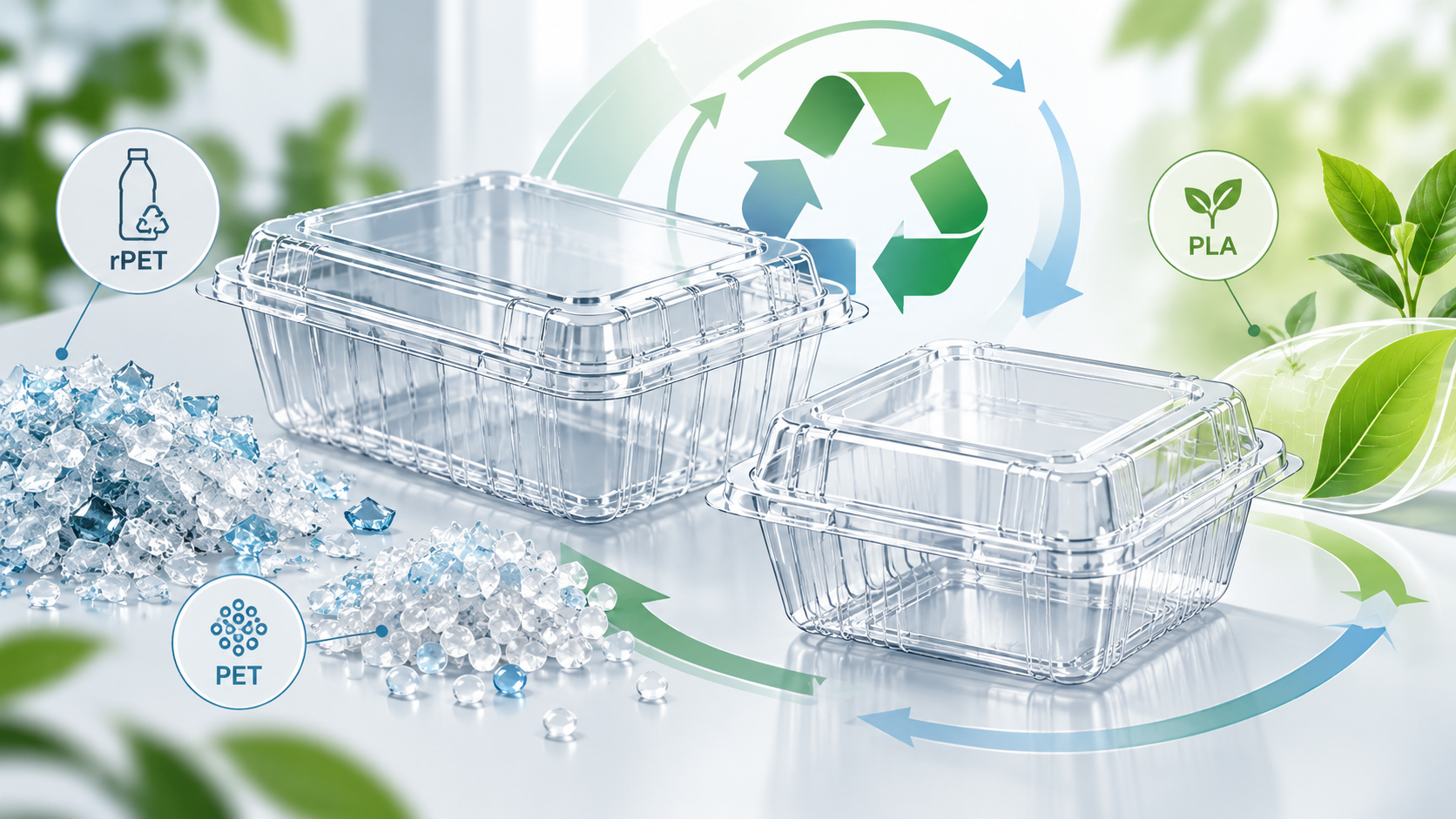
For many thermoformed clamshell applications, that can mean mono-material PET, increased RPET content or a carefully evaluated PLA solution. The right choice depends on product protection, clarity, food-contact requirements, sealing, local recycling or composting infrastructure and the market where the package will be sold.
For manufacturers supplying Europe, packaging design should also be reviewed in the context of the EU Packaging and Packaging Waste Regulation (PPWR).
Searches for biodegradable clamshell containers often come from buyers looking for a more sustainable alternative to conventional plastic packaging.
However, biodegradable, compostable, recyclable and recycled-content packaging are not interchangeable terms.
For example:
PET is generally selected for recyclability and clarity, not biodegradability.
RPET contains recycled PET and supports recycled-content strategies.
PLA can be suitable for certain compostable packaging applications when the material and finished package meet the relevant requirements.
Mono-material packaging aims to simplify the material structure so that sorting and recycling may be easier.
A package should therefore be described according to its actual end-of-life route rather than using “eco-friendly” as a general claim.
For a broader comparison of thermoformed packaging structures, materials and production methods, see the Thermoformed Packaging Guide.
| Strategy | Main Advantage | Key Consideration |
|---|---|---|
| Mono-material PET | Clear, established thermoforming material with recycling potential | Labels, adhesives and closures should not unnecessarily interfere with recycling |
| RPET | Adds post-consumer recycled content | Sheet quality, clarity and forming consistency must be controlled |
| PET/RPET blend | Balances recycled content and processing requirements | Actual recycled content and application requirements must be verified |
| PLA | Can support certified compostable packaging applications | Industrial composting infrastructure and certification are important |
There is no universal “most sustainable” material. The correct option depends on the complete packaging system and available waste-management route.
One of the most useful design principles for recyclable clamshell packaging is material simplification.
A clamshell made primarily from one compatible polymer can be easier to sort and recycle than a package combining several permanently bonded materials.
For example, a PET clamshell may be designed around:
PET thermoformed body
Minimal labels
Compatible inks and adhesives
Easily removable inserts
Reduced decorative components
The goal is not simply to label the package “mono-material.” Designers should examine every component that remains attached when consumers discard it.
A clamshell may appear to be PET but also contain:
Large paper labels
Different plastic films
Adhesives
Sleeves
Inserts
Sealing layers
Those components can affect how the package behaves during collection, sorting and recycling.
Sustainable packaging design should therefore begin with:
Main resin → attached components → separation → collection → sorting → recycling
not just with the resin name printed on the specification sheet.
PET is widely used for transparent thermoformed packaging because it can combine:
High clarity
Good stiffness
Product visibility
Practical thermoforming performance
Compatibility with established PET recycling streams in many markets
For retail clamshells, this makes PET an important starting point when recyclability is part of the packaging objective.
However, simply changing the material to PET does not automatically make the entire package recyclable.
Designers should also review:
Package color
Labels
Adhesives
Printed areas
Closures
Additives
Local collection systems
For a broader technical comparison of PET and other thermoforming plastics, see the Thermoforming Materials Guide.
RPET is recycled polyethylene terephthalate, commonly produced using recovered PET material.
Using RPET in clamshell packaging can help manufacturers increase recycled content while maintaining a PET-based package structure.
Potential applications include:
Retail clamshells
Produce containers
Bakery packaging
Consumer-product packaging
Other thin-gauge thermoformed containers
But replacing virgin PET with RPET should not be treated as a simple one-to-one material substitution without validation.
Manufacturers should evaluate:
Sheet consistency
Variation in recycled feedstock and sheet production can influence forming behavior.
Clarity
RPET appearance can vary according to feedstock and sheet specification.
Heating behavior
The actual sheet should be tested under production conditions rather than assuming identical settings to another PET grade.
Wall-thickness distribution
Deep cavities and sharp geometry can expose processing differences more clearly.
Application compliance
Food-contact or other regulated applications require suitable material documentation and compliance for the intended market.
The objective should be stable package performance with increased recycled content—not recycled content at the expense of manufacturing consistency.
Sustainability does not always require moving immediately from virgin PET to the highest possible percentage of recycled material.
For some manufacturers, a more practical transition is:
Virgin PET → PET/RPET structure → higher RPET content after validation
This allows forming parameters, sheet quality and finished-package performance to be evaluated systematically.
Important questions include:
Does the package still meet clarity requirements?
Is cavity definition stable?
Does the hinge perform correctly?
Has minimum wall thickness changed?
Does trimming remain consistent?
Can recycled content be increased without creating unacceptable rejection rates?
A sustainability improvement that dramatically increases scrap or rejects may simply shift environmental and production costs elsewhere.
For buyers searching specifically for biodegradable clamshell containers, PLA is one material they may encounter.
PLA, or polylactic acid, is a bio-based thermoplastic that can be thermoformed into selected packaging products.
However, three terms need to be kept separate:
Bio-based describes the source of the material.
Biodegradable describes its ability to biodegrade under specified environmental conditions.
Compostable normally means a product meets defined requirements for biodegradation under particular composting conditions.
A PLA package should therefore not simply be marketed as “biodegradable anywhere.”
For European industrial composting claims, the finished packaging system should be assessed against the applicable requirements, such as EN 13432, rather than assuming that the resin name alone establishes compostability.
PLA can be worth evaluating when:
A compostable packaging route is intentionally required
Suitable collection and industrial composting infrastructure exists
The packaging specification supports that end-of-life route
Product temperature and storage conditions are suitable
The material can meet forming and package-performance requirements
PLA is therefore an application-specific sustainability option, not a universal replacement for PET.
This distinction is important when choosing an end-of-life strategy.
Usually focuses on:
Material collection
Sorting
Mechanical or other recycling
Recycled content
Circular use of PET resources
Usually focuses on:
Certified compostability
Appropriate organic-waste collection
Industrial composting conditions
Correct disposal behavior
The best option depends partly on infrastructure.
If a market has an established PET collection and recycling system but little access to industrial composting, a recyclable PET/RPET package may have a more realistic recovery route.
Conversely, certified compostable packaging can have value in applications where packaging is intentionally collected with organic waste and suitable treatment infrastructure exists.
The EU Packaging and Packaging Waste Regulation is changing the way packaging producers need to think about recyclability, recycled content and packaging minimization.
The regulation does not say that every clamshell must use one specific resin.
Instead, manufacturers should increasingly evaluate questions such as:
Is the package designed for recycling?
Can unnecessary material be reduced?
Does the plastic package need recycled content?
Do labels, inks or adhesives interfere with recycling?
Is the package format appropriate for the intended recycling stream?
Are relevant market and labeling requirements being met?
These issues become particularly important for companies supplying packaging into the European Union.
MINGDU has covered the regulatory direction in more detail in EU PPWR and Thermoformed Food Packaging: What Manufacturers Need to Know.
PPWR compliance depends on the complete package, not on the thermoforming machine alone.
Material substitution receives a lot of attention, but one of the simplest sustainability questions is:
Are we using more plastic than the package actually requires?
A clamshell can sometimes be optimized through:
Reduced starting gauge
Better wall-thickness distribution
More efficient cavity geometry
Smaller flange areas
Reduced oversized package dimensions
Improved nesting
Better sheet utilization
The objective is not to make the sheet as thin as possible.
If excessive downgauging produces weak hinges, cracked corners or high rejection rates, the result is not an efficient package.
A better goal is:
minimum material required for reliable product performance
Material choice and package geometry should be reviewed together.
The hinge must remain functional when switching between material grades or increasing recycled content.
Snap-fit geometry should account for the mechanical behavior of the selected sheet.
Deeper forming creates greater sheet stretching and can make material consistency more important.
Large permanently attached labels can change the recyclability characteristics of an otherwise simple clamshell.
Paper or plastic inserts should ideally be easy to separate when separation supports the intended recycling route.
Sustainable design is therefore not only a purchasing decision. It is also a product engineering decision.
PET, RPET and PLA all require their own validated processing windows.
A production team should confirm:
Sheet grade
Sheet thickness
Heating profile
Forming depth
Cooling
Mold geometry
Cutting behavior
Hinge performance
Finished wall thickness
Manufacturers producing lightweight clamshells can evaluate MINGDU's Thin-Gauge Thermoforming Machines, which are designed for thin-sheet packaging applications and can be considered according to the intended PET, RPET, PLA or other thermoforming material.
Equipment selection should be based on the actual package drawing, sheet specification, mold layout and production target.
A machine cannot make an unsuitable package design “sustainable” by itself.
| Requirement | Material Direction to Evaluate |
|---|---|
| High clarity + recyclable PET route | PET |
| Increased recycled content | RPET or validated PET/RPET structure |
| Simple recycling-oriented construction | Mono-material PET-based design |
| Compostable packaging objective | Certified PLA-based system where appropriate |
| EU market | Review PPWR requirements together with package design |
| Lower material use | Optimize gauge, geometry and nesting before material substitution |
The final choice should also consider product protection, regulations and actual local end-of-life infrastructure.
No. PET should generally be treated as a recyclable thermoplastic rather than a biodegradable material.
RPET remains part of the PET material family, but the recyclability of the finished package depends on its complete design, including labels, adhesives, colors and local recycling infrastructure.
Some applications use materials such as PLA for compostable thermoformed containers. Claims should specify the relevant conditions and certification rather than assuming all bio-based plastics biodegrade in normal disposal environments.
Not universally. PLA and RPET support different end-of-life strategies. RPET supports recycled-content and PET recycling approaches, while certified compostable PLA can support industrial composting in suitable applications and infrastructure.
It is packaging designed primarily around a single compatible material family rather than combining multiple difficult-to-separate materials. The purpose is often to simplify sorting and recycling.
PPWR contains recycled-content and recyclability requirements that vary by packaging category, application, timing and applicable exceptions. Manufacturers should review the exact classification of their package rather than assuming one percentage applies to every clamshell.
There is no single material that makes clamshell packaging sustainable.
The more useful approach is to define a realistic end-of-life strategy and design the package around it.
For many applications, that may mean:
PET + simple mono-material design
or
PET + increased RPET content
For selected applications with appropriate collection and treatment infrastructure, a certified compostable PLA solution may also be worth evaluating.
Regardless of material, manufacturers should reduce unnecessary packaging, improve material utilization, validate forming performance and consider how the finished package will actually be collected and treated after use.
For companies supplying the European market, these decisions should also be reviewed alongside the evolving requirements of the EU PPWR.
MINGDU's Thin-Gauge Thermoforming Machine range can be evaluated for PET, RPET, PLA and other thin-sheet packaging projects according to the actual material, clamshell geometry, mold and required production output.


