
Views: 0 Author: Site Editor Publish Time: 2026-11-19 Origin: Site
A twin sheet machine is a thermoforming machine. It heats, forms, and welds two plastic sheets at the same time. The result is one hollow, structurally strong component.
The basic operation is direct. An operator loads one sheet in the upper frame and one in the lower frame. Both sheets heat to a malleable state. Two tools then shape them, and the sheets join together. This process answers the core question of how the equipment works.
Beyond these basics, three surprising facts await. Each one changes how people view a twin sheet machine. The equipment plays a larger role in modern manufacturing than many readers expect.
A twin sheet machine makes two plastic sheets at the same time, which saves time during production.
The machine joins the two sheets into one strong, hollow part by welding. It does this without glue or fasteners.
This process makes complex shapes that resist impact and lowers the cost of making large parts.
A twin sheet machine holds two plastic sheets in a single frame. One sheet sits in the upper frame. The other sheet sits in the lower frame. Heating elements warm both sheets at the same time. Each sheet reaches a malleable state. The machine then moves the softened sheets into the molding area.
Each sheet takes shape against its own tool. The upper tool forms the top half of the part. The lower tool forms the bottom half. The tools press the two sheets together during forming. This pressure compresses the sheets to about 50% of their original thickness. The material thins in a controlled way. The finished walls stay strong despite the reduction.
Most people picture one sheet per part. That mental image comes from simple thermoforming. A single sheet heats, stretches over a mold, and cools. Forming two sheets at once in a single cycle feels counterintuitive. Readers often assume the machine needs two separate passes.
The dual-sheet setup changes the math of production. One cycle yields one complete part with two formed surfaces. Operators load both sheets together. The machine heats both sheets together. This parallel action saves time in the manufacturing process. The surprise fades once readers see the frame design. Two sheets enter, and one hollow component leaves. The process treats the pair as a single unit from start to finish.
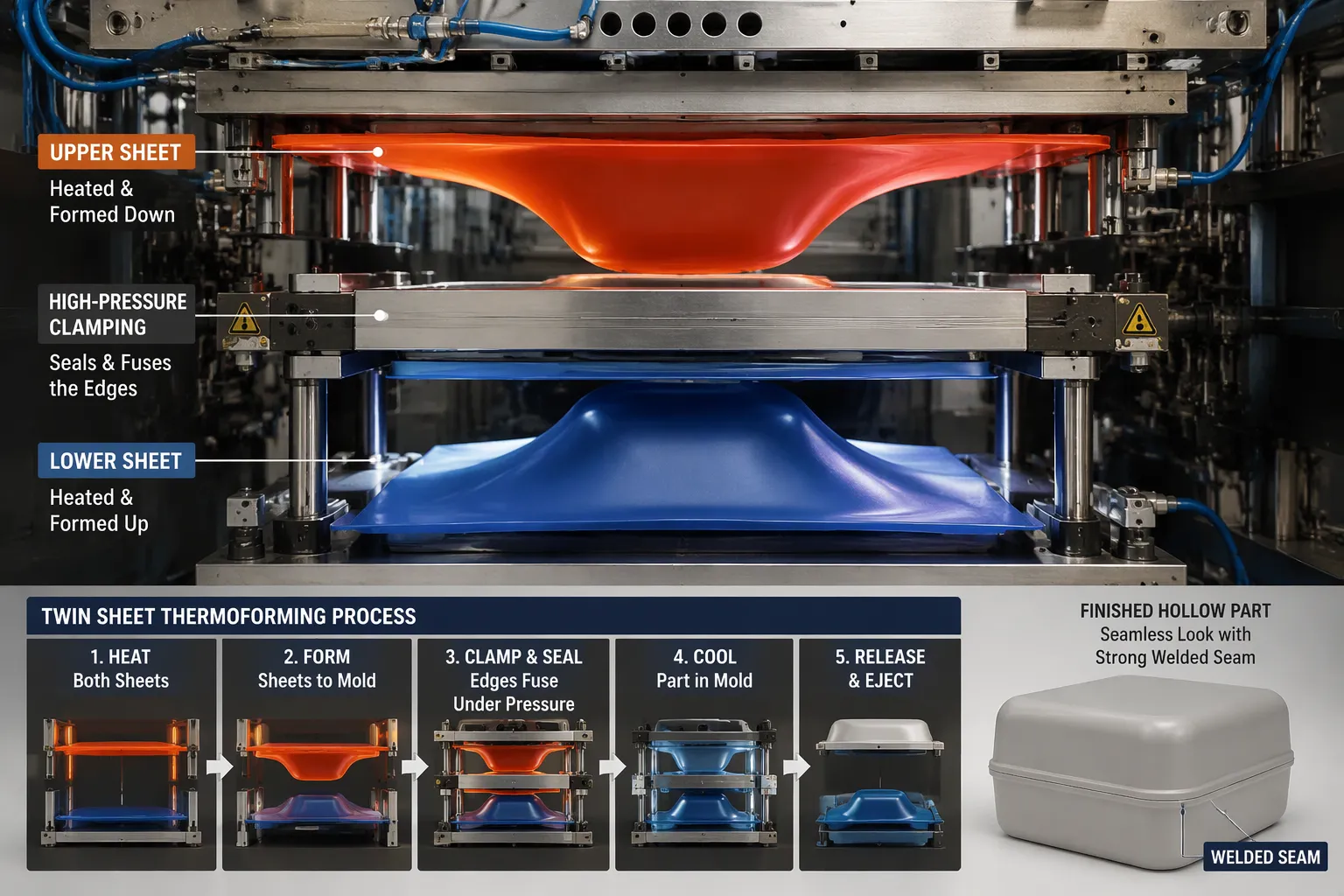
The machine heats each sheet in its own station. The upper sheet and the lower sheet reach a malleable state separately. The frames then carry both sheets into the molding area. Vacuum pulls each sheet tight against its tool. This step shapes the outer surfaces with sharp detail.
Next, the two sheets meet under pressure. Accurate air cell lockup high-pressure forming platens clamp the sheets together. The platens hold a precise gap and force the softened edges to bond. The two sheets weld into one piece. The result is a single hollow, structurally strong component. No glue and no separate fasteners hold the halves together.
Most people picture thermoforming as a one-sheet craft. A flat sheet heats, drapes over a mold, and cools into a simple shell. A seamless, hollow, load-bearing part from flat plastic sheets defies that image. The part looks like a molded enclosure with two finished faces.
The surprise grows when readers learn the part carries loads. The welded seam acts as a structural joint, not a cosmetic line. Hollow sections add stiffness without adding solid mass. This capability sets the twin sheet machine apart in the manufacturing process. The production of large, strong, hollow parts becomes a single-cycle task. The production team skips the assembly line for glued halves. The process delivers a finished component straight from the forming station.
A twin sheet machine can make shapes that simple forming cannot. Deep draws, undercuts, and ribbed sections form in a single pass. The hollow sections make the part stiffer. The welded seam carries load across the joint. These features give the part impact resistance that a single-sheet shell rarely matches. Large molded parts often need this toughness. A fuel tank, a pallet, or a machine housing must take a hit without cracking. The twin sheet process delivers that strength through geometry, not through extra material.
The tooling shapes each half of the part with its own detail. Molders can place ribs, bosses, and mounting points exactly where the design calls for them. The finished part leaves the machine ready for the next step. This ability expands what a thermoforming machine can build. Designers gain freedom to plan complex internal structures without adding assembly work.
The cost angle starts with the cycle. Forming and joining happen in one pass. The machine welds the two sheets while it shapes them. This step removes a separate assembly stage from production workflows. The part count drops as well. One molded component replaces two shells, a set of fasteners, and a gluing step. Fewer parts mean fewer handling steps across manufacturing operations.
The savings fit best on large, impact-resistant, hollow parts. Examples include tanks, enclosures, and structural panels. Each option in manufacturing has its own best use. Simple thermoforming suits shallow, open parts. Injection molding suits small, high-volume parts with tight tolerances. The twin sheet process suits large hollow parts that need strength and low tooling cost. This fit keeps the manufacturing process efficient for the right job. Production teams gain a fast route to strong parts. The method supports modern manufacturing where large, tough components matter.
A twin sheet machine heats, shapes, and joins two plastic sheets into one hollow, strong part. That definition answers the main question one last time.
Three facts stand out. Dual-sheet forming shapes both sheets in one cycle and presses them to about 50% of their original thickness. Fusion under vacuum and high-pressure platens turns the pair into a seamless hollow part. Complex shapes then bring cost savings for large, impact-resistant parts.
Twin sheet machines hold a clear place in modern manufacturing. They give production teams a single-cycle route to large, tough, hollow components. The process will keep serving designs where strength and low tooling cost matter together.
The machine handles common thermoformable plastics. These include HDPE, ABS, and polypropylene. Each sheet must soften under heat without burning. Operators pick a material grade that suits the part's strength needs. The process works best with plastics that weld cleanly under pressure.
Wall thickness depends on the starting sheet gauge. The tools compress the sheets to about 50% of their original thickness during forming. Thicker starting sheets yield thicker walls. Designers plan the gauge around the load the part must carry.
No. Each tool forms one half of the part. The upper tool shapes the top sheet. The lower tool shapes the bottom sheet. Both tools sit in the same molding area. One cycle completes the whole component.
Twin sheet machines handle large molded parts well. Tanks, pallets, and machine housings fit the typical working envelope. Small, tight-tolerance parts usually go to injection molding instead. Each method serves its own production niche.
One cycle forms and joins the sheets together. A glued assembly needs two forming runs plus a bonding step. The twin sheet route cuts handling and part count. That saving matters most in high-volume manufacturing runs.


