
Views: 0 Author: Site Editor Publish Time: 2026-11-17 Origin: Site
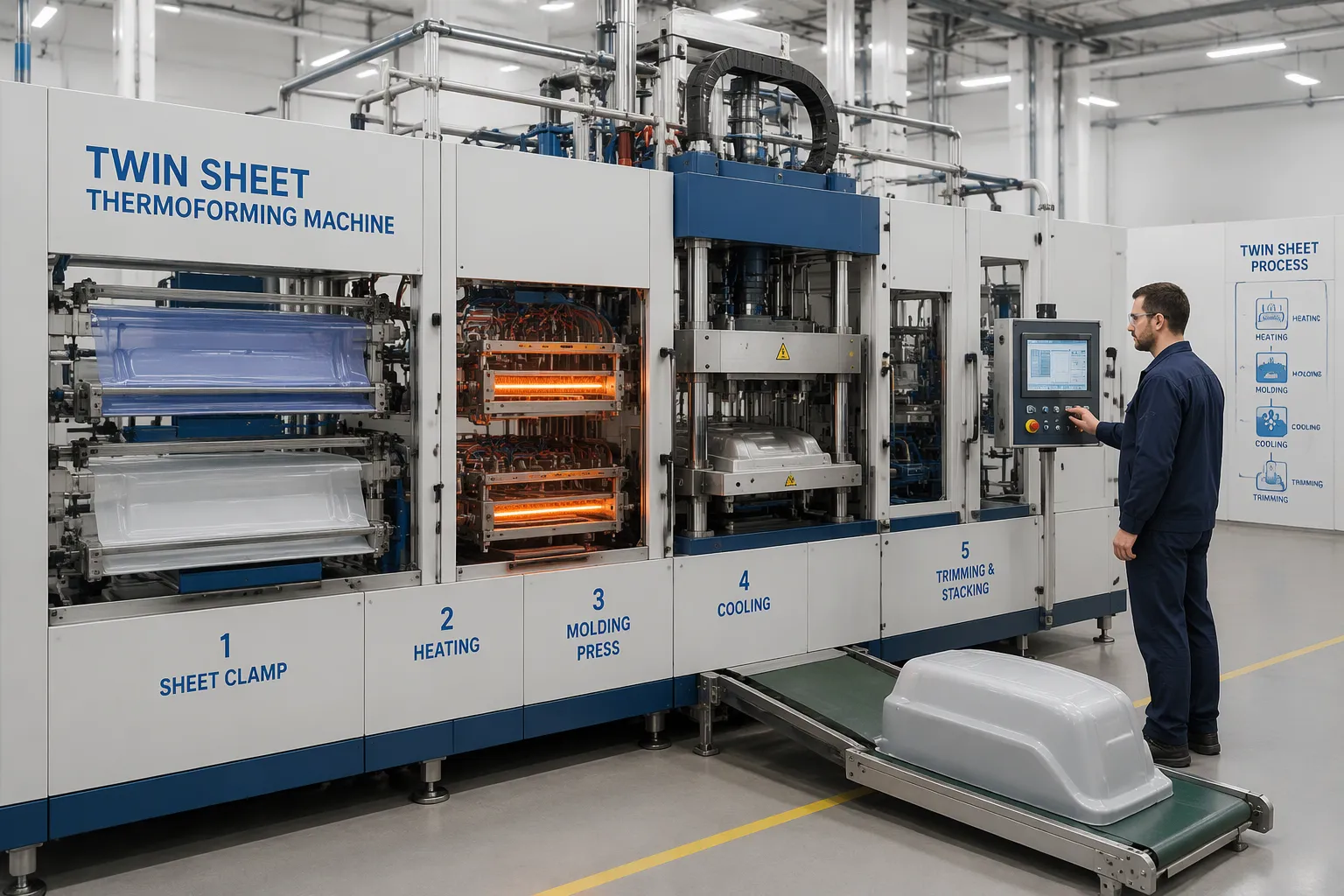
Twin sheet thermoforming heats two plastic sheets at the same time. It forms each sheet against a mold on the opposite side. Then it bonds them into one hollow part with two walls. The finished part usually has features on both outside sides, so it works well for housings and enclosures. A sealed double wall makes the part stiff without adding extra weight. Both sheets stay hot during bonding, so the joint forms a strong, continuous connection. This article explains how the process works step by step, what it is good for, and how it compares with other molding methods. Readers who know single-sheet thermoforming will see where the two-sheet approach differs.
Twin sheet thermoforming heats two plastic sheets and joins them into one strong, hollow part.
This process makes strong, light parts with details on both sides, which is great for housings and enclosures.
Twin sheet forming saves time on assembly and costs on tooling compared to injection molding for low-to-mid volumes.
Designers need to plan for draw ratios and realistic tolerances. This helps prevent thin walls and shrinkage problems.
Pick twin sheet thermoforming for big parts with two walls. Choose other methods for high precision or simple shapes.
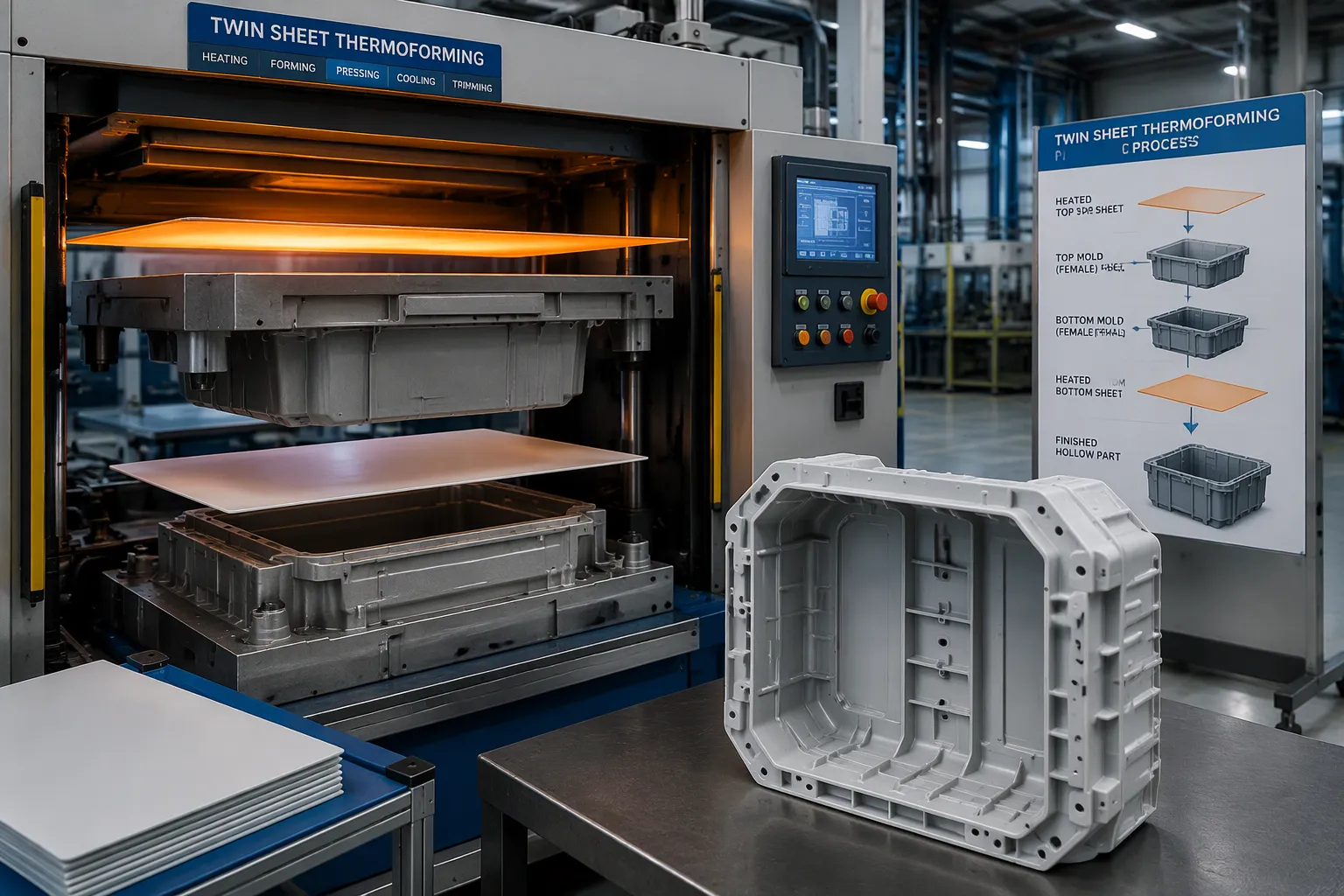
Twin sheet thermoforming is a manufacturing method that heats two thermoplastic sheets at the same time. Each sheet then forms against a female mold, one from above and one from below. The two sheets meet while still hot, and pressure bonds them into a single piece. The bond is permanent, not a glued seam. The result is a hollow part with two walls and features molded into both exterior surfaces.
This construction produces hollow (or double-walled), three-dimensional parts with real depth. A designer can place ribs, recesses, and mounting points on the outside of both halves. The sealed wall between them adds stiffness without extra weight. That combination suits multi-dimensional housings and enclosures, where the inside must stay open and the outside must carry shape and detail.
The twin sheet process differs from single-sheet work in one clear way. Standard thermoforming shapes one flat thermoplastic sheet over a single mold, so the part has one finished face and one open back. Twin sheet forming closes that back with a second formed sheet. The part becomes a closed shell instead of an open tray.
Readers who ask what is thermoforming in general usually picture the single-sheet version. A flat plastic sheet softens in an oven, then vacuum forming pulls it down over a tool. The finished part is a shell with one show surface. Twin-sheet forming takes the same starting point and doubles it. Two sheets heat together, form on opposing tools, and join under pressure before they cool.
The practical difference shows up in part design. A single-sheet part needs a separate lid, backer, or bracket to close it. Twin sheet forming builds that closure into the part itself. Assembly steps drop away, and the joint between the halves is a molded bond rather than a fastener line. The trade-off is tooling: twin sheet thermoforming needs a matched pair of molds and tighter process control, because both sheets must stay hot until they meet.
For a housing with features on both sides, the two-sheet route often wins on part count. For a simple cover or tray, single-sheet thermoforming remains the simpler choice. The next section walks through the steps that turn two heated sheets into one finished part.
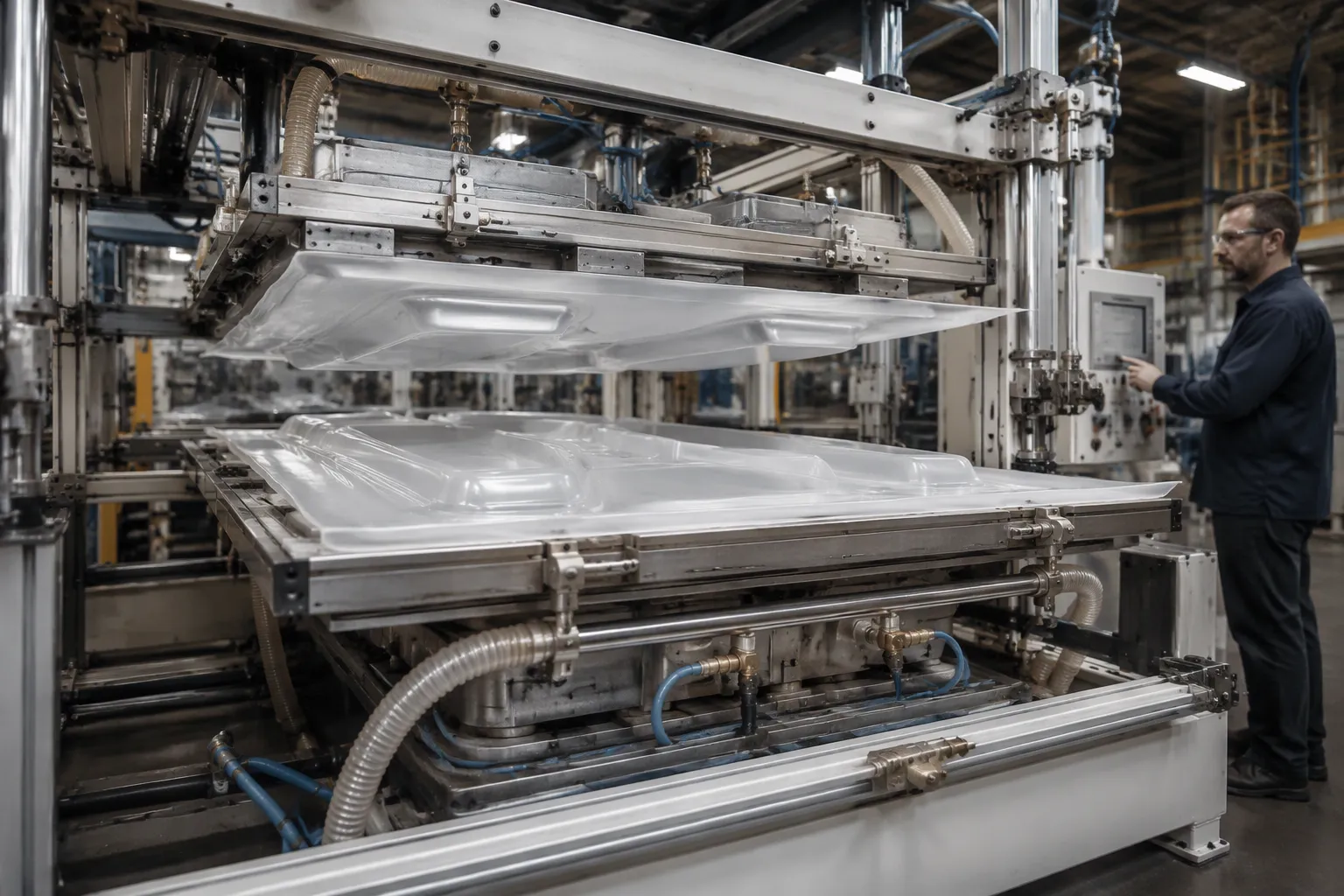
The sequence starts with two plastic sheets loaded into a machine frame. Clamps hold each sheet at its edges. An oven then heats both sheets at the same time until they turn soft and malleable. Operators watch the sag of each sheet to judge readiness. Uneven heat causes thin spots later, so oven control matters as much as mold design.
Once the sheets reach forming temperature, the machine moves them into position. One sheet sits above the lower tool, and the other sits below the upper tool. These pressure-forming molds for the top and bottom carry the shape of each half of the part. A vacuum system then pulls each heated sheet against its mold surface. This step is vacuum forming in its purest form: air pressure does the shaping, and the tool sets the geometry.
Some jobs add pressure forming on top of the vacuum pull. Compressed air pushes the sheet into tight corners and sharp details. The combination gives better definition than vacuum alone. Readers who wonder how does thermoforming work at this stage should picture two ovens, two tools, and one synchronized cycle. The twin sheet process keeps both halves in the same machine so neither sheet cools before the next step.
The molds move together while both sheets stay hot. Contact plus applied pressure makes the two heated sheets fuse along their mating surfaces. The bond forms a sealed edge around the perimeter and at any internal weld points. This is how the tools create the hollow part: the joined sheets trap an air space between them. The hollow part keeps its shape because the fused seam locks the two walls together.
Cooling follows the bond. Air or water channels in the molds draw heat out of the plastic. The part stiffens against the tool, which holds critical dimensions during shrinkage. After enough cooling, the machine opens, and the part demolds. A vacuum forming cycle for a large twin sheet part takes longer than a single-sheet run because two sheets must heat, form, and cool as one unit.
Trimming comes next. A CNC router or trim fixture cuts the part free of its clamp frame and opens any required holes. Secondary operations may add inserts, mounting hardware, or assembly features. The finished part then moves to finishing or inspection.
Tooling and equipment set the limits of the process. A matched pair of separate pressure-forming molds defines both faces of the part. Vacuum and pressure systems drive the forming, and oven zones control heat across the sheet. A shop that can hold temperature across a large platen can run large twin sheet parts. A shop with tight oven control handles thinner gauges and finer detail. The next section covers where this process earns its place.
The biggest reason to pick twin sheet forming is strength. Two formed walls trap a hollow space between them, and the fused seam holds the walls together. That sealed gap works like a stiff core. A designer gets a rigid panel without adding solid material in the middle. The part stays light for its size.
Features on both faces come next. Each mold carries its own detail, so ribs, recesses, and mounting bosses can sit on either outside surface. One molded part can replace a shell plus a lid plus a bracket. Combining parts cuts assembly labor and the number of fasteners. Tooling costs also favor this route at low-to-mid volumes. A matched mold pair costs far less than a similar injection mold, and the tool pays for itself over a modest production run. That balance answers why use twin sheet forming for large housings built in moderate quantities.
Common uses include equipment enclosures, machine housings, vehicle panels, and structural covers. These parts all need depth, stiffness, and detail on both sides. Medical carts, industrial cabinets, and material-handling containers all fit the profile. The process also suits dunnage trays and protective cases, where the double-walled shell absorbs impact.
Material choice follows the service environment. High-density polyethylene and ABS handle many general housings. Polycarbonate offers impact resistance for protective covers. Nylon and glass-filled grades serve stiffer structural panels. Each resin must form and bond at a compatible temperature, so the two sheets usually match in material and gauge. A qualified thermoformer can confirm which grades bond reliably before tooling begins.
Each molding method works best for a different set of part needs. The table below shows where twin sheet forming and the other methods usually fit.
Method | Typical Fit | Cost Profile |
|---|---|---|
Twin sheet thermoforming | Large hollow housings with features on both faces | Lower tooling cost; economical at low-to-mid volumes |
Injection molding | Small, complex, high-precision parts | High tooling cost; economical at high volumes |
Rotational molding | Large hollow tanks and simple shells | Moderate tooling cost; slow cycles |
Blow molding | Hollow bottles and containers with simple shapes | Moderate tooling cost; fast cycles for simple forms |
Injection molding gives the tightest tolerances and the finest detail of the group. It also requires the largest tooling investment, so it pays off when you make many units. Rotational molding makes large hollow parts with even walls, but its cycle times are long. Blow molding is great at hollow vessels with simple shapes. Twin sheet forming falls between these options. It gives you double-walled strength and detail on both sides, and its tooling costs are much lower than injection molding. A vacuum forming line or a pressure forming setup can run the same family of parts, which gives a shop flexibility across a product line.
Rules vary by market, and each method can meet them with the right material and paperwork. Twin sheet thermoforming uses standard thermoplastic grades, so a shop can pick resins that carry the certifications a program needs. Injection molding and rotational molding use the same resin families. Blow molding works best with grades that have high melt strength. So compliance depends more on material choice and process control than on the molding method itself.
Application fit makes the choice. A sealed enclosure with molded ribs on both sides fits twin sheet forming. A precision gear housing with fine features fits injection molding. A large water tank fits rotational molding. A bottle fits blow molding. None of these methods is best in every case. The right pick depends on part geometry, volume, and budget.
Draw ratio is the first design rule to know. It compares how deep a part is to its smallest opening. A deep, narrow shape pulls the heated sheet thin along the walls. Designers keep the depth small compared to the width and add wide curves at the corners. A smooth change lets the plastic flow instead of tearing. Sharp steps and undercuts work against the forming process, so the part shape should open the way the mold moves.
The tooling plan shapes the budget. A matched mold pair forms both faces, and each half needs its own vacuum and pressure paths. Shops often build aluminum tools for full production runs and composite or cast tools for early models. Equipment matters too. The platen size limits how big a part can be, and the oven zones limit how evenly a large sheet heats. A shop that runs vacuum forming every day can usually quote a twin sheet job with confidence, because the heating and clamping steps work the same way.
Secondary operations should be in the plan from the start. Trimming removes the clamp frame and cuts holes, and a CNC router does most of that work. Inserts, threaded bosses, and mounting hardware go in after forming. Assembly steps, like joining two formed parts or adding a gasket, also need time in the schedule. Designers should leave trim allowance and flat lands for fasteners.
Geometry limits deserve honest attention. The process forms a shell, so it cannot make solid sections or fine internal features the way injection molding can. Deep draws thin the walls, and the designer must accept a wall thickness range instead of one exact value. Tolerance planning follows the same logic. Plastic shrinks as it cools, and the two bonded sheets cool as one unit. Critical dimensions should carry realistic tolerances that allow for shrink and trim variation. A tolerance stack that assumes machined-metal precision will cause trouble at inspection.
These points are planning items, not reasons to walk away. A designer who sets realistic draw ratios, budgets for a matched tool pair, and specifies achievable tolerances gets a strong double-walled part. Talking with the thermoformer early prevents most surprises.
Twin sheet thermoforming heats two plastic sheets together, forms each against an opposing mold, and bonds them into one hollow, double-walled part. The twin sheet process delivers stiff, lightweight housings with features on both faces. It suits enclosures, panels, and structural covers at low-to-mid volumes.
Buyers should screen a thermoformer on several points:
Process and draw-ratio experience
Tooling approach and cost
Material options
Secondary operation support
Quality and compliance documentation
Scalability from prototype to production
Twin sheet forming is one strong option among several. Part geometry, volume, and budget decide the right method. Thermoforming fits when a hollow, double-sided shell suits the job.
The sheet thickness depends on how big the part is and how much weight it must hold. Large housings often use thicker sheets so they stay stiff across wide areas. Thin sheets work well for smaller covers and trays. A skilled thermoformer picks the thickness based on how deep the part is drawn and what it must handle. Buyers should share load and handling needs early.
Shops can use sheets of different colors. Some also pair different plastics when the two bond well at the same forming temperature. Most production jobs keep both sheets the same material and thickness so the bond is predictable. A thermoformer should confirm any mixed-material pairing before tooling starts.
Tool life depends on what the tool is made of and the plastic used. Aluminum tools last through long production runs. Composite or cast tools work for prototypes and smaller runs. A shop checks for wear at high-stress spots like seal edges. Buyers should ask how long the tools will last at their planned volume.
Lead time has two parts: tooling and production. Building a matched mold pair takes longer than a single-sheet tool because both faces need vacuum and pressure paths. Production cycles also run longer, since two sheets heat and cool as one unit. A thermoformer can quote both stages once the design is set.
Yes. Shops often build cast or composite tools for early samples, then switch to aluminum tools for production. This step-by-step approach lets designers test fit and function before paying for full tooling. Buyers should confirm the shop offers this path and ask how sample parts compare to production parts.


