
Views: 0 Author: Site Editor Publish Time: 2025-05-30 Origin: Site

You need to lower making costs and launch products quickly. Buying a modern thermoforming machine gives your business a strong operational edge. You get lower tool costs, fast sample making, quick production, and great product quality. Modern thermoforming methods shape hard plastics into exact parts with ease. You remove annoying slowdowns and lower your running costs right away.
Experience the main benefits of thermoforming during project setup:
Thermoforming cuts the production tool phase from 12 - 16 weeks down to 6 - 8 weeks. This cuts tool time by about 50% compared to injection molding.
Speed up your time-to-market and lead your market today.
Thermoforming machines lower your starting tool costs. Simple aluminum molds save money when compared to costly steel molds.
You create test parts much faster. Shorter wait times help your business launch new products quickly.
One thermoforming machine processes many plastic types. You easily make clear food containers or large auto parts.
Your factory uses much less energy overall. You re-use extra plastic pieces to build an earth-friendly making system.
You protect your company profits when you select efficient plastic forming methods. Purchasing a modern thermoforming machine reduces your immediate money risks. You avoid pricey custom tools and long setup delays.
You save a lot of cash immediately on making molds. Older molding ways need complex pairs of steel dies. On the other hand, thermoforming uses easy single-sided molds made from aluminum or plastic blends. Often, you only need one side of the mold set. This simple design drops tool making costs and speeds up your project schedule.
| Cost Factor | Thermoforming | Injection Molding |
|---|---|---|
| Typical Tooling Cost Range | $2,000 - $50,000 | $15,000 - $150,000+ |
| Mold Material | Simple aluminum or composite molds | Steel molds (for high-volume) |
| Key Characteristic | Lower initial capital investment; molds fabricated/modified quickly | Substantially higher upfront investment; molds are durable but a significant capital commitment |
These smaller starting mold prices make thermoforming great for short or medium factory runs. You change test shapes easily without spending too much money. As a result, you grow your factory work safely while keeping tooling costs low.
You lower overall business danger when you pick accessible machinery. A fresh thermoformer demands a much smaller initial capital investment than other plastic machines. Cheaper equipment prices lower your debt loads and guard your daily cash flow.
Return on investment (ROI) varies by scale and industry.
Small shops running a thermoformer gain a 15% – 20% clear profit margin. They cover all costs in 1 – 2 years and create a 150%+ 5-year ROI. You can also use equipment loans or leases with low starting fees to save cash.
You get the strong benefits of thermoforming by cutting high entry costs in the busy plastic industry. Buying an efficient thermoformer helps you launch new items quickly, boost single-item profits, and save essential business cash reserves.
You can test new product designs quickly without waiting long months for sample parts. Old injection molding needs 12 to 16 weeks (84 to 112 days) for first samples. Choosing thermoforming prototyping cuts this wait down to 20 to 30 workdays (about 4 to 6 weeks).
You speed up tests and beat rival companies with ease. Normal thermoforming schedules take 20-50 workdays from design approval to finished parts. Fast options deliver finished items in only 15-20 workdays. You change shapes quickly because every thermoformer uses easy single-sided molds.
You grow to large production runs quickly after fixing your final design. Modern machines yield quick results for well-planned factory runs. For example, a 300×300mm × 1mm thin sheet needs a cycle time of ~45 seconds, making 80/hr.
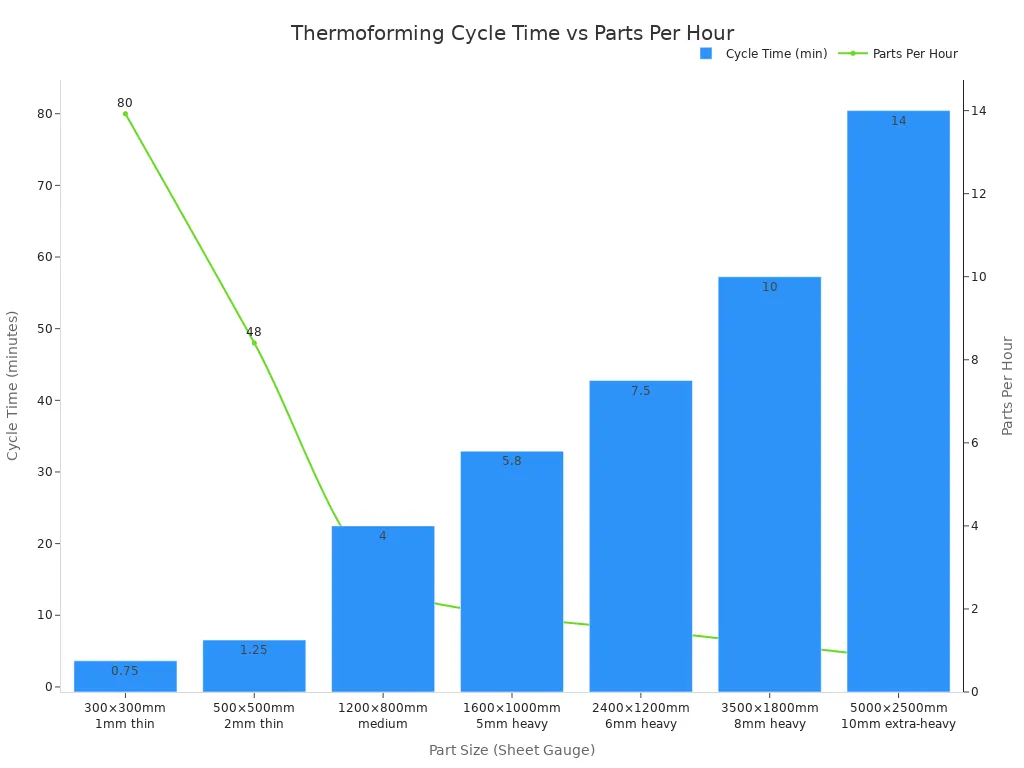
Your shop stops normal factory slowdowns by using a top thermoforming machine. Better water-cooled molds and pushed air cut down the cooling step fast. Quick part hardening and automatic material tools raise your total output across the line.
You clean up every work shift with modern tools. Built-in line trimmers remove extra cutting steps after making parts. Each single-station or continuous thermoformer keeps steady plastic movement. This safe thermoforming process stops backlogs down the line. You save your daily plan while growing active shop work. Picking a good thermoforming process boosts total output and keeps factory work moving nicely.
You can easily handle changing market demands by processing various thermoforming materials on one machine. Modern thermoformer machines run common plastics like rPET, HDPE, polypropylene, polycarbonate, and PVC without long delays. Your shop uses recycled waste to create green products like bakery trays. Industry expert Jim Soles stated, "So far in 2024, we have used 65.5% of returned material to create your substrate layer."
Picking the right thermoforming plastics boosts your item quality while cutting down shop costs. On-site recycling systems feed side trim right back into daily work. This smart thermoforming process stops costly plastic waste. You pick thermoforming materials based on strength, clear view needs, and outdoor use goals.
| Material Gauge Type | Sheet Thickness Range | Typical Product Characteristic | Common Example Applications |
|---|---|---|---|
| Thick/Heavy-Gauge | 0.060" to 0.500" (1.5 – 12.7 mm) | Durable components with complex shapes | Automotive panels, equipment housings, aircraft interior parts |
| Thin-Gauge | Under 0.060" (1.5 mm) | Lightweight disposable packaging | Food containers, blister packs, retail displays |
Your factory gets top results on both thin blister packs and heavy truck covers. Getting flexible thermoformer tools helps your team process recycled plastic smoothly.
You grow your catalog by molding big parts with deep shapes. Industrial units work with plastic sheets up to 96" x 48" using broad clamping frames. Huge machines offer giant 120" x 60" plastic forming areas. You mold big hot tubs, roof skylights, tractor covers, and storage bins from one plastic sheet.
Machine options scale smoothly from 19" x 17" small desktop beds up to 92" x 44" large beds with 40" maximum draw depths.
The thermoforming process keeps part wall thickness even across all deep curves. You use plug helpers, pre-stretch air, and targeted heating to stop plastic thinning. Selecting top thermoforming plastics guarantees good stretching under high pressure.
You supply strong build panels to plane, car, medical, and tech fields. Thermoforming machinery helps you form tricky thermoforming materials into tough final goods daily.
You get great product quality by using modern vacuum pumps and advanced electric heaters. Regular heat softens stiff plastic sheets evenly before vacuum pressure pulls them tight against single-sided mold shapes. Parts follow standard sizing rules, and fitting tools to material shrinkage keeps sizes exact. For example, steady plastics like ABS hold tight sizes, but HDPE needs larger space. Next, workers use 5-axis CNC cutting machines to trim main connection points and outer edges to exact shapes.
Your custom package shapes draw fast consumer attention on busy retail store shelves. You can choose clear plastics like PET to show items through clear packaging windows. The thermoforming process easily presses sharp 3D shapes, company logos, and detailed textures right into plastic parts. Also, a modern thermoformer handles many easy surface choices to boost brand recognition:
Molded-in colors, standard paints, shiny metal coatings, and hot stamping foil
Silk screening for clean text, clear pictures, and brand logos
Glued films, shield paint for electronic signals, and UV protection layers
Anti-graffiti coats, real metal plating, and printed decorative designs
You make light, thin parts without losing overall strength. Factory thermoforming equipment shapes tough packaging and strong covers for hard medical, car, and tech uses. These strong plastics stand up to hard hits, big shaking, and rough handling. Exact plastic shapes hold fragile items safely during long trips or rough warehouse moves. Custom tray inserts also arrange items neatly to improve the opening experience.
The flexible thermoforming process spreads plastic sheets evenly across deep shapes and complex curves. A steady thermoformer moves uniform sheets to remove thin spots and weak areas. Your shop grows large packaging runs while dropping total shipping weight. Running an automated thermoformer ensures steady part copies, protects delicate items, and improves final item looks across all industrial thermoforming uses.
You improve your brand appeal while protecting resources by using modern thin gauge machinery. A flexible thermoforming machine warms film and forms adaptable plastics into custom shapes. This clever method keeps goods fresh and builds very tough packaging.
| Packaging Type | Key Benefit for Visibility & Appeal |
|---|---|
| Blister Packaging | Crystal-clear retail packaging that maximizes shelf appeal. |
| Clamshell Packaging | Provides superior product visibility and acts as secure retail packaging. |
You grab buyer attention fast since clear packs highlight item traits on store shelves. You also cut energy needs across your plant. Modern thermoformer tools cut power use by up to 85% compared to methods like injection molding. Lower power use helps you lower running costs while trimming plant carbon outputs. Choosing an efficient thermoformer lets your firm make pretty, green packs at lower total costs.
You stop bad scrap habits by running an exact thermoforming setup. Careful shaping of plastic sheets leaves very little excess waste. In fact, makers often reuse over 80% of their base stock during work runs. You keep costly thermoplastics out of local dumps and guard core company profits.
Your shop easily runs green thermoforming materials:
PET (Polyethylene Terephthalate) and HDPE (High-Density Polyethylene)
PP (Polypropylene) and LDPE (Low-Density Polyethylene)
Using these common thermoforming materials helps you make eco-friendly goods using closed-loop systems. You crush factory side-trim back into fresh stock and send it straight to your thermoformer line.
High recyclability allows you to reuse PET and HDPE plastics multiple times, reducing the need for virgin materials and landfill waste.
This simple reuse loop drops raw material costs a lot. You meet rising buyer demand for eco-friendly goods and craft a clean brand image. Using green thermoforming ways helps your firm boost material use, drop shipping costs with light parts, and lead clean plant trends easily.
Choosing a modern thermoforming machine for your shop gives you strong market leads. Key thermoforming perks include tiny tool bills, fast output speed, wide design freedom, and minimal plastic waste. You craft durable goods while guarding your core company profits. Modern plastic thermoforming improves your daily production smoothly and reliably.
Using advanced thermoforming machinery gives your business a clear competitive edge in product presentation, speed, and cost efficiency. Check your current shop capabilities today to find hidden bottlenecks. Contact leading equipment experts now to upgrade your lines, boost total output quality, and maximize your business profits!
You pick different thermoformer units based on your sheet thickness needs. Thin-gauge systems handle plastics under 0.060 inches for large packaging runs. Heavy-gauge thermoformer models shape thick sheets up to 0.500 inches for big industrial items. Every thermoformer delivers fast output across these main types of thermoforming machines.
Regular hard plastics perform very well inside common factory setups. You get top results when using PET, HDPE, and ABS. These thermoforming materials allow speedy heating and rapid cooling cycle times. This clean thermoforming process stops extra material waste. You choose custom thermoforming materials or recycled thermoforming materials to lower raw stock expenses while making goods.
You build clear blister packs, food trays, car panels, and machine covers with ease. These typical applications for plastic thermoforming cover major medical, car, and store packing fields. These jobs need high strength. Flexible gear makes light throwaway packs and heavy build parts to grow your total sales.
Electric heaters soften stiff plastic sheets during the active thermoforming process. Next, strong air pressure or vacuum pumps pull the warm plastic flat against mold curves. Cold water molds harden the plastic sheet fast. Automatic cutters finish the piece, so your thermoformer works non-stop without line slowdowns.
You lower early mold prices a lot and make fresh items many weeks faster. The smart thermoforming process drops power consumption up to 85 percent compared to injection molding. You recycle over 80 percent of leftover scrap plastic easily to raise factory income and run clean work shifts.


