
Views: 0 Author: Site Editor Publish Time: 2026-10-22 Origin: Site
Thermoforming tooling cost can vary significantly even when two finished packages look similar.
A simple single-cavity tray may require relatively straightforward forming tooling, while a high-output packaging project may need a multi-cavity aluminum mould, engineered cooling, plug assist, precision cutting tools and additional fixtures.
That is why asking “How much does a thermoforming mold cost?” without defining the package usually does not produce a useful answer.
For thermoformed packaging, the main cost drivers are typically:
Part size → Cavity count → Tool material → Geometry → Cooling → Venting → Cutting → Precision → Production volume
Understanding these factors makes it easier to compare quotations and avoid paying for tooling features that the project does not actually need.
For a broader overview of thermoformed packaging types and production methods, see the Thermoformed Packaging Guide.
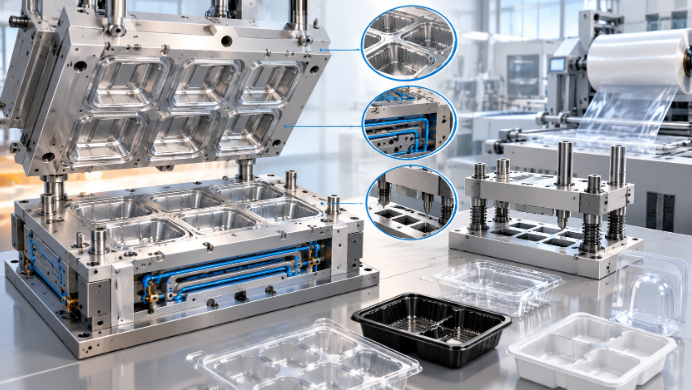
Packaging tooling may include more than one mould.
Depending on the machine and package, the tooling system can include:
Forming mould
Plug assist
Pressure box
Punching mould
Cutting tool
Trim fixture
Stacking or positioning components
For a simple project, the forming mould may represent most of the tooling investment.
For an automated high-volume packaging line, however, forming and cutting tooling need to be considered together.
MINGDU's thermoforming mould solutions include forming, punching and different cutting mould configurations for thermoforming applications.
One of the first questions in a tooling quotation is:
How many packages should be formed in each machine cycle?
A single-cavity mould is generally simpler than a production tool containing multiple cavities.
For example, moving from one cavity to eight cavities can increase:
Mould dimensions
Aluminum volume
CNC machining time
Vacuum passages
Cooling channels
Venting
Cutting complexity
Inspection requirements
So more cavities normally increase the upfront tooling cost.
But that does not mean fewer cavities are always cheaper.
A higher-cavity tool can produce more parts during each forming cycle.
If production demand is high enough, this can reduce:
Machine time per part
Labor per part
Energy allocation
Tooling amortization per part
The real decision is therefore:
Higher tooling investment vs lower production cost per package
A buyer producing 20,000 trays per year may make a different tooling decision from a manufacturer producing several million trays.
Larger packaging normally requires a larger mould.
That means more:
Aluminum or other tooling material
Machining
Structural support
Cooling capacity
Machine forming area
Package size also affects how many cavities can fit within the machine's usable forming area.
For example, a small blister may allow many cavities per cycle, while a large industrial tray may fit only one or two.
This is why the mould quote should be evaluated together with the intended thermoforming machine.
Thermoforming tools can be made from different materials depending on the development stage and production requirements.
Prototype or short-run tools may use lower-cost materials or simplified constructions.
Their purpose is often to validate:
Product fit
Package geometry
Material behavior
Forming feasibility
They are useful when the design may still change.
Machined aluminum is widely used for production thermoforming moulds because it provides:
Good machinability
Good thermal conductivity
Dimensional stability
Long production life when correctly specified
However, aluminum production tooling requires more investment than a temporary prototype tool.
The appropriate question is therefore not:
What is the cheapest mould material?
It is:
What tooling material is appropriate for the expected production life?
Using expensive production tooling for an unproven concept can waste money.
Using temporary tooling for a high-volume program can create maintenance, dimensional and productivity problems later.
Two moulds with the same outside dimensions can still have very different prices.
A shallow rectangular tray with generous radii is much easier to manufacture than a package containing:
Deep cavities
Small detailed features
Multiple cavity depths
Complex ribs
Tight radii
Product-retention features
Difficult undercut-like geometry
More complex geometry requires additional:
CAD/CAM work
CNC machining time
Tool finishing
Vent placement
Inspection
Design decisions made before tooling therefore directly affect mold cost.
Every feature should have a purpose.
If an extra rib, recess or decorative detail does not improve:
Product protection
Rigidity
Stacking
Positioning
Branding
it may add tooling and forming complexity without improving the package.
Design for manufacturability is one of the most effective ways to control packaging tooling cost.
Cooling is sometimes treated as a machine issue, but the mould itself plays an important role.
During thermoforming, the plastic sheet is heated, formed against the mould and then cooled sufficiently to maintain its shape.
A production mould may therefore require engineered cooling channels.
More sophisticated cooling can increase tooling cost because it requires additional:
Drilling
Machining
Water passages
Connections
Sealing
Design work
But reducing the mould price by simplifying cooling can create a false saving.
If inadequate cooling increases the cycle by even a small amount, that delay is repeated over every production cycle.
Tooling cost is usually paid once.
Cycle time affects every package produced.
For high-volume production, spending more on effective thermal management can therefore reduce the total manufacturing cost.
Cooling should be evaluated according to:
Part dimensions
Material
Sheet thickness
Cavity count
Production rate
Required dimensional stability
When heated plastic moves toward the mould surface, the air between the sheet and tool must escape.
Small vents or vacuum passages are therefore incorporated into the mould.
Simple geometry may require straightforward venting.
Complex or deep packages can require more carefully positioned vents around:
Deep cavity bottoms
Corners
Narrow details
Areas that form last
Poor venting can cause incomplete cavity definition even if the mould shape itself is correct.
Venting normally does not dominate the tooling quote, but detailed tooling with extensive vacuum distribution requires more engineering and machining than a very simple tool.
A thermoformed package normally has to be separated from the surrounding plastic web.
This means buyers should not ask only:
How much is the forming mould?
They should also ask:
What cutting tooling is required?
Depending on the production method, this may involve:
Punching mould
Steel-rule cutting
Hardware cutting mould
Matched cutting tool
Laser cutting setup
Separate trim fixture
MINGDU's Mould capabilities include forming, punching, hardware cutting and laser cutting mould solutions.
A simple rectangular perimeter is easier to cut than a package containing:
Irregular contours
Multiple holes
Hang features
Tight dimensional requirements
Multiple cavities close together
More complicated cutting normally means higher tooling cost.
It can also affect production speed and maintenance.
For high-volume packaging, forming and cutting should therefore be designed as one production system rather than purchased as unrelated tools.
Increasing cavity count affects both ends of the process.
For example:
More forming cavities
→ more output per cycle
but also:
More parts to locate and cut
→ larger or more complex cutting tooling
The layout must maintain enough space for:
Flanges
Trim lines
Cutting clearance
Web strength
Part removal
Packing cavities as closely as possible may appear to improve sheet utilization, but overly aggressive layouts can make cutting unreliable.
The best mould layout balances:
Output + Material utilization + Forming stability + Cutting reliability
Not every package needs the same dimensional accuracy.
A disposable food tray and an electronics tray feeding a robot may have very different tolerance requirements.
Higher precision can require:
More accurate machining
Additional inspection
More controlled tooling assembly
Trial adjustments
Tighter process validation
The tolerance should therefore match the package function.
Specifying unnecessarily tight tolerances can increase tooling cost without improving real-world performance.
Instead of applying the tightest possible tolerance to every dimension, identify critical-to-function dimensions.
These may include:
Cavity position
Product seating area
Seal flange
Robot datum
Stack height
Cutting location
Tool surface finish influences the appearance of the thermoformed part.
Some packaging requires a simple functional finish.
Other products may require:
Highly polished transparent surfaces
Textured areas
Special cosmetic finishes
Higher surface requirements can add:
Polishing
Finishing operations
Inspection time
Do not specify premium surface finishing for areas that customers will never see unless it serves a functional purpose.
A production mould should ideally be manufactured only after the package design is sufficiently stable.
If there is uncertainty about:
Product fit
Draw depth
Material
Stacking
Nesting
Appearance
a prototype stage can be useful.
The logic is straightforward:
Change CAD → relatively inexpensive
Change prototype tool → manageable
Change completed multi-cavity production tooling → potentially expensive
MINGDU's Mould page also includes product prototyping and sample inspection as part of its tooling-development process.
The purpose of prototyping is not to add another cost.
It is to move design changes to an earlier and less expensive stage.
The lowest mould quotation is not always the lowest-cost solution.
Consider two tools:
Tool A
Lower upfront cost
Fewer cavities
Simpler cooling
Lower output
Tool B
Higher upfront cost
More cavities
Better cooling
Higher output
At low production volumes, Tool A may make more sense.
At high volumes, the productivity of Tool B may recover the additional investment.
A useful calculation is:
Tooling Cost per Part = Total Tooling Investment ÷ Expected Production Quantity
But this should be considered together with production cost.
The more complete comparison is:
Total Cost per Part = Material + Machine Time + Labor + Scrap + Secondary Operations + Tooling Amortization
MINGDU's existing comparison of Thermoforming vs Injection Molding uses the same total-cost principle: tooling price should not be evaluated separately from production economics.
A useful thermoforming tooling quotation normally requires more than a package photo.
Provide:
| Information | Why It Matters |
|---|---|
| 2D/3D package drawing | Defines tool geometry |
| Product dimensions | Confirms cavity fit |
| Material | Affects forming and thermal design |
| Sheet thickness | Affects tool and process requirements |
| Package depth | Influences forming difficulty |
| Required cavity count | Major tooling-cost driver |
| Machine model/forming area | Defines available tool dimensions |
| Cutting method | Determines trim tooling |
| Production volume | Helps select prototype vs production tooling |
| Tolerance requirements | Influences machining and inspection |
| Surface requirements | Influences finishing cost |
Without this information, a tooling price should normally be treated as preliminary rather than final.
The most effective savings usually come from design decisions—not from simply asking the toolmaker for a lower price.
Remove features that do not add packaging function.
Do not build an expensive high-cavity tool for low-volume demand.
Likewise, do not choose a low-cavity tool for a program that will quickly outgrow its capacity.
Resolve product-fit and forming issues before expensive tooling is complete.
Avoid discovering after tool completion that the package cannot be trimmed efficiently.
For high-volume production, cycle-time losses may cost more than the cooling system saved.
There is no universal price. Cost depends on tool size, cavity count, material, geometry, cooling, venting, precision and cutting requirements. A meaningful quotation requires the actual package and production specifications.
Usually yes, because it requires more tool material, machining, cooling, venting and often more complex cutting tooling. However, multiple cavities can reduce production cost per package at sufficient volume.
Aluminum is widely used for production thermoforming tooling because it combines good machinability, thermal conductivity and dimensional stability.
Not always. Forming and cutting may use separate tools depending on the machine and production method. Buyers should confirm exactly what is included in the tooling quotation.
Yes. Engineered cooling channels add manufacturing complexity, but they can also improve cooling consistency and production cycle time.
Prototype tooling is generally intended for validation or limited production. High-volume programs usually require tooling designed for repeatability, cooling, durability and the intended production rate.
Thermoforming tooling cost is determined by much more than the outside dimensions of the mould.
The biggest factors are usually:
Cavity count → Tool material → Geometry → Cooling → Cutting → Precision
A lower mould price may be attractive initially, but it can become expensive if it results in:
Low output
Long cooling cycles
Difficult cutting
Poor dimensional consistency
Frequent tool modifications
The better approach is to evaluate tooling according to the expected production life.
For a new thermoformed packaging project, define the package design, material, cavity count, cutting method and production volume first, and then select the tooling configuration that delivers the best total production economics.
MINGDU provides custom thermoforming mould solutions covering forming, punching and cutting requirements for different packaging applications.


