
Views: 0 Author: Site Editor Publish Time: 2025-07-11 Origin: Site
Choosing the right vacuum forming machine can make or break your project. You want results that fit your goals and materials. Think about how much you plan to make and what you need now and later. The right vacuum forming setup lets you work smarter and save time.
Think about what your project needs before you pick a vacuum forming machine. You should think about how much you want to make, how much money you can spend, and how good you want your products to be. This will help you choose the best machine for you.
Pick the right type of machine for how much you need to make. Manual machines are good if you are just starting out. Big machines are better if you need to make a lot of things.
Make sure your vacuum forming machine has good safety features. Check for emergency stop buttons and easy-to-use controls. These things help keep everyone safe while working.
You want your vacuum forming projects to go well. Good results matter. First, think about what you need now and later. Ask yourself some questions before picking a vacuum forming machine:
How many parts do you want to make each month?
How fast do you need to get your product to market?
What is your budget for the machine and the process?
Do your designs have lots of small details?
How important is consistency and repeatability for your parts?
What level of quality do you expect from your finished pieces?
Think about the size and shape of your parts. Write down the outside size, flange allowance, draw depth, material thickness, and how many you want to make each month. This helps you choose the right size machine. It also makes sure the machine fits your needs.
Tip: If you want your business to grow, pick a vacuum forming machine that can handle more work later. This way, you will not need to buy a new one soon.
Here’s a quick look at how production volume affects your choice:
| Selection Criteria | Impact on Machine Selection |
|---|---|
| Production Volume Requirements | Tells you what size and automation level you need to meet your goals. |
| Current Production Volumes | Shows what you need right now and how much you make each day. |
| Future Scaling Needs | Helps you plan for more work and bigger orders in the next few years. |
Vacuum forming machines come in different types. Each type is good for certain jobs. Let’s look at them:
| Type | Pros | Cons |
|---|---|---|
| Manual Clamp Systems | Cost less, simple to use, easy to fix | Needs you to watch it; clamp pressure can be uneven and cause problems. |
| Semi-Automatic Models | More repeatable, faster, safer with covers | Costs more, takes up more space. |
| Fully Automatic Units | Very repeatable, great for big jobs, less work for people | Much more expensive; not needed for small jobs. |
If you are a hobbyist or just starting, a desktop or manual vacuum forming machine is a good choice. These machines are simple and cost less. You can use them for small batches or to learn. If you want to make prototypes or run a small business, a mid-size or semi-automatic machine gives you more control and better results. For big factories or companies making lots of plastic parts, a heavy-duty or large industrial machine is best.
Here’s a quick guide to help you match your needs:
| Machine Class | Suitability for Production |
|---|---|
| Large-Scale Industrial Machines | Good for making lots of parts |
| Mid-Size/Semi-Automatic Machines | Good for medium-sized jobs |
| Desktop and Custom Large Format Machines | Good for testing ideas and small businesses |
Note: Always pick the machine class that matches your project and how many parts you want to make. This helps you get the best results and saves money over time.
Picking the right vacuum forming machine means thinking about your project, your materials, and how much you want to grow. Take your time, look at your choices, and pick the machine that fits your goals.
You want your vacuum forming projects to look great. The way the machine heats the plastic is important. Most machines use infrared or convection heating. Infrared gets hot quickly, but the heat can be uneven. Convection spreads heat better, but it takes more time. If the heat is not even, your parts might have problems. Always check if you can control the temperature in different areas. This helps you make better parts.
Tip: Even heating means your parts will look nicer and have fewer problems.
Picking the right mold makes your work easier. You can use wood, cast aluminum, structural foam, 3D-printed, or urethane resin molds. Each type has good and bad points.
| Mold Type | Advantages | Limitations |
|---|---|---|
| Wood | Simple to use, lasts for many uses | Can bend or break from heat |
| Cast Aluminum | Smooth finish, very exact | Costs more and takes longer to make |
| Structural Foam | Strong and light | Not good for making lots of parts |
| 3D-Printed | Good for testing ideas fast | Surface can be rough, not great with heat |
| Urethane Resin | Shows details well, handles heat | Does not last as long for big jobs |
Think about what you want to make and how many you need. Choose the mold that works best for your project.
New vacuum forming machines have cool features. You can get machines that feed sheets by themselves. They can control the heat very well. Some let you watch your work as it happens. PLC controls help you run things smoothly. Machines with automatic material handling and motion control make your job easier. These features help you work faster and make fewer mistakes.
Note: Shop vacs are fine for small jobs. For bigger jobs, vacuum pumps are faster and more exact.
Safety is important when using vacuum forming machines. Look for machines with emergency stop buttons, heat shields, and covers for moving parts. Easy-to-use controls help keep you safe and make learning simple. These features protect you and help you focus on your work.
| Safety Feature | Description |
|---|---|
| Emergency Shut-offs | Stops the machine quickly if needed |
| Thermal Insulation | Keeps you safe from getting burned |
| Operator Shields | Stops you from getting hurt by moving parts |
| User-friendly Interfaces | Makes the machine easy and safe to use |
You want a vacuum forming machine that is safe, simple to use, and good for any size job.

You want your cosplay armor to look sharp and last a long time. Choosing the right plastic makes a big difference in vacuum forming. Each material has its own strengths. Some work better for custom-fit parts, while others are great for lightweight armor or detailed cosplay props. Take a look at this table to see how different materials stack up:
| Material Type | Properties | Typical Applications |
|---|---|---|
| Acrylic PMMA | High quality, hard, clear, but brittle, high cost | Domes, signs, light diffusers |
| ABS | Rigid, strong, good impact, weather resistant, medium cost | Luggage, vehicle parts, cosplay armor |
| Polycarbonate PC | Tough, clear, self-extinguishing, high cost | Machine guards, riot shields, armor |
| PETG | FDA approved, strong, easy to shape, clear | Medical parts, point of sale, cosplay props |
| HDPE | Flexible, strong, low cost | Housings, vehicle parts |
| Polypropylene PP | Flexible, strong, low cost | Food containers, toys, cosplay armor |
| HIPS | Impact resistant, low cost, easy to form | Packaging, models, cosplay props |
| PVC | Medium strength, clear in thin sheets, fire retardant | Car trims, packaging |
When you pick a material, think about how it will handle heat and stretching. Thicker sheets give your armor more strength, but they can be harder to shape. If you want high-quality results, match the material to your project’s needs. For example, ABS and HIPS are favorites for cosplay prop makers because they are easy to form and finish. Choosing the right plastic helps you get consistent armor pieces every time.
Good design principles help your parts release cleanly from the mold. You want your cosplay armor to pop out without cracks or tears. Here are some tips to make the process smoother:
Add draft angles between 3-5 degrees to your mold. This helps the plastic slide off easily.
Avoid undercuts. These make it hard to remove the armor from the mold and can ruin your piece.
Keep the width-to-height ratio in mind. If your mold is too tall compared to its width, the plastic can stretch too much and get thin or even tear. Try to keep the height no more than 2 to 3 times the width.
Tip: Shallow molds work best for thicker or rigid materials. Deep molds need thinner, stretchier plastic for best results.
You want your cosplay armor to look great and fit well. Following these design principles means your parts release cleanly, and you get custom-fit parts every time. Smart choices in material and mold design lead to high-quality results in vacuum forming.
You want your cosplay projects to turn out great. Picking a reliable vacuum forming machine is important. Some machines are known for strong build and good performance. Check this table to see how popular models compare:
| Model Name | Price | Forming Area (mm) | Depth of Draw (mm) | Sheet Size (mm) |
|---|---|---|---|---|
| Formech 300DT | $3,410.00 | 280 x 230 | 136 | 300 x 250 |
| Formech 450DT | $6,450.00 | 430 x 280 | 160 | 450 x 300 |
| Formech 508DT | $9,050.00 | 482 x 432 | 185 | 508 x 457 |
| Formech 508FS | $14,200.00 | 482 x 432 | 290 | 508 x 457 |
| Formech 686 | $24,800.00 | 646 x 620 | 320 | 686 x 660 |
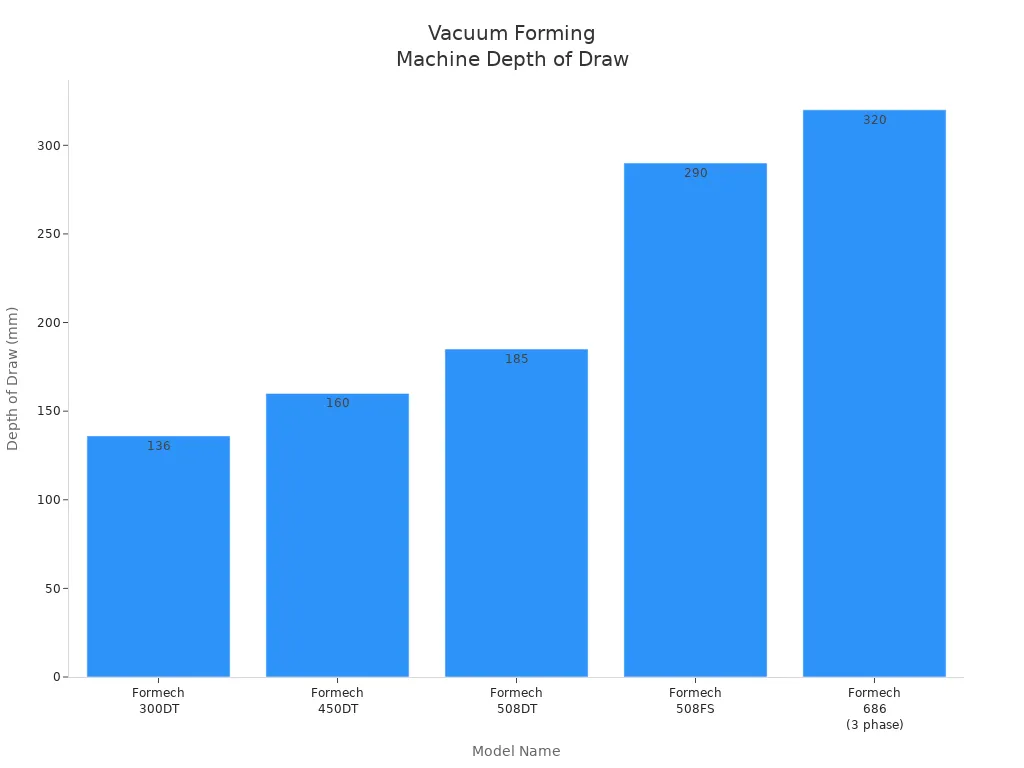
You want help you can trust if something goes wrong. Most brands give a 12-month warranty. Some let you pay for up to 36 months of coverage. If you need help, you can call for technical support. You can also ask about delivery or returns. This makes you feel better when you buy a new machine for cosplay armor or your business.
User reviews help you know how a vacuum forming machine works. Many cosplay makers share their thoughts online. They talk about how easy it is to shape armor and control the heat. They also say if parts come off the mold easily. Some people talk about problems like machine breakdowns, loud noise, or sore backs. Here are some common issues:
| Issue | Description |
|---|---|
| Machine Malfunction | Needs regular care to keep working well. |
| Ergonomic Injuries | Doing the same moves can hurt your back. |
| Noise Exposure | Machines can be loud, so wear hearing protection. |
| Chemical Exposure | Always use safety gear and keep the air fresh. |
Tip: Read reviews from other cosplay fans before you buy. You can learn how the machine handles heat, mold changes, and part release. This helps you pick the best vacuum forming machine for your next armor project.
When you look at vacuum forming machines, you see a big range in prices. Entry-level models start at $500, mid-range machines go up to $10,000, and industrial units can cost over $65,000. Here’s a quick price guide:
| Machine Type | Price Range (USD) |
|---|---|
| Entry-Level Vacuum Formers | $500 - $3,000 |
| Mid-Range Vacuum Formers | $3,000 - $10,000 |
| Industrial Vacuum Formers | $10,000 and above |
You pay more upfront for bigger machines, but you save money over time. Modern machines use less energy and waste fewer materials. This makes them cost-effective for your shop. You spend less on plastic and get better quality parts. Choosing the right plastic also helps you save money and get the results you want.
Tip: Think about how much you will use the machine. If you plan to make lots of parts, a bigger investment pays off in the long run.
Keeping your machine in good shape is important. You need to clean and check it every week. Lubricate moving parts and inspect the mold for rough spots. Make sure your air and water systems work well. Train your staff so they know how to use the machine safely. Here’s a simple maintenance checklist:
Clean and lubricate mechanical parts.
Inspect dies for burrs or rough edges.
Check air and water quality.
Train operators for safe use.
Schedule weekly inspections.
You also need to replace worn parts before they break. Service the vacuum pump once or twice a year. Regular checks help you avoid big repairs and keep your machine running smoothly. Upgrades can make your machine last longer and improve quality. If you follow these steps, you keep your vacuum forming setup cost-effective and ready for any project.
Before you buy a vacuum forming machine, ask for a demo. Watching a machine in action helps you see if it fits your cosplay projects. You can bring your own mold or sheet and test how well the machine forms your armor. Demos let you check how easy the controls are and how fast you can switch between different cosplay designs. You also get to see how the machine handles real materials. If you have questions, you can ask the staff right away. This step gives you confidence that your new machine will help you make great armor for your next cosplay event.
Talking to experts saves you time and money. You can reach out to machine suppliers, cosplay community leaders, or even local makerspaces. Experts know which machines work best for detailed armor or large cosplay props. They can share tips about machine care, mold design, and material choices. You might even find someone who has made the same type of cosplay armor you want. Their advice helps you avoid mistakes and pick a machine that matches your goals.
Tip: Join online cosplay forums or groups. You can read reviews and ask questions about vacuum forming machines for armor projects.
Think about the future when you choose your machine. If you want to make more cosplay armor or start selling your designs, you need a machine that can grow with you. Here are some smart strategies:
| Strategy | Description |
|---|---|
| Production Volume Requirements | Choose a machine size and automation level that matches your cosplay goals. |
| Mold Complexity Capabilities | Pick a machine that can handle the shapes and details you want for your armor. |
| Operating Cost Management | Look for machines that save energy and need less upkeep. |
| Energy Efficiency Ratings | Machines with good ratings cost less to run and help the planet. |
| Maintenance Schedules | Regular care keeps your machine ready for every cosplay project. |
| Automation Integration Options | Some machines let you add features later if you want to make more armor or bigger cosplay pieces. |
You should also keep these points in mind:
Check your current cosplay production needs and daily output.
Think about how much you want to grow in the next few years.
Make sure your machine can handle the materials you plan to use for armor.
Plan your workspace so your machine and tools fit well.
Check if your shop has enough power for a bigger machine.
When you plan for growth, focus on the sizes and styles of cosplay armor that people want most. This helps you make smart choices and keeps your projects on track.
When you pick a vacuum forming machine, make sure it has what you need. Look at how it heats, the pressure it uses, what plastics it works with, and the size of the forming area. Here is a checklist to help you:
| Checklist Item | Description |
|---|---|
| Heating Capabilities | Heats evenly so your parts look good |
| Vacuum Forming Pressure | You can change the pressure for better results |
| Material Compatibility | Works with your plastic and the right thickness |
| Size of Forming Area | Big enough for your project |
| Automation Features | Makes your job simpler |
| Brand Reputation and Warranty | Good brands help you and fix problems |
Learn about the machines, ask people who know, and think about what you need before you buy one.
Think about the biggest thing you want to make. Choose a machine with a forming area that is a little bigger. This helps you work on new ideas later.
You can try using plastics from home, but results are not always good. Some plastics melt in strange ways or make bad smells. Always check if the plastic is safe and what temperature it needs.
Clean your machine often so it stays in good shape. Look for any loose parts that might cause problems. Lubricate the moving parts to help them work better. Always follow the maintenance steps in your manual for the best results.


