
Views: 0 Author: Site Editor Publish Time: 2026-10-16 Origin: Site
How much does thermoforming cost?
There is no single price that applies to every thermoforming project.
A small PET food tray produced from thin roll-fed sheet and a large ABS equipment housing may both use thermoforming, but their tooling, material usage, machine cycle, trimming process and production volume are completely different.
A useful thermoforming cost estimate should therefore separate the project into several parts:
Tooling
Plastic sheet
Machine time
Labor
Scrap and material utilization
Cutting and secondary operations
Maintenance and energy
Production volume
For manufacturers planning a new project, the more useful question is not simply:
“How much does a thermoforming machine cost?”
It is:
“What will one acceptable finished part cost at my expected production volume?”
For an overview of the overall manufacturing process, see our Thermoforming Guide.
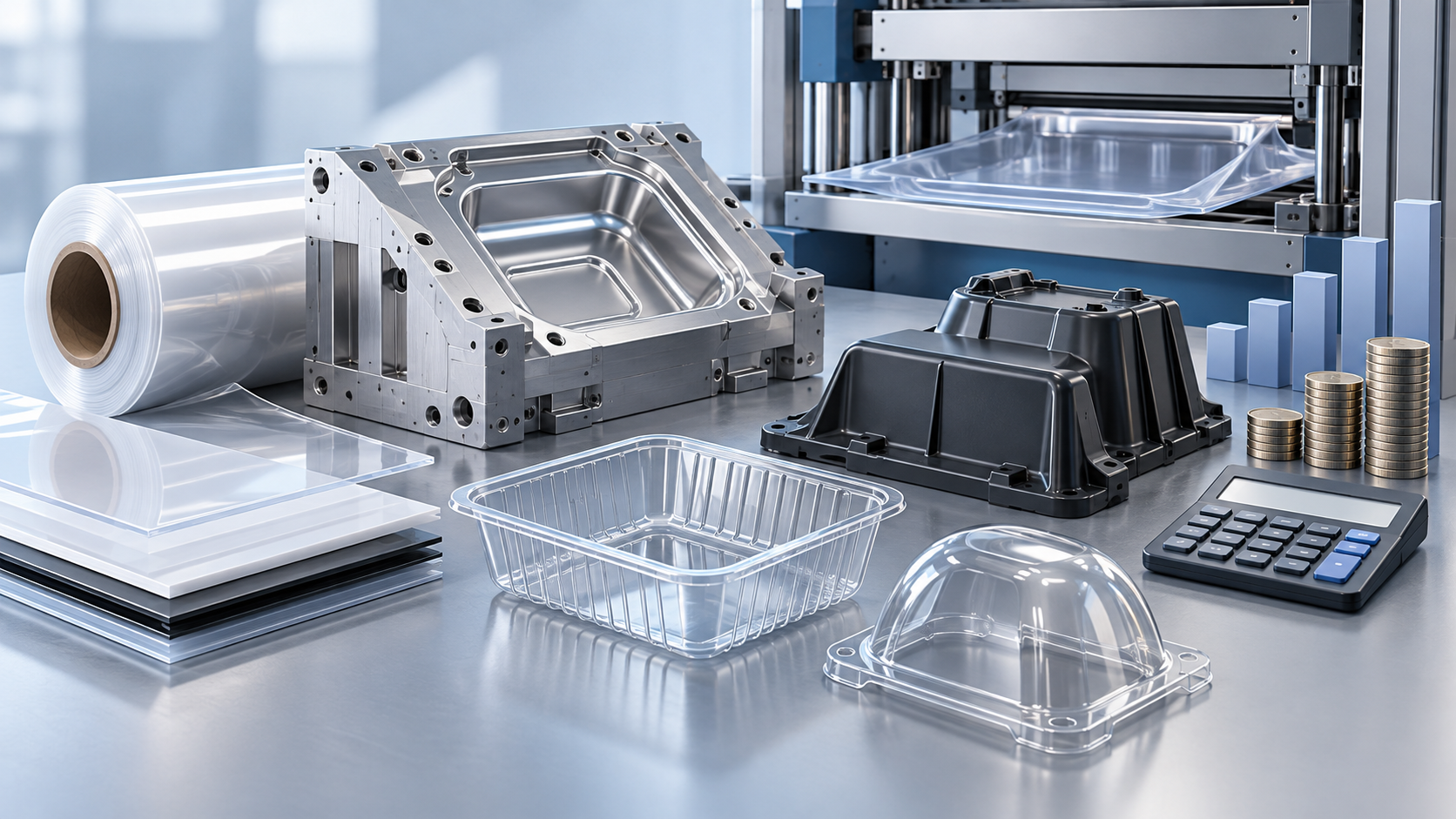
A practical cost model can be expressed as:
Total Production Cost = Tooling + Material + Machine Time + Labor + Scrap + Secondary Operations + Maintenance and Overhead
For cost-per-part calculations, one-time expenses such as tooling must be spread across the expected number of good parts.
A simplified unit-cost model is:
Cost per Part = Material + Machine Cost + Labor + Secondary Processing + Scrap/Reject Cost + Tooling Amortization
Each part of that equation can change significantly depending on the project.
Tooling is usually one of the largest upfront costs in a new thermoforming project.
Tool price depends on:
Part dimensions
Number of cavities
Forming depth
Mold material
Surface finish
Cooling system
Vacuum holes and venting
Plug-assist requirements
Cutting tooling
Dimensional tolerances
A simple prototype mold and a high-volume multi-cavity production mold should not be expected to cost the same.
Prototype tooling can be made from materials such as:
Wood
Epoxy
Composite
3D-printed tooling
These options can reduce initial development cost when the objective is to:
Validate geometry
Test material distribution
Produce samples
Confirm fit
For production, CNC-machined aluminum tooling is commonly used because it provides:
Better heat transfer
Greater dimensional stability
Longer service life
More consistent cooling
Before purchasing final tooling, manufacturers can review MINGDU's Thermoforming Mould Solutions together with the machine configuration.
Tooling is a one-time investment, but it still contributes to every finished product.
For example:
If a production mold costs:
$15,000
and is allocated across:
250,000 good parts
then:
Tooling cost per part = $15,000 ÷ 250,000 = $0.06
If the same mold is used for only 25,000 parts:
$15,000 ÷ 25,000 = $0.60 per part
This is why expected production volume should be defined before selecting tooling.
A more expensive multi-cavity tool may actually reduce the total cost per product when production volume is high enough.
For many thermoforming projects, plastic sheet is the largest recurring cost.
Common materials include:
PET
RPET
PP
HIPS
ABS
PETG
PVC
HDPE
Polycarbonate
You can compare their processing characteristics in our Thermoforming Materials Guide.
Material cost depends on more than price per kilogram.
You also need to consider:
Sheet thickness
Sheet width
Part weight
Trim area
Cavity layout
Scrap recovery
Reject rate
A heavier sheet increases material cost even if the resin price stays the same.
Thermoforming begins with a flat sheet, but not all of that sheet becomes part of the finished product.
Material can remain around:
Product edges
Cavity gaps
Clamp areas
Cutting lines
This material is often called trim scrap or web scrap.
The correct way to estimate material cost is therefore:
Material Cost per Good Part = Material Input Cost ÷ Number of Good Parts
not simply:
finished part weight × material price.
Suppose a finished tray weighs:
20 g
but because of trim and cavity spacing, producing one tray requires an average of:
25 g of sheet input.
If material costs:
$2.00/kg
then the material cost is:
25 g = 0.025 kg
0.025 × $2.00
= $0.05 per tray
This example is only illustrative; actual resin and sheet pricing varies by material, grade, thickness, recycled content and market.
More efficient cavity nesting can increase the percentage of each sheet that becomes saleable product.
Do not solve every forming problem simply by increasing sheet gauge.
Better:
Heating control
Plug assist
Corner radius
Mold design
may reduce local thinning without making the entire product heavier.
Poor heating or unstable forming creates rejected parts that consume both material and machine time.
A stable process can therefore reduce cost without changing the raw material price.
Machine cost has two meanings.
If you are producing parts in-house, the initial machine investment depends on:
Forming area
Maximum forming depth
Heating system
Vacuum system
Pressure capability
Servo control
Number of stations
Cutting method
Automatic stacking
Sheet handling
Production speed
A simple machine and a fully automated forming-cutting-stacking line have very different investment levels.
For high-volume roll-fed packaging, manufacturers can compare MINGDU's Thin-Gauge Thermoforming Machines and Multistation Thermoforming Machines.
For industrial parts that require greater mold definition or more forming force, a Pressure Forming Machine may be more appropriate.
Once the machine is installed, its cost can be allocated according to production output.
A simple calculation is:
Machine Cost per Part = Machine Hourly Cost × Cycle Time ÷ Good Parts per Cycle
For an in-house factory, the hourly cost may include:
Equipment depreciation
Electricity
Compressed air
Maintenance
Factory overhead
If production is outsourced, these costs are usually built into the supplier's machine rate.
Cycle time determines how many parts a machine can produce per hour.
A typical thermoforming cycle can include:
Sheet feeding
Heating
Forming
Cooling
Mold movement
Cutting
Stacking or unloading
If any one stage becomes a bottleneck, production output falls.
This is particularly important for thicker industrial products because heating and cooling times can be much longer than thin-gauge packaging cycles.
Suppose:
Machine A produces:
1 part every 30 seconds
while Machine B uses a four-cavity mold and produces:
4 parts every 30 seconds.
The second system spreads machine time across more products.
This is one reason cavity count, mold layout and cycle time should be calculated together.
Labor requirements vary significantly between thermoforming systems.
A basic production process may require operators for:
Loading sheet
Removing products
Cutting
Trimming
Inspection
Stacking
An automated packaging line may integrate many of these operations.
For example, a Multistation Thermoforming Machine can combine forming with downstream cutting and stacking operations.
Automation increases initial equipment investment but can reduce:
Manual handling
Labor cost per part
Production inconsistency
Cycle interruptions
The correct decision depends on expected production volume.
High automation may not be economically necessary for a low-volume project.
The product is not always finished when it leaves the forming mold.
Possible secondary operations include:
Punch cutting
CNC trimming
Laser cutting
Drilling
Deburring
Printing
Assembly
Welding
Labeling
A simple thin-gauge tray may be cut automatically in the production line.
A large ABS machine housing may need CNC trimming, drilling and manual assembly.
These steps can significantly change the final cost per part.
This is why two products made from the same ABS sheet can still have very different production costs.
Scrap should be separated into two categories.
This is the material intentionally left between parts or around the sheet during forming and cutting.
Some thermoplastics may allow controlled trim recovery or recycling depending on the material and product requirements.
Rejects are caused by problems such as:
Incomplete forming
Uneven wall thickness
Warpage
Cutting defects
Surface damage
Dimensional errors
Rejects are especially expensive because they consume:
material + machine time + labor + energy
without producing a saleable part.
A small improvement in reject rate can therefore have a meaningful effect on production cost.
Production volume changes almost every thermoforming cost calculation.
The main concern is often reducing:
Tooling investment
Machine setup
Engineering cost
Prototype or simpler tooling may be appropriate.
Manufacturers begin balancing:
Better tooling
More cavities
Faster trimming
Improved automation
The focus increasingly moves toward:
Material utilization
Cycle time
Cavities per cycle
Energy efficiency
Automated cutting
Automated stacking
At high volumes, saving even a very small amount per part can become more important than saving several thousand dollars on the initial mold.
A useful calculation is:
Cost per Part =
Material + Machine Time + Labor + Secondary Operations + Scrap/Reject Allowance + Tooling Amortization
Here is a simplified example.
Assume:
8 cavities per cycle
6-second cycle
Machine operating cost = $75/hour
Tooling cost = $15,000
Planned production = 250,000 parts
Material cost per part including trim = $0.055
Labor and trimming = $0.025 per part
Maintenance/reject allowance = $0.020 per part
One cycle costs:
$75 ÷ 3,600 × 6
= $0.125 per cycle
Eight parts are produced:
$0.125 ÷ 8
= approximately $0.016 per part
$15,000 ÷ 250,000
= $0.060 per part
Material: $0.055
Machine: $0.016
Tooling: $0.060
Labor/trimming: $0.025
Maintenance/reject allowance: $0.020
Estimated manufacturing cost:
$0.176 per part
This is an illustrative calculation only.
It is not a quotation.
Actual thermoforming cost depends on the specific product, material, machine, country, labor rate and production plan.
| Cost Driver | Why It Matters |
|---|---|
| Material and sheet utilization | Recurs on every part |
| Tooling | Major upfront investment |
| Cycle time | Controls machine output |
| Cavity count | Spreads machine time over more products |
| Sheet thickness | Directly affects material use |
| Scrap rate | Adds material cost without saleable output |
| Secondary trimming | Can add machine and labor time |
| Automation | Raises equipment investment but can reduce labor |
For long-term production, material efficiency and cycle time can have a larger financial effect than relatively small differences in initial machine price.
Sometimes—but not always.
Thermoforming often offers lower tooling investment because tooling is generally simpler than a high-pressure injection mold.
This can make thermoforming particularly attractive for:
Large parts
Low-to-medium production volumes
Packaging
Products requiring faster tooling changes
Injection molding can become economically attractive for certain smaller products manufactured at extremely high volumes.
The correct comparison is therefore:
total lifetime cost
rather than:
thermoforming mold price vs injection mold price.
For a deeper comparison, see our Thermoforming vs Injection Molding guide.
This depends on production volume and business model.
Annual volume is low
Product demand is uncertain
You are still validating the market
You do not want to manage production
Production is continuous
Multiple products use similar processes
You need control over delivery
Unit volume is high
Labor and automation can be optimized internally
The correct decision should be based on:
annual production volume × expected unit margin × machine utilization
not simply machine purchase price.
Reduce unnecessary trim and avoid over-thickening the entire part.
Higher cavity count can reduce machine cost per part, provided heating and forming remain uniform.
Better heater-zone control can reduce:
Energy consumption
Rejects
Cycle time
Cooling should be fast enough for efficient production but not so short that the product warps after demolding.
For high-volume packaging, integrated downstream automation can reduce manual handling.
A machine that is too large can increase unnecessary capital and operating cost.
A machine that is too small may:
Run slowly
Limit cavity count
Require additional operations
Equipment should be selected around the actual finished product.
Before requesting a machine or production-cost estimate, prepare:
Product drawing or sample
Length, width and depth
Required wall thickness
Surface requirements
Annual production quantity
Material type
Sheet thickness
Sheet width
Virgin or recycled content
Material supplier if known
Required parts per hour
Working hours per day
Number of product designs
Expected annual production
Vacuum or pressure forming
Cutting method
Automatic stacking requirement
Secondary processing
With this information, the machine supplier can estimate:
Required forming area
Mold cavity count
Expected cycle
Appropriate machine configuration
Likely production output
There is no universal price. Total cost depends on tooling, material, sheet thickness, production volume, machine time, trimming, labor and scrap.
Tooling cost varies significantly depending on size, material, cavity count, cooling design and required service life. Prototype tooling may cost much less than multi-cavity production aluminum molds.
For many projects, plastic sheet is one of the largest recurring expenses, particularly where sheet utilization and trim scrap significantly affect material consumption.
Usually yes. Tooling, setup and machine costs are spread across more finished products, although raw material remains a recurring cost for every part.
Not automatically. More cavities can increase output, but they also increase mold size, tooling cost and heating requirements.
Thermoforming often requires lower tooling investment, especially for larger parts and low-to-medium production volumes. Injection molding may be more economical for certain very-high-volume products.
Thermoforming cost cannot be understood from one number.
The true economics come from the complete production system:
tooling + material + machine time + labor + scrap + trimming + production volume.
For many projects, material utilization and cycle time have a greater effect on long-term cost than a small difference in the initial machine price.
The best approach is therefore to calculate the cost per acceptable finished part, not simply compare equipment quotations.
Before selecting a thermoforming machine, prepare the product drawing, material, sheet thickness, target output and expected annual volume. These details make it possible to evaluate the forming area, mold configuration, automation level and suitable equipment more accurately.


